

Reviewed · TICKETS
Royal Observatory Greenwich & Prime Meridian Entry Ticket London
Stand in two hemispheres at once. The Royal Observatory Greenwich makes an abstract idea feel wonderfully physical: one foot east, one foot west, right on the Prime Meridian. I especially like the views across Greenwich Park toward London, and I like the chance to see John Harrison’s remarkable clocks, the machines that helped solve the problem of longitude.
The self-guided format gives you freedom to move at your own pace, with a free audio guide available in several languages. The main caution is the hill: reaching the observatory means a steep walk, and the building itself has stairs and limited accessibility. Also, this ticket focuses on the observatory and its time displays, not a planetarium show.
In This Review
- Key things to know before you go
- Why Greenwich is worth the trip
- The walk up through Greenwich Royal Park
- The Prime Meridian in the Meridian Courtyard
- Flamsteed House and the Astronomers Royal
- Harrison’s clocks and the problem of longitude
- The Shepherd Gate Clock and Greenwich Mean Time
- The red time ball and the Great Equatorial Telescope
- How the audio guide changes the visit
- Planning the rest of your Greenwich day
- Access, families, and practical limits
- The mobile ticket question
- Who should book this Royal Observatory ticket?
- Should you book it?
- FAQ
- How long does the Royal Observatory visit take?
- Does the ticket include admission to the Royal Observatory?
- Can I stand on the Prime Meridian line?
- Is an audio guide included?
- Is transportation included?
- Are the National Maritime Museum and Queen’s House included?
- Is Cutty Sark included?
- Are children under four charged admission?
- Is the Royal Observatory fully accessible?
- Can I cancel for a refund?
Key things to know before you go
- The Prime Meridian photo comes first: The Meridian Courtyard is the obvious place for a photo with one foot in the eastern hemisphere and one in the western hemisphere.
- The climb is real: The observatory sits on a hill in Greenwich Royal Park, with impressive views but a demanding approach for anyone with mobility concerns.
- Timekeeping is the main subject: Harrison’s clocks, the Shepherd Gate Clock, the time ball, and the work of the Astronomers Royal give the visit its focus.
- The audio guide adds useful context: You can download a free guide in 10 languages, making the self-guided visit easier to follow.
- Plan for more than two hours in Greenwich: The National Maritime Museum and Queen’s House are nearby and free, while Cutty Sark offers another major attraction.
- Check your entry method before arriving: Some visitors had trouble with mobile vouchers and scanners, so keep your ticket ready and allow extra time.
Why Greenwich is worth the trip
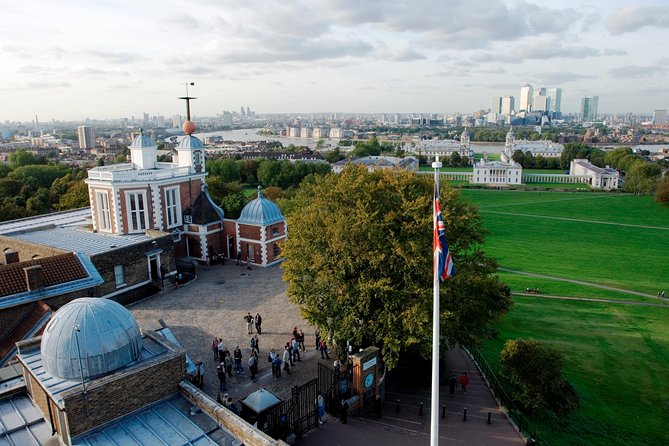
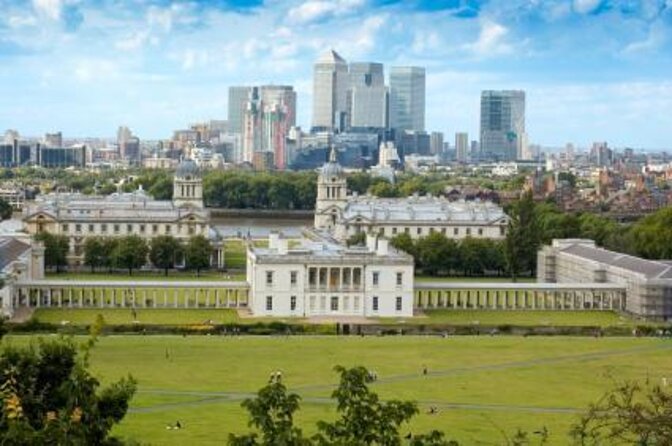
The Royal Observatory is not in central London. It sits above Greenwich Park, southeast of the main tourist core, and the setting is part of the appeal. You get open grass, long views, and a sense of space that is hard to find around Westminster or the City.
From the park and observatory hill, you can look toward the City of London and the River Thames. On a clear day, this view may be one of the best reasons to come. The climb gives you a gradual reveal of London rather than dropping you straight at a museum entrance.
The attraction costs about $33.90 per person and takes roughly two hours. That is a fair price if you care about science, navigation, clocks, astronomy, or the practical story behind Greenwich Mean Time. It is less compelling if you only want a quick photograph on the Prime Meridian, since the line itself takes little time to see.
I would treat the ticket as one part of a full Greenwich day. You can pair it with the free National Maritime Museum and Queen’s House, then see Cutty Sark nearby. The observatory is the strongest choice for time and astronomy, while the surrounding attractions make the trip feel more worthwhile financially.
More Tickets in London
- London: The London Eye Entry Ticket
★ 4.6 · 35,875 reviews - London: Tower Bridge Entry Ticket
★ 4.7 · 15,560 reviews - London: Westminster Abbey Entrance Ticket
★ 4.6 · 11,254 reviews
The walk up through Greenwich Royal Park
Your visit begins before you reach the entrance. The observatory is located on a hill inside Greenwich Royal Park, and the route upward is steep enough to affect your planning.
Several people found the walk longer or harder than expected. That matters if you are traveling with an older relative, a young child, or anyone who tires easily. The views improve as you climb, but you should not think of this as a flat museum visit.
The approach can also be affected by weather. Rain makes the outdoor portion less pleasant, and the hill can feel like more work when the ground is wet. On a fair day, though, the park setting adds real pleasure. Give yourself time to walk rather than arriving at the last minute.
The observatory is near public transportation, but getting there can still be confusing. Directions may lead you to the general Greenwich area without making the hill and final approach clear. A Thames ferry is one possible way to reach Greenwich, and one review specifically praised the route by river for its views.
The Prime Meridian in the Meridian Courtyard
The first major stop is the Meridian Courtyard, where the Prime Meridian line passes through the observatory. This is the moment most people picture when they book the ticket.
You can place one foot on each side of the line and take the classic photo. It is a simple gimmick, but it works because the location has a genuine role in the way the modern world measures longitude and time.
I recommend making this your first priority after entering. The area can become crowded quickly, especially soon after opening. If your main goal is a clear photograph, go to the line before spending time with the displays. You can return to the rest of the attraction at a slower pace.
The line also gives the visit an easy starting point. Before you see the clocks or hear about the Astronomers Royal, you have already encountered the central idea: the world needs a fixed reference point to describe east and west.
Flamsteed House and the Astronomers Royal
From the courtyard, you move into Flamsteed House, the original home of the Astronomers Royal. The rooms connect the building to the people who worked there, including scientists and inventors associated with the observatory.
The attraction refers to figures such as John Harrison, Isaac Newton, Edmond Halley, James Bradley, Annie Maunder, George Airy, and Albert Einstein. You are not simply looking at old instruments. You are seeing the place where questions about the sky, navigation, and time were investigated over generations.
The Octagon Room, designed by Sir Christopher Wren, is one of the most memorable interiors. It is described as one of the best-preserved Wren interiors in London, so it rewards visitors who enjoy architecture as much as astronomy.
I would not rush through Flamsteed House. The rooms are not huge, and the visit can feel limited if you expect a large modern science center. Its strength is atmosphere and context. You are walking through historic working rooms, not entering an interactive theme park.
A few more trips worth a look before you book
- From London: Harry Potter Warner Bros Studio Tour
★ 4.7 · 26,588 reviews - London: Westminster to Greenwich River Thames Cruise
★ 4.5 · 22,836 reviews - Magical London: Harry Potter Guided Walking Tour
★ 4.7 · 22,044 reviews - London: Madame Tussauds London
★ 4.6 · 20,915 reviews
Harrison’s clocks and the problem of longitude

For many people, the clocks are the heart of the visit. John Harrison’s inventions helped address one of the hardest practical problems in ocean navigation: knowing your position east or west when far from land.
The displays explain how the measurement of time developed and why accurate clocks mattered so much. Even if you arrive knowing little about the subject, the story gives the observatory a clear purpose. It is not just about looking at stars. It is about making travel and mapping safer and more reliable.
The clocks are especially good for visitors who like clever machines. Their importance comes from the problem they solved, not just their age. I found this part more rewarding than the Prime Meridian photo because it explains how an idea changed daily life and long-distance travel.
The audio guide can help here. The visit is self-guided, so you will not necessarily have a live guide leading everyone from room to room. Free talks by staff or volunteers may be available, but they are not the structure of the ticket. Download the audio guide before or during your visit and use it to connect the objects with their purpose.
The Shepherd Gate Clock and Greenwich Mean Time

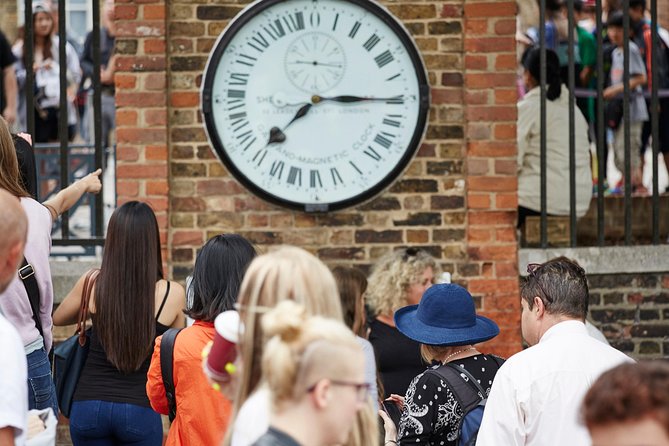
Outside Flamsteed House, look for the Shepherd Gate Clock. It was the first clock to show Greenwich Mean Time publicly.
That small detail helps explain why Greenwich became linked with time around the world. Today, GMT is a familiar phrase, but the observatory shows that standard time was not always automatic. Public clocks, scientific work, navigation, and international coordination all had to develop over time.
The Shepherd Gate Clock is easy to miss if you are focused only on the interior rooms. Keep an eye out for it as you move between sections. It adds a useful connection between the technical work inside the observatory and ordinary people checking the time outside.
The red time ball and the Great Equatorial Telescope
Look up at the bright red Time Ball on top of Flamsteed House. It was first used in 1833 as one of the world’s earliest public time signals, and it still operates today.
The time ball is a wonderfully visible piece of the observatory. Unlike a small instrument behind glass, it communicated with people beyond the building. Its purpose was public and practical, which makes it easy to understand even if you are not an astronomy enthusiast.
The Great Equatorial Telescope is housed inside the observatory’s huge onion dome. It gave astronomers new views of the universe more than 100 years ago and remains one of the building’s most recognizable features.
The telescope and dome add an astronomy angle to a visit that otherwise leans heavily toward timekeeping. Still, you should set expectations correctly. This ticket is an observatory visit with historic displays and an audio guide. It does not automatically mean a planetarium presentation is included.
How the audio guide changes the visit
The free audio guide is an important part of the ticket. Since the experience is mainly self-guided, the guide supplies the explanations that make the rooms and instruments meaningful.
The supplied information lists a downloadable guide in 10 languages, while the visit information also refers to audio options in seven languages. Because those details differ, check the current language choices when you receive your ticket or arrive. The key point is that you have multilingual audio support rather than needing to rely entirely on printed information.
I like the flexibility of this format. You can pause, move ahead, or spend extra time with the clocks. One visitor also appreciated audio support in crowded, noisy areas, where it was easier to hear than a nearby live talk.
The tradeoff is that you must take responsibility for the pace. If you prefer a guide who explains everything in sequence and answers questions throughout, this may feel less personal. Occasional staff talks can add warmth, and one highly praised guide named Ross was singled out for making the subject especially interesting, but a live guide is not guaranteed with this ticket.
Planning the rest of your Greenwich day
The observatory works best when you do not treat it as an isolated two-hour stop. The National Maritime Museum and Queen’s House are within a short walk and free to enter.
That combination gives your day a useful range. The observatory explains time, astronomy, and navigation. The National Maritime Museum broadens the maritime story, while Queen’s House adds art and architecture. You can also visit Cutty Sark, the surviving tea clipper that now operates as a museum and visitor attraction.
Greenwich Park itself deserves time. After the indoor rooms, the open park and London views offer a change of pace. A pub lunch in Greenwich is another practical way to turn the ticket into a half-day or full-day outing.
If you only allow two hours total for Greenwich, you may feel rushed. The observatory itself can take around two hours, especially if you listen to the audio guide and stop for photographs. I would allow at least that much for the attraction, then add time for the park and nearby sites.
Access, families, and practical limits
Children under four enter free, but children must be accompanied by an adult. The subject can work well for families if children enjoy space, clocks, or hands-on ideas, though the visit is more about historic objects and explanations than play areas.
Service animals are allowed, and most people can participate. Accessibility is the main concern. Certain parts of the attraction are not fully accessible, and the route includes the steep hill, stairs, and limited lift access. One lift outside covers only a short set of steps, while the interior has no lifts according to one detailed account.
If mobility is an issue, contact the attraction before your visit to discuss the route and available assistance. Do not assume that the presence of a lift makes the entire site wheelchair friendly.
The site is also weather sensitive. You spend time outdoors crossing the park and moving around the hill, so rain can take some of the shine off the visit. Bring suitable clothing and avoid packing the schedule too tightly.
The mobile ticket question
Advance booking is useful because the Royal Observatory can get crowded, particularly around the Prime Meridian photo spot. The ticket is mobile, and confirmation is provided at booking.
However, ticket scanning has caused problems for some people. Reports include staff being unable to scan a voucher and phone apps failing to display the ticket properly. One person using an iPhone 12 Pro with iOS 17.0.6 had to buy another set of tickets at the box office after the app would not load the access button.
I would save the ticket before arriving, keep your phone charged, and take a screenshot if the booking system allows it. If the barcode will not scan, speak with the observatory staff before paying again. The attraction is the National Maritime Museum’s site, but the booking platform and entrance scanning process may not always work perfectly together.
The cancellation terms are straightforward: you can receive a full refund if you cancel at least 24 hours before the start time. Changes or cancellations inside that window are not accepted for a refund.
Who should book this Royal Observatory ticket?
I would recommend it most strongly if you have an interest in:
- Time zones and how GMT developed
- Astronomy and historic telescopes
- Mechanical clocks and engineering
- Navigation and longitude
- London viewpoints
- Greenwich as a full-day outing
You will probably enjoy the visit even without a science background, especially if you use the audio guide. The displays give you enough story to understand why the instruments matter.
I would hesitate if you only want the Prime Meridian photograph, have significant mobility limitations, or expect a planetarium show. In those cases, the hill, stairs, price, and limited scope may leave you disappointed.
Should you book it?
Book this ticket if you want the story behind Greenwich Mean Time, not just a photo on a line. The Prime Meridian is fun, but the clocks, Octagon Room, time ball, telescope, and views give the visit its real value.
At $33.90, the ticket is reasonable when you spend time with the exhibits and combine the visit with Greenwich Park, the free National Maritime Museum, Queen’s House, or Cutty Sark. Book ahead if you want a fixed plan, but prepare your mobile ticket carefully and expect a steep walk.
FAQ
How long does the Royal Observatory visit take?
The visit lasts approximately two hours. You may want more time if you listen to the full audio guide or combine it with nearby Greenwich attractions.
Does the ticket include admission to the Royal Observatory?
Yes. The attraction admission ticket is included.
Can I stand on the Prime Meridian line?
Yes. In the Meridian Courtyard, you can stand astride the Prime Meridian with one foot in the east and one in the west.
Is an audio guide included?
Yes. A free downloadable audio guide is included. The supplied information lists 10 available languages, while another section refers to seven languages, so check the current options at the attraction.
Is transportation included?
No. Transportation to and from the Royal Observatory is not included.
Are the National Maritime Museum and Queen’s House included?
They are not part of the observatory admission ticket, but both are free to visit and within a short walking distance.
Is Cutty Sark included?
No. Cutty Sark is a separate museum and visitor attraction.
Are children under four charged admission?
No. Children under four enter free, and children must be accompanied by an adult.
Is the Royal Observatory fully accessible?
No. Certain parts are not fully accessible. The site includes a steep hill and stairs, and you should contact the attraction before visiting if you need help planning an accessible route.
Can I cancel for a refund?
Yes. You can cancel at least 24 hours before the experience start time for a full refund. Cancellations or changes made less than 24 hours before the start time are not refunded.
Recently added around London
- PRIVATE HIRE 45 min Speedboat Tour – Embankment/Westminster Pier★ 5.0 · 55 reviews
- Private Tour of London’s Historic Pubs★ 5.0 · 55 reviews
- From London: Glastonbury and Cheddar Gorge Guided Day Trip★ 4.8 · 55 reviews
- London: Kew to Westminster River Thames Cruise★ 4.2 · 55 reviews
- Gatwick Airport Taxi – Private Transfer to/from London★ 5.0 · 55 reviews
- London by Night – Tootbus Sightseeing Tour★ 3.5 · 55 reviews
- London: Tower of London After Hours Tour and Key Ceremony★ 4.8 · 56 reviews
- From London: Cotswolds Guided Trip Including Bourton-on-the-Water★ 4.5 · 56 reviews
Tickets, compared.


Buckingham Palace: The State Rooms Entrance Ticket
Read our review →

Tower of London and Crown Jewels Exhibition Ticket
Read our review →Browse the lists this tour appears in