Reviewed · TOURS
Torquay: The extraordinary life of Agatha Christie tour
Agatha Christie’s Torquay is a real-life mystery. This 2.5-hour walk follows the Queen of Crime through the seaside town where she spent her first 30 years, linking familiar streets and landmarks to her family life, marriages, wartime work, and famous fictional detectives. I like the way the tour connects real Torquay locations to Christie’s plots, rather than treating her life as a string of dates. I also like the guide’s playful approach, with props, quizzes, group photos, and the chance to pose as Poirot or Miss Marple.
The main consideration is the distance. The route covers roughly 3 miles on flat ground, but it remains a walking tour with no included building entrances, food, or drinks. If you have limited mobility, note that mobility scooters are not allowed. For most visitors, the $26 price is fair, especially because the tour combines Christie’s story with a useful introduction to central Torquay and the English Riviera shoreline.
In This Review
- Key points to know before you book
- Starting with Agatha Christie’s first Torquay years
- The Pavilion and a marriage proposal by the sea
- Princess Pier and a moment from 1910
- Torre Abbey and the real-life seed of Poirot
- Miss Marple, poison, and the writer Agatha never planned to become
- Agatha Christie’s 11-day disappearance
- Ending near the Grand Hotel and Christie’s wartime writing
- How the $26 price measures up
- Pace, comfort, and who will enjoy it most
- Should you book the Agatha Christie tour?
- FAQ
- Where does the Agatha Christie tour meet?
- How long does the tour last?
- How far do you walk?
- What language is the tour in?
- Which Torquay sights are included?
- Do I enter any buildings?
- Is food or drink included?
- What should I wear?
- Can I cancel or pay later?
Key points to know before you book

- Agatha’s Torquay story begins in childhood: The tour explains her early years in a large Georgian villa overlooking the sea and shows how local people and places shaped her imagination.
- Princess Pier offers a precise historical connection: You can stand where Agatha stood in 1910, when she and her friends roller-skated beside well-dressed Victorian promenaders.
- Torre Abbey links Christie to Poirot: A 1916 gathering for Belgian refugees helped introduce her to the man who inspired Hercule Poirot.
- Props make the storytelling playful: You may transform into Poirot or Miss Marple and even stage a mock murder beside Agatha Christie’s bust.
- The route covers about 3 miles: The terrain is flat, with stops along the way for seats, shelter, photographs, and a toilet break when needed.
- Guide Graham is a major part of the appeal: His style mixes solid Christie facts, local history, gentle drama, group activities, and plenty of deliberately bad jokes.
Starting with Agatha Christie’s first Torquay years
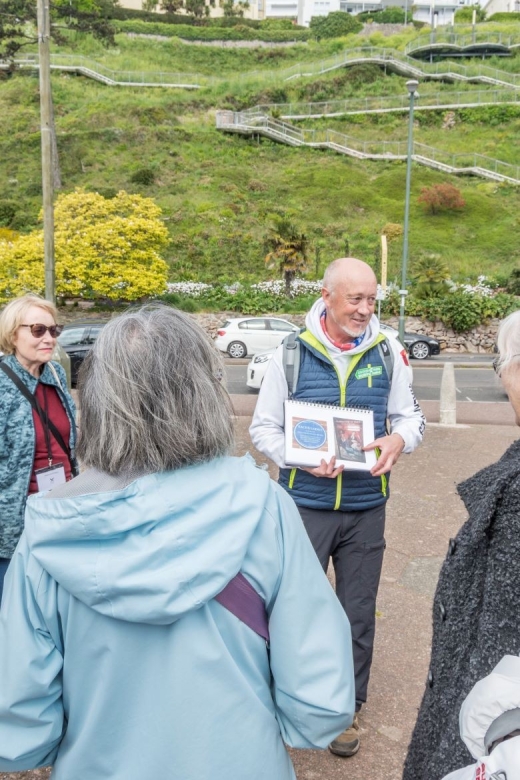
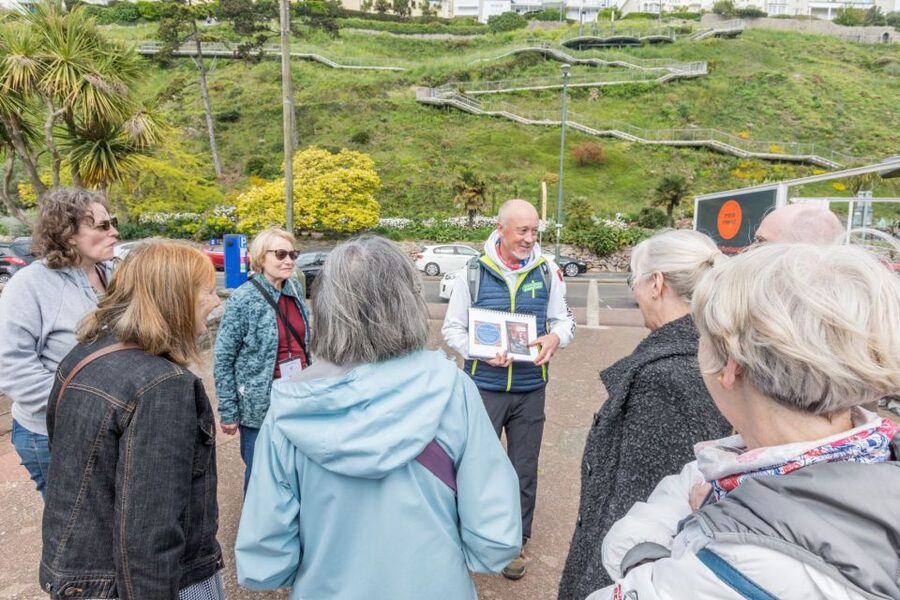
Meet at the English Riviera Tourist Information Office, postcode TQ2 5JG. The guide wears a yellow fluorescent jacket, which makes the meeting point easy to spot. From there, the tour starts with Christie’s childhood and young adulthood, rather than rushing straight to the murder stories.
That beginning matters. Christie did not set out with a firm plan to become a novelist. She grew up in Torquay in a substantial Georgian home with sea views, in a comfortable family setting that gave her access to the social world she later observed so sharply. The walk uses her early life to explain the habits of attention that became central to her fiction: watching how people behave, noticing social distinctions, and understanding that a quiet setting can hide plenty of trouble.
I appreciate this approach because it gives you a person before it gives you a literary brand. The tour explores the people Agatha met and the places she visited, then shows how those experiences fed into her plots and characters. You are not simply told that Torquay inspired Christie. You are shown the places that helped make that connection believable.
The route also gives you some local orientation. If you have just arrived in Torquay, the walk helps you understand how the seafront, gardens, historic buildings, and resort landmarks fit together. Several visitors have used the tour as an introduction to the town as well as a Christie experience.
Other trips around the UK people book alongside this one:
- London: The London Eye Entry Ticket
★ 4.6 · 35,875 reviews - From London: Harry Potter Warner Bros Studio Tour
★ 4.7 · 26,588 reviews - London: Westminster to Greenwich River Thames Cruise
★ 4.5 · 22,836 reviews
The Pavilion and a marriage proposal by the sea
One of the early coastal stops is the Pavilion, a famous Torquay venue connected to a personal turning point in Christie’s life. Agatha and Archibald Christie watched a concert here, and Archibald proposed to her afterward.
That detail gives the Pavilion more weight than a simple sightseeing stop. Christie’s life is often remembered through her books and the mystery surrounding her disappearance, but this part of the walk brings you back to the ordinary emotional events behind the public figure: courtship, excitement, marriage, and the decisions that shaped her adult life.
The English Riviera setting helps, too. You are walking beside the coast while hearing about a young woman whose world included concerts, promenades, family expectations, and social gatherings. The sea views are not just scenery between stories. They help explain the atmosphere of the town where Christie formed many of her early impressions.
The tour is led in English, and Graham’s storytelling style is conversational rather than formal. He is praised for combining facts with humor and for making the group feel comfortable. His jokes are intentionally corny, but that is part of the experience. If you want a quiet lecture, this may feel too playful. If you enjoy a guide who brings people into the story, it works well.
Princess Pier and a moment from 1910
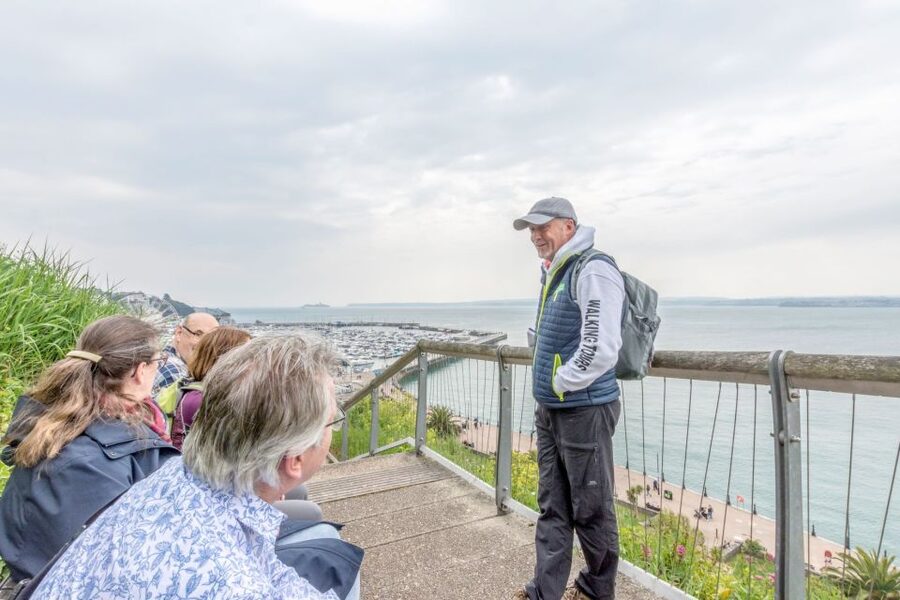
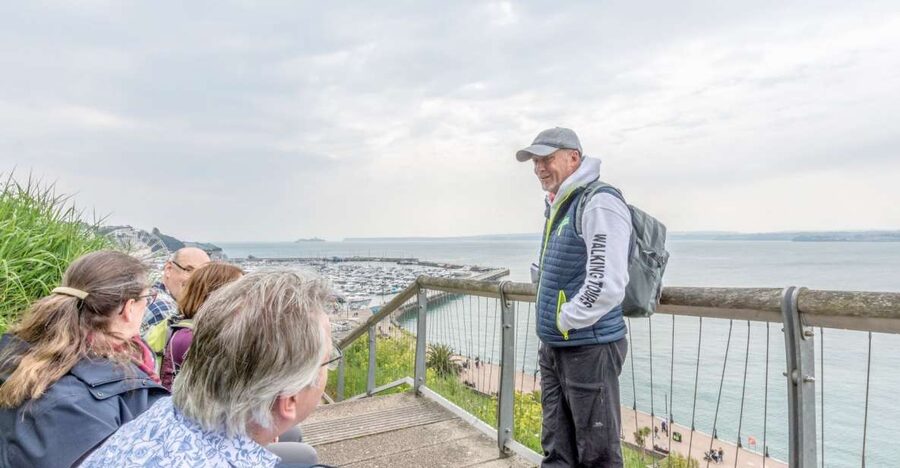
At Princess Pier, the tour pauses at one of its clearest physical links to Christie. Agatha and her friends roller-skated here while wealthy Victorian visitors promenaded in their best clothes. You get the chance to stand in the same spot where she stood in 1910.
This is the sort of detail that makes a walking tour worthwhile. A book can tell you that an author lived in Torquay, but standing in a place she actually used gives the story a more direct connection. The pier also lets you picture the social life of the resort: skating, promenading, public display, and the mix of local residents and well-off holidaymakers.
Bring comfortable clothes and sensible shoes. High heels are not allowed, and they would be a poor choice for a three-mile walk anyway. The route is described as flat, but the length still matters if you are not used to walking for two and a half hours.
Weather can affect this stretch. Torquay’s sea breeze may be strong, and the walk takes place outdoors. Graham has adjusted stops for wind and sun, finding sheltered places and shade where possible, but you should still dress for changeable coastal conditions.
Torre Abbey and the real-life seed of Poirot
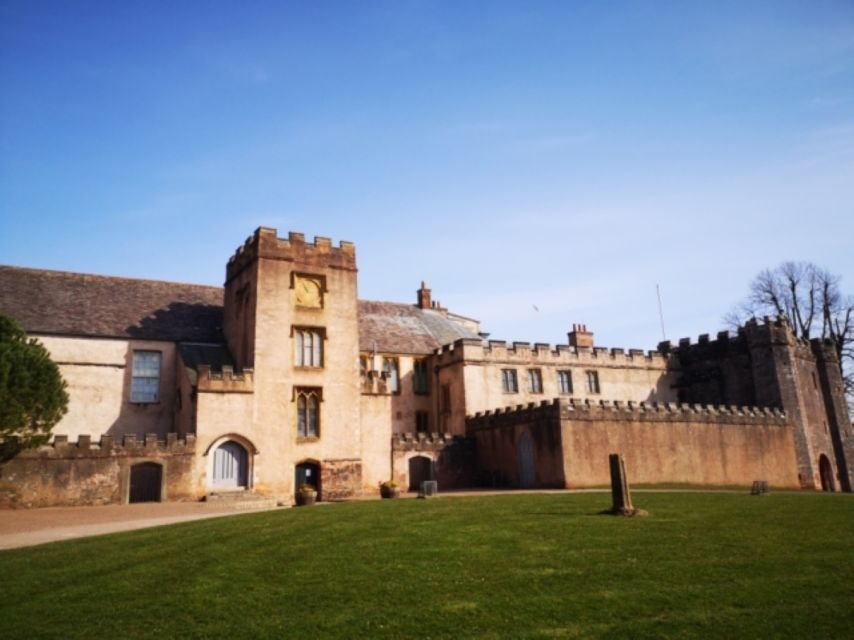
Torre Abbey is Torquay’s oldest building and one of the most rewarding stops on the route. The tour passes through its gardens, where the story turns to Agatha’s meeting with the man who helped inspire Hercule Poirot.
The connection comes from a soiree arranged for Belgian refugees in 1916. During the event, Christie met a Belgian man who became an important model for Poirot. This does not mean the fictional detective was a direct copy, but it helps explain why Poirot feels so specific: his nationality, mannerisms, pride, and particular way of approaching a crime all have roots in Christie’s real observations.
For me, this is one of the tour’s strongest sections because it shows how fiction grows from small encounters. A social event arranged to help people displaced by war became part of the creative material behind one of the world’s most famous detectives.
The use of props adds a lighter touch here and elsewhere. You may be asked to adopt the posture or manner of Poirot or Miss Marple. The activities are not meant to be serious theater, but they help break up the walking and give children, families, and groups something to do besides listen.
A different sort of outing around the UK:
- Magical London: Harry Potter Guided Walking Tour
★ 4.7 · 22,044 reviews - London: Madame Tussauds London
★ 4.6 · 20,915 reviews - Stonehenge, Windsor Castle, and Bath from London
★ 4.5 · 18,662 reviews - London: Warner Bros. Studio Tour with Transfers
★ 4.7 · 17,586 reviews
Miss Marple, poison, and the writer Agatha never planned to become
The tour gives attention to Miss Marple as well as Poirot. You hear how Christie created the village detective and why she preferred writing about Miss Marple to writing about Poirot.
That preference is worth hearing because the two characters represent different kinds of detection. Poirot is famous for method, order, and his famous little gray cells. Miss Marple relies more on human behavior, village observation, and the patterns she recognizes in people. Christie’s explanation of her own characters gives you a better sense of the range of her work.
The walk also covers the bet from Agatha’s sister that encouraged her to write her first published Poirot novel. It is a useful reminder that literary careers rarely begin with perfect confidence. Christie had not intended to become a writer, yet a family challenge helped push her toward the first step.
Her wartime work adds another important layer. When the First World War began, she volunteered as a nurse and worked at Torquay’s Town Hall. Later, she moved to the dispensary, where her experience with medicines and poisons influenced her use of poison in crime fiction.
This section should appeal even if you have only seen television adaptations. You do not need to have read every Christie novel to understand the connection between practical medical work and her careful use of poisoning as a plot device. If you are a longtime reader, the stories behind those details add extra pleasure.
Agatha Christie’s 11-day disappearance
No account of Christie’s life can avoid her disappearance. The tour explains the 11-day episode that led to one of the biggest manhunts in British history at the time.
This part is handled as a major chapter in her life, not as a cheap shock ending. The incident affected Christie deeply and contributed to her decision to leave Britain for the Middle East. Those journeys later helped inspire books such as Murder on the Orient Express and Death on the Nile.
The episode also connects to her second husband, Max Mallowan. By this stage, the tour has moved far beyond childhood Torquay. It shows how Christie’s personal experiences, travel, relationships, and wartime years all fed into the settings and tensions of her novels.
You should expect some drama in the telling. Graham has a reputation for adding theatrical touches to Christie’s story, and props and group participation may appear along the route. The humor keeps the subject from becoming too heavy, but the material itself remains serious. Anyone hoping for a narrowly literary tour may find this broader biography more useful.
Ending near the Grand Hotel and Christie’s wartime writing

The walk ends near the Grand Hotel, where Agatha and Archibald spent their honeymoon. It is a fitting final stop because the tour began with Christie as a young woman in Torquay and ends with a look at the public figure she became.
The final discussion covers Christie’s work during the Second World War and the way her writing helped maintain national morale. Her output was enormous, and she later received a Damehood. The tour also puts her lasting popularity in perspective: she still sells around 5 million novels a year.
That closing gives the experience a wider purpose. Christie was not only a creator of puzzles. She was a woman who built a lasting career despite not originally planning to become a writer, worked through personal crises, and developed characters that remain part of popular culture across the world.
After the tour, Graham can also offer suggestions for other things to do around Torquay. One useful recommendation from the walk is Cockington Village, which can help you picture the sort of English village atmosphere associated with Miss Marple’s St. Mary Mead.
How the $26 price measures up

At $26 per person, this is a reasonable price for a 2.5-hour guided walk. You are paying for a live guide, local knowledge, a planned route, storytelling, and activities rather than an admission ticket to a museum or historic house.
The value is strongest if you care about Christie, Poirot, or Miss Marple. You see Princess Pier, the Pavilion, Torre Abbey, the gardens, the coastline, and the area near the Grand Hotel while hearing why each place matters. That combination makes the tour more useful than a simple biography talk delivered indoors.
It is also good value for a first visit to Torquay. The route helps you get your bearings, and Graham has shared suggestions for other local sights, seafood, and places such as Cockington Village. I would not book it expecting extensive interior visits, though. The tour does not include entrance to buildings, and food and drinks are not included.
The price is less appealing if you dislike group activities, theatrical jokes, or a fairly long walk. The guide may invite you to take part in quizzes, poses, photographs, and a mock murder near Agatha Christie’s bust. Those moments are fun for many people, but they are not essential if you prefer a quiet sightseeing walk.
Pace, comfort, and who will enjoy it most
The terrain is flat, and the route is roughly 3 miles. That makes it manageable for many people, but you should still allow for a continuous outdoor experience lasting about two and a half hours.
Graham has been attentive to practical comfort. Stops can include seats, shade, shelter from the wind, and a toilet break. Group photographs may also be taken and sent to you the same day, giving you a simple souvenir of the walk.
The tour is best suited to:
- Agatha Christie readers and fans of screen adaptations
- Visitors who want biography tied to real places
- First-time visitors seeking an introduction to Torquay
- Couples, families, and small groups who enjoy light participation
- International visitors comfortable following an English-language guide
It may not suit anyone who cannot walk 3 miles, wants to visit interiors, or needs a mobility scooter. Bikes, handcarts, drones, alcohol, drugs, and intoxication are not allowed. Bare feet and high-heeled shoes are also prohibited, which is sensible advice for a coastal walking route.
You can cancel up to 24 hours ahead for a full refund, and you can reserve now while paying later. Those options are useful in a coastal town where rain or wind can change your plans.
Should you book the Agatha Christie tour?
Book it if you want stories tied to actual Torquay places, not just a list of Christie’s novels. The strongest parts are the personal connections: the Pavilion proposal, Princess Pier in 1910, the Belgian refugee gathering near Torre Abbey, Christie’s dispensary work, and the Grand Hotel honeymoon.
I would especially recommend it for visitors who have watched Poirot or Miss Marple but have not yet read much of Christie’s work. The walk may send you back to her books with a better sense of where her characters came from.
Skip it if you want museum admissions, a short stroll, or a strictly serious academic presentation. For everyone else, $26 buys an entertaining and well-paced way to see Torquay through the life of one of Britain’s most enduring writers.
FAQ
Where does the Agatha Christie tour meet?
The meeting point is the English Riviera Tourist Information Office, postcode TQ2 5JG. The guide wears a yellow fluorescent jacket.
How long does the tour last?
The advertised duration is 2.5 hours.
How far do you walk?
The route is roughly 3 miles long, with flat terrain.
What language is the tour in?
The live guided tour is in English.
Which Torquay sights are included?
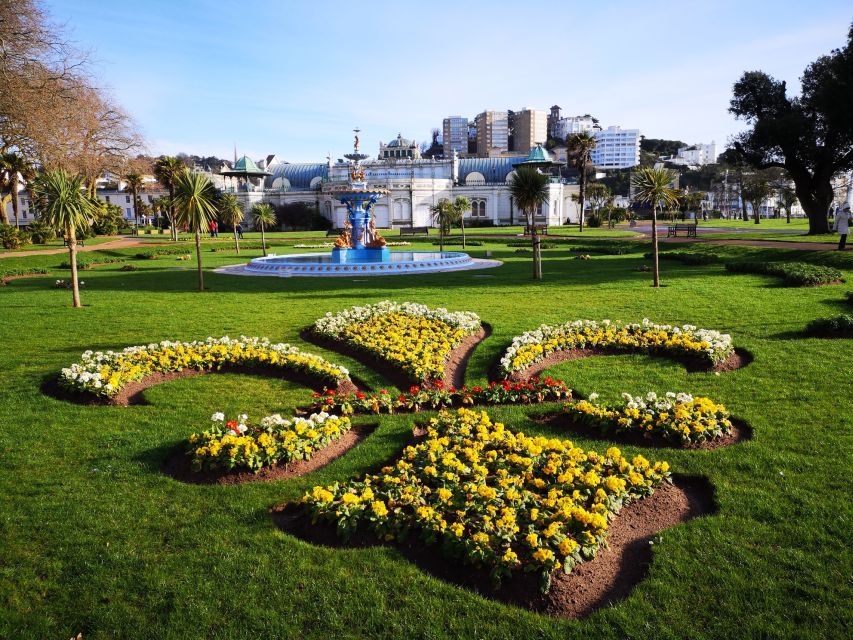
The route visits or passes Princess Pier, the Italian Gardens, the Pavilion, Torre Abbey, the coastline, and the area near the Grand Hotel.
Do I enter any buildings?
Entrance into buildings is not included. The experience is a guided walking tour.
Is food or drink included?
No. Food and drinks are not included.
What should I wear?
Wear comfortable clothes and suitable walking shoes. High-heeled shoes are not allowed.
Can I cancel or pay later?
You can cancel up to 24 hours in advance for a full refund. You can also reserve your place and pay later.
Recently added around the UK
- Cairngorms & Whisky Day Tour from Inverness Including Admission★ 5.0 · 55 reviews
- PRIVATE HIRE 45 min Speedboat Tour – Embankment/Westminster Pier★ 5.0 · 55 reviews
- From Edinburgh: Islay and The Whisky Coast 4-Day Tour★ 4.9 · 55 reviews
- Fantastic Creatures of Edinburgh, and where to find them!★ 4.5 · 55 reviews
- E-bike excursion exploring the Purbecks★ 5.0 · 55 reviews
- ‘A Wee Pedal’s’ Family Friendly Cycle Tour to Edinburgh’s Coast★ 5.0 · 55 reviews
- Private Tour of London’s Historic Pubs★ 5.0 · 55 reviews
- Vera Tour of Northumberland TV Locations★ 5.0 · 55 reviews
Tours, compared.
Magical London: Harry Potter Guided Walking Tour
Read our review →

Loch Ness, Glencoe & the Scottish Highlands Tour
Read our review →
Loch Ness, Glencoe & Scottish Highlands Tour
Read our review →
London Big Bus Hop-On Hop-Off Tour with Optional River Cruise
Read our review →
Liverpool Football Club Museum and Stadium Tour
Read our review →