
Reviewed · WALKING TOURS
J & M York City Walking Tours
York rewards anyone willing to look up and slow down. This two-hour walk turns the city’s crooked lanes, old gates, churches, walls, and market squares into one connected story, from Roman York to Vikings, medieval traders, kings, queens, and the darker characters of the past. I especially like the way it combines famous sights with easy-to-miss corners, and how guides such as Nick and James mix solid facts with dry humor and useful local advice. The main trade-off is that you only walk one section of the city walls, so anyone hoping for a longer wall circuit may feel shortchanged.
At $18.02 per person, the tour offers good value if you are new to York or have only one day in town. You do not need to plot a route through the winding center, and the end point leaves you close to the Shambles, York Castle Museum, Clifford’s Tower, the Jorvik Viking Centre, and the river. The group can reach 30 people, so your experience may be more intimate or more public depending on the booking.
In This Review
- Key points to know before booking
- Why this York walk works so well
- Starting beside Constantine the Great
- York Minster, 252 years in the making
- Castle grounds and the darker side of York
- The Shambles and the city below street level
- St Cuthbert’s Church and the Devil’s Door
- Walking the walls, from Rome to the Victorians
- Guilds, markets, and the business of medieval York
- Gates, street names, and Viking Jorvik
- The Black Swan and a glimpse of old Hungate
- York Castle Museum and the real Dick Turpin
- What the price includes, and what it does not
- Practical details for a smoother walk
- Who should book this York walk?
- Should you book J & M York City Walking Tours?
- FAQ
- How long is J & M York City Walking Tours?
- Where does the tour start?
- Where does the tour finish?
- Are York Minster and museum admissions included?
- How large can the group be?
- What happens if bad weather cancels the tour?
Key points to know before booking
- A two-hour introduction to 2,000 years: The route links Roman, Saxon, Viking, Norman, medieval, and Victorian York.
- The guide is the main attraction: Nick receives repeated praise for his clear delivery, humor, pacing, and ability to answer questions. James is also singled out for friendly, informative guiding.
- Famous sights plus overlooked corners: You see York Minster and the Shambles, but also St Cuthbert’s Church, Ogleforth, the Black Swan, and sections of the old walls.
- Admissions are not included: The Minster, Castle Museum, and other museums require separate admission. Museum tours can be arranged for an additional fee.
- The walls are only one part of the walk: You see Roman defenses, Danish earthworks, medieval sections, and Victorian changes, but not a long continuous wall circuit.
- The finish is useful for further sightseeing: The walk ends near the Shambles, Jorvik Viking Centre, Castle Museum, Clifford’s Tower, and the river.
Why this York walk works so well
A good city walk should help you understand where you are, not just point at old buildings. J & M does that by using York’s streets as a timeline. You move through places shaped by Roman emperors, Viking settlers, medieval guilds, religious change, warfare, trade, and prison reform.
I like this approach because York can feel like a collection of separate sights. The Minster is impressive, the Shambles is photogenic, and the walls are easy to spot, but the connections between them are less obvious. A guide gives you the missing links.
The strongest part of the experience is the human delivery. Nick is repeatedly praised for speaking clearly, keeping a steady pace, and making facts easy to follow. The tone is informative without becoming a lecture. You can expect questions to be welcomed, and the guide may add small oddities about York that you would likely miss on your own.
The tour has earned a 4.7 rating from 480 reviews, with 95 percent recommending it. That is a strong record, though it does not mean every part will suit everyone. One fair criticism is the limited time on the walls. The guide explains that covering more of the walls would take the route farther from the center and leave less time for York’s many historical layers.
More City Tours in York
- York: Daytime Sightseeing Boat Cruise with Live Commentary
★ 4.2 · 2,618 reviews - Daytime Sightseeing Boat Cruise in York
★ 4.5 · 1,256 reviews - York: City Sightseeing Hop-On Hop-Off Bus Tour
★ 4.6 · 954 reviews
Starting beside Constantine the Great
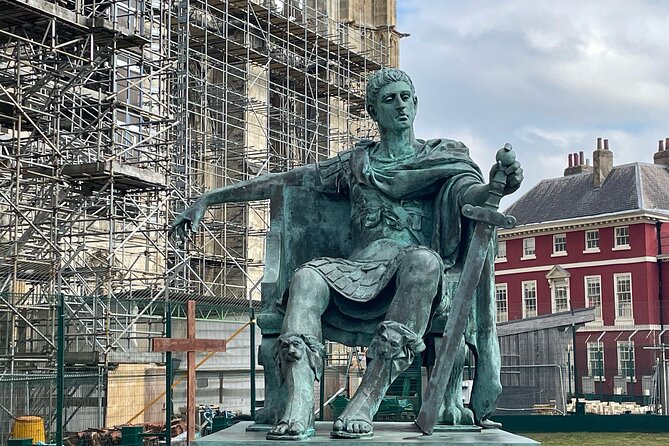
The meeting point is Constantine the Great at 4 Minster Yard, York YO1 7JB. This is a fitting place to begin because the statue introduces York’s Roman past before the route moves into later periods.
You learn about the city’s origins, the emperors who visited, and Constantine the Great’s connection with York and Christianity. The subject gives the tour an early anchor: York was not simply a medieval town with pretty streets. It was an important place long before the familiar stone gates and timbered buildings appeared.
From here, the guide brings the city’s long story into focus. You may hear about ancient tribes, Roman rule, kings and queens, and some of the more notorious figures connected with York. The value is not just the number of facts, but the sense that each age left something behind.
York Minster, 252 years in the making
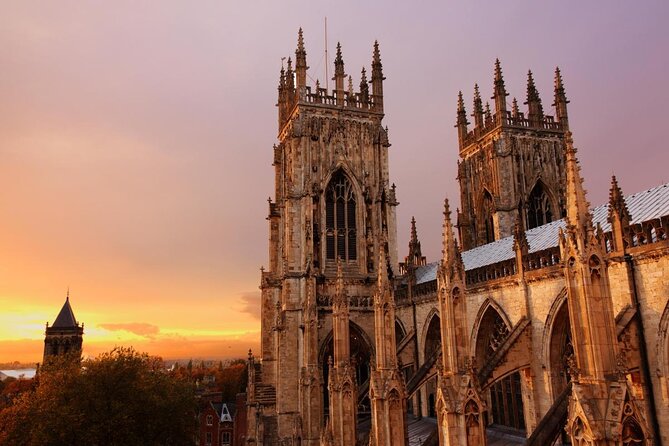
York Minster receives about 20 minutes of the walk. It is described as the largest Gothic cathedral in Northern Europe and took 252 years to build.
That short visit is best understood as an exterior introduction rather than a full cathedral tour. Admission is not included, and Minster guides inside offer separate tours lasting about an hour. If you want time for the interior, stained glass, towers, or a longer look at the building, plan that for another part of your day.
The guide’s role here is to explain why the Minster matters within York’s wider story. You get context before deciding how much of your own time and budget to give the cathedral.
This is one reason I would book the walk early in a York visit. After the tour, you can return to the Minster with a clearer idea of its place in the city, rather than treating it as an isolated photo stop.
Castle grounds and the darker side of York
The route continues around the motte of the castle built in 1069. The guide brings out the violent and grim stories connected with the site and explains what would once have been one of England’s finest castles.
The stop is not presented as a full castle visit. You walk in the grounds and hear about the site’s past, so you should not expect an included admission or an extended interior tour. Still, the castle setting adds a useful contrast to the religious grandeur of the Minster.
York’s story includes power struggles, sieges, punishment, and political change. This section gives those themes a physical setting. It also prepares you for the later discussion of York Castle Museum and Dick Turpin.
More Walking Tours in York
- Shadows of York: Ghost Walk and Horrible History.
★ 5.0 · 1,403 reviews - Private Historical Walking Tour of York
★ 5.0 · 1,324 reviews - York: Harry Potter Guided Walking Tour
★ 4.5 · 1,231 reviews - York: Witches and History Old Town Walking Tour
★ 4.7 · 928 reviews
The Shambles and the city below street level
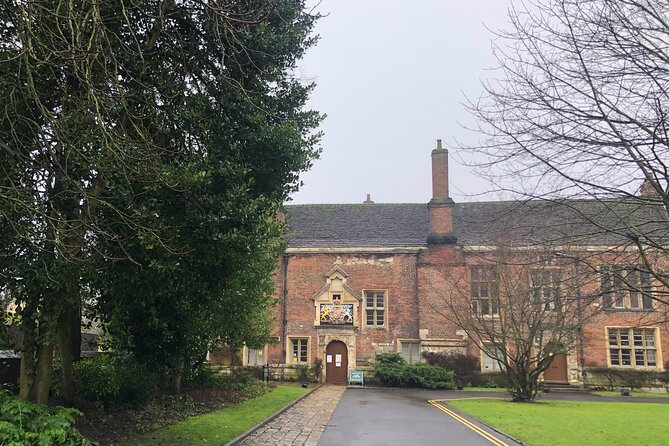
The Shambles takes about 10 minutes. This famous medieval street was once associated with butchers, and the guide leads you toward the shrine of St Margaret Clitheroe while explaining the street’s older stories.
The Shambles can be crowded and easy to reduce to a quick photograph. A guide helps you notice why the street looks the way it does and how its trade shaped daily life. The stop is brief, so you will not spend long browsing every shop or side lane.
The walk also considers the medieval levels of York and the city’s Guilds. You learn about one of the richest guilds in York, the role traders played in the city’s prosperity, and the important part women held within the guild.
That last point matters. Medieval York was not only shaped by kings, bishops, and soldiers. Trade, craft, household work, and guild membership also supported the city. This is the kind of detail that gives the route more substance than a simple parade of old buildings.
St Cuthbert’s Church and the Devil’s Door
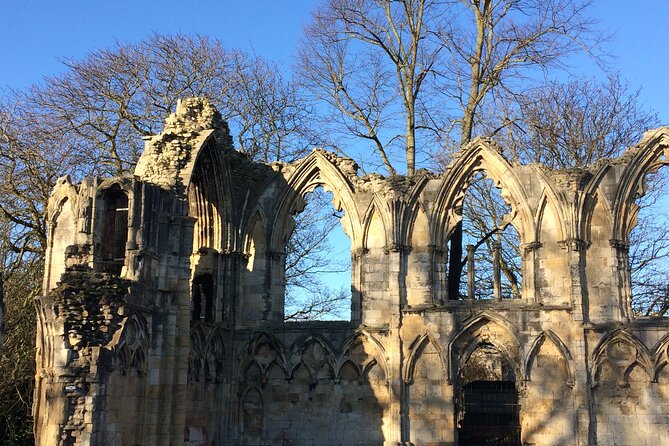
St Cuthbert’s Church receives about six minutes. It is a medieval church built partly with Roman brickwork, and it includes Saxon and Norman architectural elements.
The most unusual feature is its Devil’s Door. The guide explains the story behind the name and separates the popular myth from the likely meaning. This is a small stop, but it shows how much York’s past is layered into ordinary streets and buildings.
You should not expect to go deeply into the church during this short visit. The value comes from seeing how Roman materials and later architectural styles appear in one place.
Walking the walls, from Rome to the Victorians

The wall section lasts around 15 minutes. You see Roman defenses, Danish earthworks, medieval remains, and Victorian alterations, along with stories of sieges and the old Jewish quarter.
This is a useful sample of York’s defenses, but it is not a full walk around the city walls. If the walls are your main reason for visiting, set aside separate time for a longer walk. The tour’s route has a lot to cover, and a complete circuit would pull you away from the center.
For most people, the shorter section is a sensible compromise. You get the key idea: York’s defenses were rebuilt and reshaped over many centuries. Roman, Danish, medieval, and Victorian work does not simply sit in separate boxes. It overlaps.
The guide also points out the former Jewish quarter, adding another important part of York’s urban story. This is one of the route’s better qualities: it does not limit the city’s past to royalty and grand buildings.
Guilds, markets, and the business of medieval York
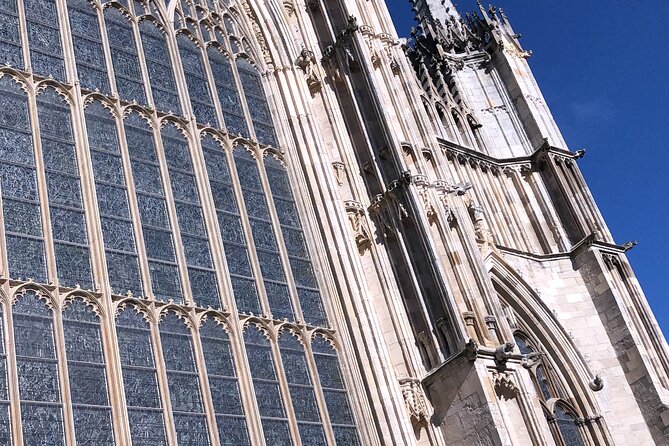
At Merchant Taylors’ Hall, you learn how guilds became economic centers in cities such as York. The Taylors’ role in the city and its continued presence today connect medieval trade with the city you see now.
The stop lasts only about four minutes, but it fits neatly with the earlier explanation of traders and women in guild life. You begin to see how work, money, rules, and social status shaped York’s streets.
The route then moves through Shambles Market for about five minutes. The guide explains the market’s part in York’s economic growth. This is practical history because markets are not decorative additions to an old city. They helped determine where people lived, worked, met, and moved.
Gates, street names, and Viking Jorvik
Monk Bar is one of York’s six gates. In five minutes, the guide explains its role in the city’s defenses, the legend of the Wild Men of York, and some of the gate’s more unpleasant uses.
The stop gives you a better way to read York’s bars, or fortified gateways. These are not just attractive entrances for modern pedestrians. They controlled movement and helped defend the city.
At Ogleforth, a Saxon street, the guide points out the Dutch House and explains how architectural changes after the Great Fire of London influenced building practices and insurance policies. It is a compact lesson in how events outside York could affect the look and rules of its streets.
Kings Square follows for about five minutes. Here, you learn the meaning behind street names, the city’s Viking connections, and the center of Jorvik. This is especially helpful if you plan to visit the Jorvik Viking Centre afterward, since the walk places Viking York within the modern city.
The Black Swan and a glimpse of old Hungate
The Black Swan takes about five minutes. In the old Hungate parish, you hear about its famous residents and links to the Battle of Quebec.
Nearby architecture reflects the Irish heritage of the area. There is also the chance to spot one of York’s famous black cats. That small detail adds a bit of local character without taking the tour off its historical path.
This section is a good example of the route’s wider appeal. It moves beyond the standard Minster, Shambles, and wall circuit and gives you a look at neighborhoods that can be easy to pass without understanding.
York Castle Museum and the real Dick Turpin
The final listed stop is York Castle Museum, viewed from outside for about seven minutes. The guide discusses the old buildings, prison reform, the site’s former uses, and the myths and facts surrounding Dick Turpin.
Admission is not included, so you will need a separate ticket if you want to go inside. The outside explanation is still useful because the buildings themselves are part of York’s changing approach to crime and punishment.
Dick Turpin is an especially good subject for a guide-led stop. Famous historical figures often collect legends over time, and the tour promises to distinguish the real Turpin from the popular stories. If this topic catches your interest, you can choose to return to the museum later.
What the price includes, and what it does not
At the stated price of $18.02 per person, this is a low-cost way to organize your first look at York. The two-hour length is long enough to cover a wide range of subjects but short enough to fit into a busy day.
The value comes from the route planning and interpretation. You are paying to have someone connect the city’s Roman, Viking, medieval, and later stories while leading you through streets that can be confusing at first.
There are no included admission tickets. The Minster, Castle Museum, and any museum tours cost extra, and alcoholic drinks are not included. The guide can take you around museums of your choice for an additional fee.
For the best value, use the walk as an orientation. Afterward, choose one or two paid sights that match your interests instead of trying to purchase every attraction at once.
Practical details for a smoother walk
The tour is offered in English and uses a mobile ticket. Confirmation arrives when you book. Service animals are allowed, the route is near public transportation, and most people can take part.
The maximum group size is 30. That is not a small private tour, though some departures may be much smaller. One account describes a group of four with the guide, while other experiences may have more people. If you want to ask frequent questions, arrive ready to stay near the guide and listen carefully in busy streets.
Wear comfortable shoes. The route includes winding historic streets, city sections, gateways, and a portion of the walls. York weather can change, and the tour requires good weather. If poor weather cancels it, you are offered another date or a full refund.
The finish is at the Parish of All Saints, Pavement, High Ousegate, York YO1 8RZ, though the endpoint may vary. It is about a six-minute walk from the starting point and close to the Shambles, Jorvik Viking Centre, Castle Museum, Clifford’s Tower, and the river walk.
Free cancellation is available up to 24 hours before the start time. Within 24 hours, refunds and changes are not accepted. The tour also requires a minimum number of participants, so a cancellation for that reason brings an offer of another date, another experience, or a full refund.
Who should book this York walk?
I would choose this tour if you are visiting York for the first time, have only a day, or want a clear plan before exploring alone. It is also a good fit if you enjoy history presented through stories rather than a formal lecture.
Families and mixed-age groups may appreciate the variety. The route shifts from emperors to guilds, churches, markets, walls, prisons, and Dick Turpin, so no single subject dominates for too long.
I would think twice if you want a long, uninterrupted walk on the city walls or extended time inside the Minster. This is a city overview, not a cathedral tour, museum tour, or full wall circuit.
Should you book J & M York City Walking Tours?
Yes, if you want an affordable and well-paced introduction to York. The strongest reasons are the broad route, the attention to overlooked streets, and guides such as Nick who explain the past clearly while keeping the mood light.
Book it near the start of your stay, then use the finish point to continue to the Shambles, Jorvik Viking Centre, Castle Museum, Clifford’s Tower, or the river. Choose a longer wall walk separately if that is your priority. For about $18.02, this tour gives you a useful map of York’s past and a better sense of what deserves your time next.
FAQ
How long is J & M York City Walking Tours?
The tour lasts approximately two hours.
Where does the tour start?
It starts at Constantine the Great, 4 Minster Yard, York YO1 7JB, United Kingdom.
Where does the tour finish?
It finishes at the Parish of All Saints, Pavement, High Ousegate, York YO1 8RZ. The endpoint may vary.
Are York Minster and museum admissions included?
No. Admission to York Minster and York Castle Museum is not included. Museum tours can be arranged for an additional fee.
How large can the group be?
The tour has a maximum of 30 participants.
What happens if bad weather cancels the tour?
You will be offered another date or a full refund.
Recently added around York
- York: Wizard Walk of York Tour – Magic, Comedy & Family Fun★ 4.8 · 57 reviews
- York: Hop-on Hop-off Sightseeing Bus Tour★ 4.6 · 61 reviews
- Private Viking Walk of York★ 5.0 · 64 reviews
- York: “All Creatures Great and Small” Yorkshire Dales Tour★ 4.9 · 65 reviews
- Historical Pub Walking Tour in York★ 5.0 · 67 reviews
- All Creatures Great & Small tour from York★ 5.0 · 71 reviews
- Dark Tales of York. Private ghost tours.★ 5.0 · 72 reviews
- Small group Tasting Tour of York★ 5.0 · 74 reviews
Walking Tours, compared.

Magical London: Harry Potter Guided Walking Tour
Read our review →
Underground Vaults Walking Tour in Edinburgh Old Town
Read our review →

Oxford University Walking Tour With University Alumni Guide
Read our review →
Edinburgh Castle: Guided Walking Tour with Entry Ticket
Read our review →
Edinburgh Castle Guided Walking Tour in English
Read our review →
Tour for Muggles The Ultimate Harry Potter Walking Tour in London
Read our review →
University and City Walking Tour with Alumni Guide
Read our review →Browse the lists this tour appears in