

Reviewed · WALKING TOURS
London: Street Art and Graffiti Guided Walking Tour
Walls tell East London’s story. This two-hour walk from Spitalfields to Brick Lane and Shoreditch reveals a side of London that is easy to miss, even when art is right in front of you. You will see work by about 40 artists, including Banksy, ROA, Invader, Shepard Fairey, and Stik, while learning how stickers, stencils, murals, tags, and paste-ups fit into the city’s creative culture. I especially like the first-hand artist insight and the way the tour connects art with East End history. The main point to consider is that street art changes constantly, so a particular piece you hope to see may be gone or altered.
I also like the route’s easy pace and useful starting point near Liverpool Street Station. Guides such as Josh, Eva, Laura, Gabi, Ava, and Natalie have been praised for explaining both the meaning and the mechanics of the art without making beginners feel out of place. The tour is listed as two hours, though one recent outing lasted about an hour and a half, so allow enough time but do not expect a rigid museum-style schedule.
In This Review
- Key points at a glance
- Meeting the guide at Old Spitalfields Market
- From Spitalfields into the East End
- Brick Lane and the busiest concentration of art
- Shoreditch and the meaning behind the walls
- Why the guide matters more than the route
- What the two-hour pace feels like
- Is $33 good value?
- Who will enjoy this walk most?
- What you should know before booking
- Should you book the East London street art tour?
- FAQ
- Where does the London street art tour start?
- Which station is closest to the meeting point?
- How long does the tour last?
- Which artists might I see?
- Is the tour wheelchair accessible?
- Can I combine the walking tour with a street art workshop?
Key points at a glance
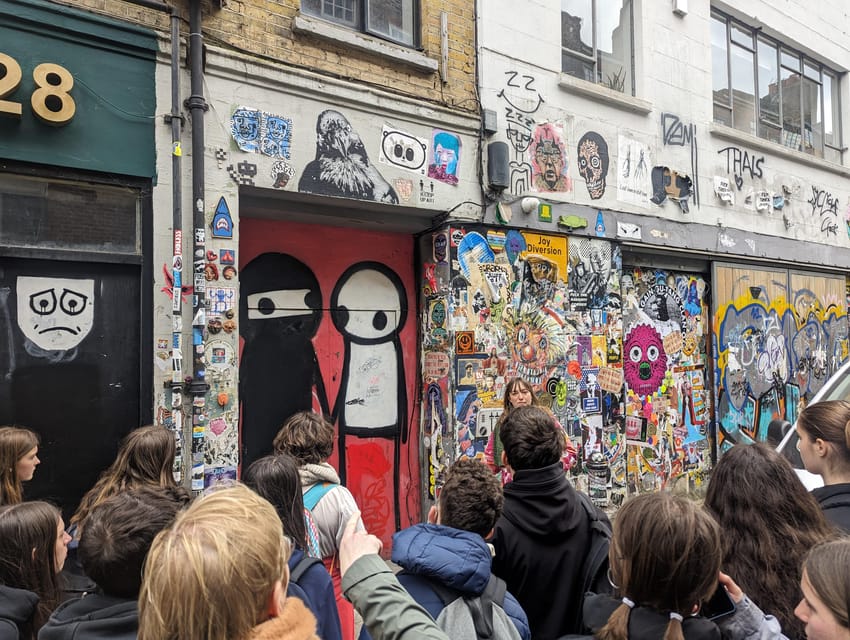
- Start under the White Goat Statue: Meet outside Old Spitalfields Market on Brushfield Street, close to Liverpool Street Station.
- See more than famous names: The walk includes large murals, small hidden pieces, stickers, stencils, floor art, signs, and work placed in surprising spots.
- Learn the rules behind graffiti: Guides explain tagging culture, techniques, materials, artist identity, and the difference between graffiti and street art.
- Walk through three changing districts: The route links Spitalfields, Brick Lane, and Shoreditch, with East End history woven into the art.
- Expect a guide-led experience, not a photo checklist: The art may change, but the explanations help you notice work throughout London later.
- Good for curious families and beginners: Teenagers and first-time art watchers can take part, while experienced graffiti fans still get technical and cultural context.
Meeting the guide at Old Spitalfields Market
The tour begins beneath the White Goat Statue on Brushfield Street, just outside Old Spitalfields Market. This is a practical meeting place because Liverpool Street Station is nearby and the statue is a clear landmark.
From Liverpool Street Station, exit onto Bishopsgate. Walk left, then turn right onto Brushfield Street between Pizza Express and the RBS building. Continue about 100 metres and look for the white goat on top of the statue. Arrive ten minutes early. The area can be busy, and finding the exact spot is easier before the group gathers.
Starting here gives the walk a useful beginning. You are just outside the City of London, the capital’s old financial core, but the tour soon moves toward the East End’s more alternative streets. That contrast helps explain why the route feels like more than a collection of painted walls.
Your guide sets the tone. The strongest part of this experience is the human explanation, not simply the number of artworks. Guides have included Josh, Eva, Laura, Gabi, Ava, and Natalie. Several are artists themselves or have worked closely with artists, which can add detail you would not get from wandering alone.
More Walking Tours in London
- Magical London: Harry Potter Guided Walking Tour
★ 4.7 · 22,044 reviews - London: The Original Jack the Ripper Walking Tour
★ 4.7 · 7,833 reviews - Tour for Muggles The Ultimate Harry Potter Walking Tour in London
★ 5.0 · 4,684 reviews
From Spitalfields into the East End
The first section introduces the area and its past while the art begins to appear. Do not expect every wall to be covered from the first minute. One especially effective way the walk is shaped is by showing where art is absent as well as where it is concentrated.
That contrast matters. Street art depends on permission, risk, access, building ownership, local attitudes, and the changing use of a street. A wall may be blank because it is protected, newly built, closely watched, or simply not a useful place for an artist. Once you understand that, the painted walls feel less random.
The East End setting adds another layer. Your guide explains how local changes and different periods of London’s past affected the area and its art. You are not given a formal history lecture, but you get enough context to see Brick Lane and Shoreditch as lived-in districts rather than outdoor galleries.
This is also where the tour can change your habits. Art may be on a wall, but it may also sit on a sign, roof, pavement, doorway, or shopfront. Some works are tiny and easy to overlook. Your guide trains your eye to scan above street level and around corners.
Brick Lane and the busiest concentration of art

Brick Lane is the visual centre of the walk. Here, you can expect a stronger concentration of murals, smaller pasted works, stickers, and graffiti. It is a popular part of East London, but the tour moves beyond the obvious photo stops and points out pieces you would probably walk past on your own.
The area is especially useful for comparing styles. One artist might use a large wall and bold blocks of colour. Another may work with a stencil, a sticker, an animal image, or a small character placed in a tight space. The variety helps you understand why street art is not one single style.
You may see work connected with artists such as ROA, whose animal imagery is often highly detailed, or Invader, known for tile-based pixel figures. Shepard Fairey’s work offers another point of comparison, while Stik’s simple figures show how a limited visual language can carry a strong mood. Banksy may appear on the route, but the tour is not built only around finding one famous name.
That is important for your expectations. If you come hoping for a Banksy photo and nothing else, the experience may feel narrow. If you are willing to look at the whole scene, the famous piece becomes one part of a much bigger lesson.
The guide also explains techniques and materials. You may learn how artists use spray paint, stencils, stickers, paste-ups, tiles, or other methods. One of the most useful elements is discovering that the process affects how you read the finished work. A fast tag, a carefully planned stencil, and a large mural involve different aims and different levels of exposure.
Shoreditch and the meaning behind the walls
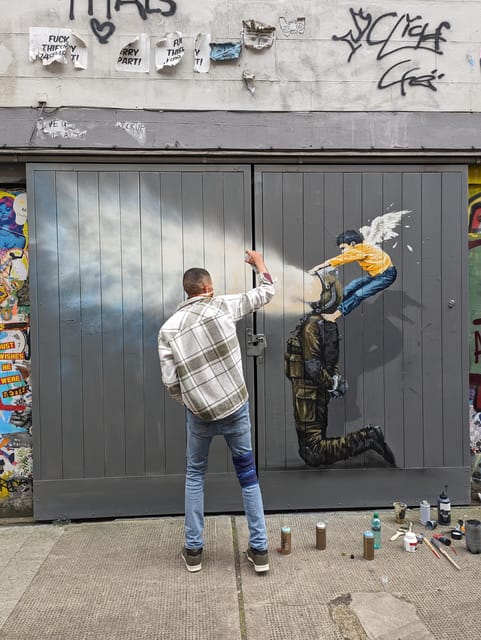
The route continues into Shoreditch, where the mix of creative businesses, old walls, side streets, and public art creates more chances to compare works. The walk does not simply point and name. It asks you to think about who made a piece, why it was placed there, and how the setting changes its effect.
Some pieces are designed to be seen from far away. Others reward a close look. You might find an artwork tucked beside a doorway or placed low on a wall, while another dominates an entire building face. Guides have pointed out art on walls, signs, roofs, and even the floor, so wear comfortable shoes and keep your eyes moving.
The explanations about meaning are often where the $33 price begins to make sense. You can stroll through Brick Lane for free, but you will not automatically know which artists matter, what a particular symbol means, or how the work relates to the local scene. The guide helps separate a quick decoration from a piece with a clear artistic or social purpose.
You will also hear about tagging and graffiti culture. That part may challenge the simple idea that all wall writing is the same. The guide explains the culture, rules, identity, and mindset behind tagging, then places it beside more formal street art. You do not need previous knowledge of hip-hop or graffiti to follow along, but people who already know the scene can ask more detailed questions.
The best guides keep both groups involved. Josh has been praised for speaking to people who knew the culture while remaining welcoming to newcomers. That balance is worth noting if your group has mixed interests.
A different sort of outing around London:
- London: The London Eye Entry Ticket
★ 4.6 · 35,875 reviews - From London: Harry Potter Warner Bros Studio Tour
★ 4.7 · 26,588 reviews - London: Westminster to Greenwich River Thames Cruise
★ 4.5 · 22,836 reviews - London: Madame Tussauds London
★ 4.6 · 20,915 reviews
Why the guide matters more than the route
Street art tours rise or fall on the person leading them. The route itself is walkable, but the art can be confusing without someone who knows what to look for.
A good guide points out small pieces before the group walks past them. They explain an artist’s methods, discuss possible meanings, and show how one work differs from another. They also answer questions and adjust the conversation to the group. Laura, for example, has been praised for tailoring the walk to people’s interests, while Natalie’s experience as a street artist added a personal connection to the subject.
The tone described by past participants is friendly rather than showy. That matters because graffiti can seem intimidating if you do not know the language. You should feel able to ask basic questions without being made to feel foolish.
Guides also bring the East End into the story. You learn about the local area alongside the art, which makes the route more worthwhile than a simple catalogue of artists. Ava, Gabi, and Eva have all been singled out for combining art explanations with local background.
Guide assignments can change, so you should not book solely to meet one named person. Still, the repeated praise for the guiding team is one of the clearest reasons to choose this walk over exploring alone.
What the two-hour pace feels like
The activity is advertised at two hours and is described as a relaxed walking tour. That is enough time to see a broad sample without turning the outing into a full-day commitment.
The pace appears suited to stopping often. You pause to examine details, listen to an explanation, take photographs, and move on to the next wall. It is not a fast march through the neighbourhood. One person found the walk lasted closer to one and a half hours, so the exact timing may vary with the group, questions, and route.
That flexibility is helpful, but it is also the main practical uncertainty. You may not receive a minute-by-minute itinerary, and the route can evolve as artworks disappear or new ones appear. Street art is temporary by nature. Paint fades, walls are cleaned, buildings change hands, and fresh work covers older pieces.
Bring rain gear. London weather can change quickly, and the tour takes place outdoors with no shelter built into the experience. Comfortable shoes are sensible, even though the walk is described as slow paced.
The tour is wheelchair accessible. You should still remember that an urban route can include busy pavements and changing street conditions, so arriving early gives you time to settle in before the group sets off.
Is $33 good value?
At $33 per person, this is not the cheapest way to spend two hours in London. You can walk around Brick Lane without paying an admission fee. The question is what you want from the outing.
If you only need a few colourful backdrops for photographs, save your money and explore independently. If you want to understand the artists, techniques, local culture, and history, the fee is fair. The guide adds the part you cannot easily find by looking at walls on your own.
I see the strongest value in three areas:
- Orientation: You find the streets and side spots that are easy to miss.
- Interpretation: You learn what you are looking at rather than treating every mark as decoration.
- Context: The art connects to the East End and to the culture that produced it.
The experience also works well as a first introduction. You do not need to recognise Banksy or know the difference between a stencil and a paste-up before you arrive. By the end, you should have a better vocabulary and a sharper eye for street art elsewhere in London.
Because the route changes, the value is not tied to a fixed collection of walls. That can be a positive. A repeat visit may feel different, though you should not expect to see the same works each time.
Who will enjoy this walk most?
I would recommend it to anyone who likes cities but wants a break from major museums and royal attractions. It offers a look at London through public art, local streets, and informal creative spaces.
It is particularly suitable for:
- First-time street art visitors
- Adults who want cultural context without a formal lecture
- Teenagers looking for an activity beyond standard sightseeing
- Amateur photographers
- Art students and practising artists
- People interested in hip-hop, graffiti, stickers, and mural work
- Couples seeking a different kind of London outing
It can also suit families with older children, though the workshop options have separate age rules. The shorter street art and spray-painting workshop is available daily for people over 10. A longer two-hour version with a break is available for people over 12. Under-16s must be accompanied by an adult throughout if members of the same group book the tour and workshop separately.
This walking tour itself is the better choice if you prefer looking and listening to making art. Choose the workshop instead if your main goal is to spray-paint and create something yourself.
What you should know before booking
The guide speaks English, and the experience is offered with free cancellation up to 24 hours before departure. You can also reserve now and pay later, which is useful if your London plans are still shifting.
Do not treat the route as a guaranteed Banksy hunt. The advertised highlights include Banksy, but street art can be covered or removed. Book for the explanations and the chance to see a changing collection of work, not for one guaranteed wall.
You should also arrive ready for an outdoor activity. Rain gear is specifically recommended, and the walk takes place in public streets rather than inside a controlled gallery. Wear shoes you can comfortably use for two hours and keep your camera ready, since some of the best pieces may be small or tucked away.
Should you book the East London street art tour?
Yes, if you want more than a quick stroll through Brick Lane. The strongest reason to book is the guide’s ability to reveal details you would miss, from tiny stickers to the technical choices behind large murals. The East End history gives the art a useful setting, and the relaxed pace leaves room for questions and photographs.
Skip it if you dislike walking outdoors, need a fixed list of guaranteed artworks, or only want a Banksy sighting. For most curious visitors, though, $33 buys a thoughtful introduction to a part of London that is changing under your feet. You leave with more than pictures. You leave better able to notice, question, and appreciate street art wherever you find it.
FAQ
Where does the London street art tour start?
Meet under the White Goat Statue on Brushfield Street, outside Old Spitalfields Market. The address is The White Goat Statue, Brushfield Street, London E1 6AA.
Which station is closest to the meeting point?
Liverpool Street Station is the closest station. Exit onto Bishopsgate, walk left, turn right onto Brushfield Street, and continue about 100 metres to the statue.
How long does the tour last?
The tour is scheduled for two hours. The exact length can vary, and one reported walk lasted around one and a half hours.
Which artists might I see?
The tour can include work by about 40 local and international artists, including Banksy, ROA, Invader, Shepard Fairey, and Stik. Street art changes, so individual pieces are not guaranteed.
Is the tour wheelchair accessible?
Yes, the activity is listed as wheelchair accessible.
Can I combine the walking tour with a street art workshop?
Yes. A shorter workshop is available daily for people over 10, and a longer two-hour workshop with a break is available for people over 12. Under-16s must be accompanied by an adult throughout.
More Street Art
- London Bike Tour: Landmarks, Secret Gems, Pub Stop & Street Art
★ 5.0 · 943 reviews - Shoreditch Street Art Tour London
★ 5.0 · 481 reviews - London: Landmarks & Secrets Bike Tour with Pub & Street Art
★ 4.9 · 314 reviews - The Original London Street Art Tour
★ 5.0 · 303 reviews
Recently added around London
- PRIVATE HIRE 45 min Speedboat Tour – Embankment/Westminster Pier★ 5.0 · 55 reviews
- Private Tour of London’s Historic Pubs★ 5.0 · 55 reviews
- From London: Glastonbury and Cheddar Gorge Guided Day Trip★ 4.8 · 55 reviews
- London: Kew to Westminster River Thames Cruise★ 4.2 · 55 reviews
- Gatwick Airport Taxi – Private Transfer to/from London★ 5.0 · 55 reviews
- London by Night – Tootbus Sightseeing Tour★ 3.5 · 55 reviews
- London: Tower of London After Hours Tour and Key Ceremony★ 4.8 · 56 reviews
- Palaces, Parliament & Power: A Walking Tour of London’s Royal City★ 5.0 · 56 reviews
Walking Tours, compared.

Magical London: Harry Potter Guided Walking Tour
Read our review →
Underground Vaults Walking Tour in Edinburgh Old Town
Read our review →

Oxford University Walking Tour With University Alumni Guide
Read our review →
Edinburgh Castle: Guided Walking Tour with Entry Ticket
Read our review →
Edinburgh Castle Guided Walking Tour in English
Read our review →
Tour for Muggles The Ultimate Harry Potter Walking Tour in London
Read our review →
University and City Walking Tour with Alumni Guide
Read our review →Browse the lists this tour appears in