
Reviewed · BRISTOL TOURS
St Mary Redcliffe Church Bristol: Guided Tour
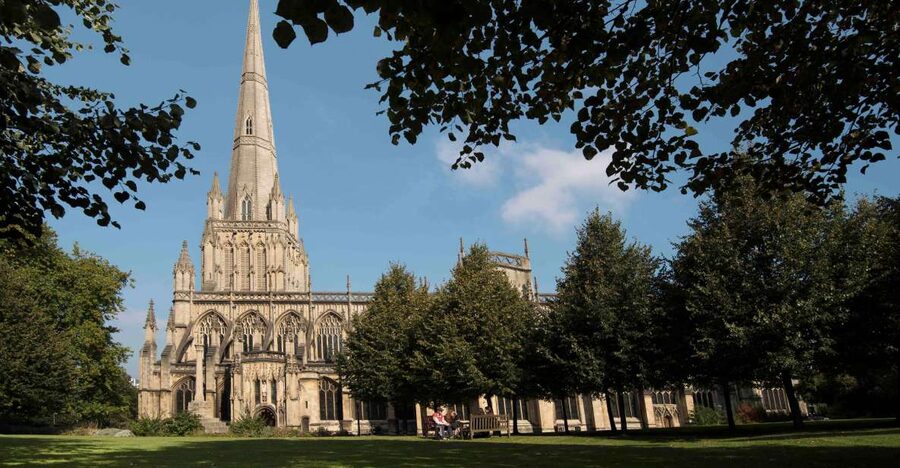
Look up, and Bristol’s past comes alive. St Mary Redcliffe’s 90-minute guided tour takes you from its unusual medieval North Porch to high, tucked-away rooms normally closed to the public, while explaining the church’s links with sailors, merchants, royalty, artists and poets. At only $8 per person, it offers an unusual amount of access and detail for the price.
I especially like the chance to see medieval graffiti and merchants’ marks, small traces left on the building for roughly 800 years. The guides also bring the church to life with stories, music and sharp observation. One consideration is the 75-step spiral staircase to the Chatterton Room. Most of the tour is on level ground, but that final hidden space is not suitable for anyone unable to climb stairs.
Guide quality is a major strength. Bryan Anderson has demonstrated the large organ, opened the church’s remarkable cope chest and answered questions with warmth and humor. Sarah and Paul have also been praised for clear, lively presentations that never feel rushed. If you enjoy old buildings but want more than a quick look at stone and glass, this is a very good-value Bristol experience.
In This Review
- Five details that make this tour worth your time
- Why St Mary Redcliffe deserves a proper visit
- Starting in the hexagonal North Porch
- Bristol’s maritime past inside the church
- Medieval glass in St John’s Chapel
- The long view beneath 1,200 roof bosses
- The unidentified knight in the North Transept
- The Lady Chapel and its later stained glass
- William Canynges and Bristol’s merchant princes
- Medieval graffiti hiding in plain sight
- Inside the Chatterton Room
- The organ, cope chest and unexpected extras
- Price, pace and who will enjoy it
- Practical details before you go
- Should you book St Mary Redcliffe’s guided tour?
- FAQ
- Where does the St Mary Redcliffe guided tour begin?
- How long does the tour last?
- How much does the tour cost?
- What language is the tour conducted in?
- Can I visit the Chatterton Room?
- Is the entire tour accessible without stairs?
- What historical objects will I see?
- Will I see medieval graffiti?
- Can I cancel the booking?
Five details that make this tour worth your time
- A rare look above the North Porch: The Chatterton Room is reached by a 75-step spiral staircase and is usually closed to the public.
- A church built over seven centuries: Construction began in the 12th century and continued through the 19th century.
- The John Cabot connection: A 15th-century whalebone and a model of Cabot’s ship, The Matthew, recall Bristol’s seafaring past.
- Over 1,200 roof bosses: The vaulted ceiling gives you plenty to study, especially when viewed from the west end.
- A possible organ demonstration: Bryan Anderson has played the five-keyboard organ, with its 4,327 pipes and 71 stops, during tours.
Why St Mary Redcliffe deserves a proper visit
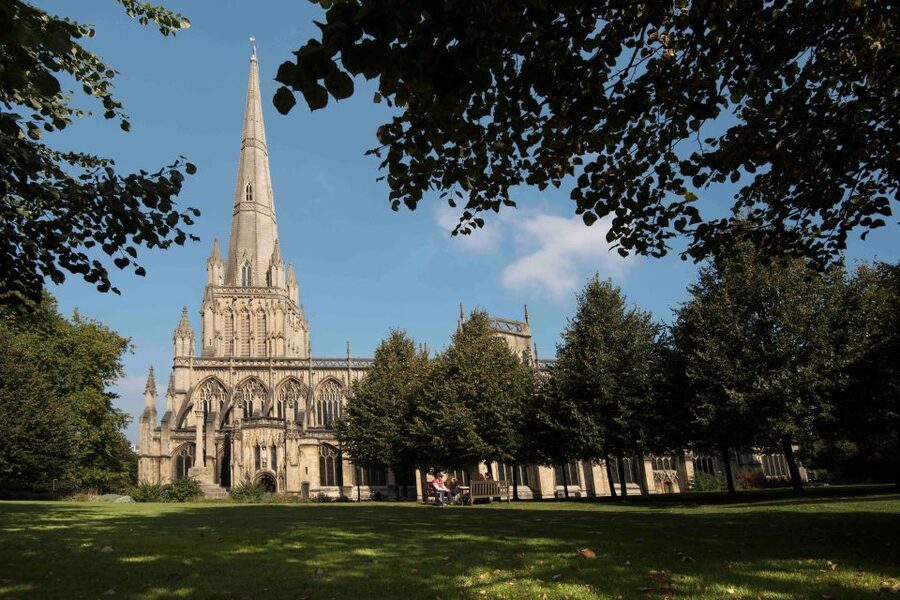
St Mary Redcliffe is not a small parish church that you can understand in five minutes. It is a huge Gothic building with layers added and altered between the 12th and 19th centuries. From outside, its tower and spire make an immediate impression. Inside, the scale is even more striking.
Queen Elizabeth I famously called it the fairest, goodliest and most famous parish church in England in 1574. That praise makes more sense once you see the height of the nave, the long view toward the chancel and the carved detail overhead.
A guide helps you read the building in the right order. Without one, you may notice the windows and grand pillars but miss the marks made by medieval merchants, the uncertain identity of an early knight or the church’s connection with Bristol’s sea trade.
The experience is also more personal than a standard sightseeing stop. The guides respond to questions, point out small details and adapt their stories to the interests of the group. Bryan, in particular, has brought his background as a retired musical director and organist into the tour. That can add a welcome sense of occasion in a church where sound is part of the architecture.
A few more trips worth a look before you book
- Blackbeard to Banksy – The Ultimate Walking Tour of Bristol
★ 5.0 · 1,961 reviews - Air Raid Shelter + St. Nicholas Market Walking Tour
★ 5.0 · 1,950 reviews - Bristol: Blackbeard to Banksy Guided Walking Tour
★ 4.9 · 1,422 reviews
Starting in the hexagonal North Porch
The tour begins inside the church near the main entrance and visitor desk. From there, you start with one of the building’s most unusual features, the hexagonal North Porch.
Dating from the 12th or 13th century, the porch once served as the church’s main chapel and held a shrine to the Virgin Mary. Its shape is unlike the familiar square entrance porch found at many English churches, and it gives the tour a strong opening because it combines architecture, religious practice and local history in one place.
Your guide then takes you outside to examine the stone carvings on the porch exterior. Some are beautiful, while others are puzzling. The fact that their meaning is not always clear makes them more interesting, not less. You get the pleasure of looking closely without being handed a neat answer for every figure.
This is also a good point to study the famous tower and spire. The church’s height is not simply decorative. A lightning strike caused the spire to collapse in the 15th century, damaging part of the nave. That event connects directly with the later rebuilding work associated with William Canynges II.
Bristol’s maritime past inside the church
St Mary Redcliffe has a strong connection with Bristol’s merchants and the sea. The church’s interior preserves an unusual reminder of John Cabot’s 1497 voyage to North America: a whalebone associated with Cabot.
Above the main entrance, you can also see a model of The Matthew, the ship used on that voyage. These objects help you connect the church with the commercial city outside its walls. Bristol’s wealth was tied to trade, and wealthy merchants put money into the church, its chapels and its memorials.
This part of the tour is especially useful if you are exploring Bristol’s harbour and maritime sites. It shows that the city’s seafaring past is not kept only in museums. It is also built into the walls and memorials of an active place of worship.
Medieval glass in St John’s Chapel
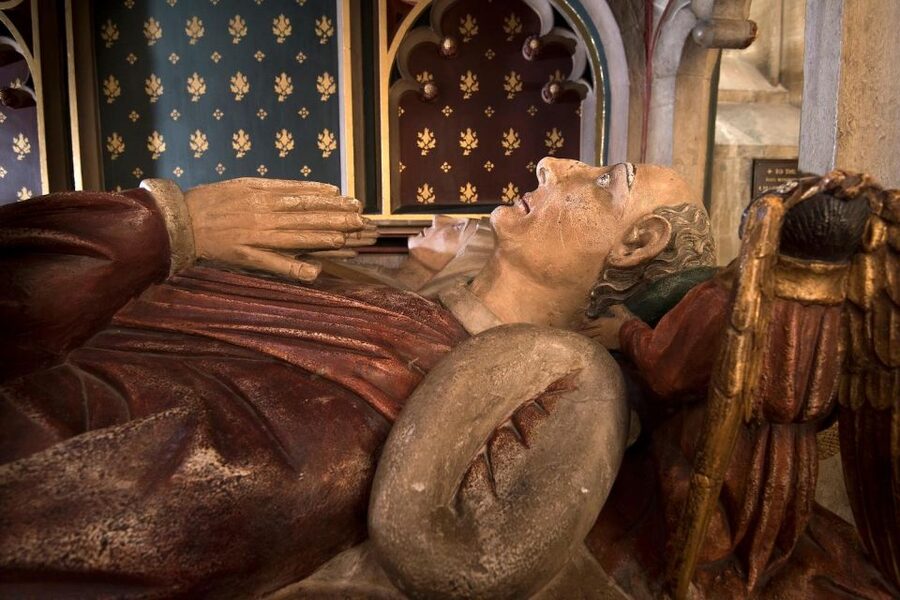
In St John’s Chapel, the focus shifts to the church’s surviving medieval artwork and design. The chapel contains stained glass dating from the 14th century, giving you a chance to see some of the oldest visual material still associated with the building.
Medieval stained glass was more than decoration. It helped communicate religious stories and ideas to people who could not read. The surviving panels also provide a sense of how color, light and craftsmanship shaped the experience of the church before modern electric lighting.
The glass is best approached slowly. A guide can direct your attention to details that are easy to miss from a distance, and the changing light can make close inspection worthwhile. Photography may compete with simply looking, so I would take a few pictures, then put the camera away for a moment.
A different sort of outing around Bristol:
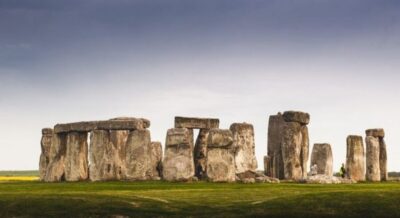
- From Bristol: Stonehenge and Cotswold Villages Day Tour
★ 4.8 · 717 reviews - (9pm) The House Magicians Comedy & Magic Show – Smoke & Mirrors
★ 5.0 · 356 reviews - Bristol: Air Raid Shelter & St. Nicholas Market Walking Tour
★ 4.8 · 320 reviews - West Country Games – the most popular group activity in the South West!
★ 5.0 · 315 reviews
The long view beneath 1,200 roof bosses
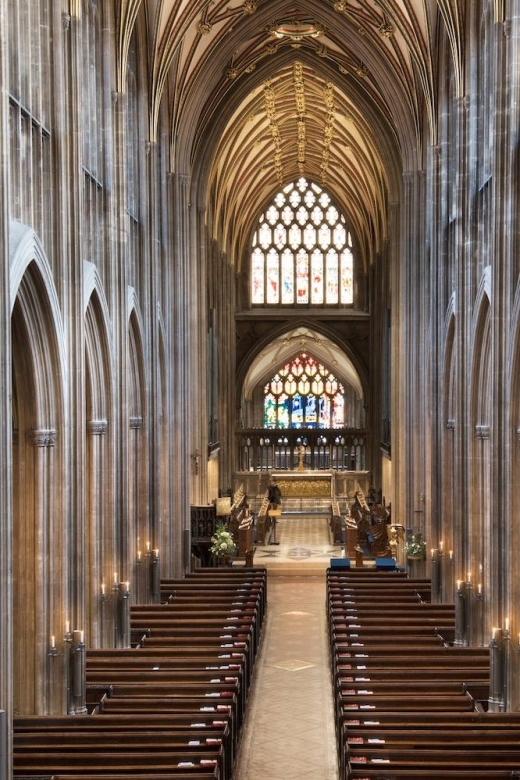
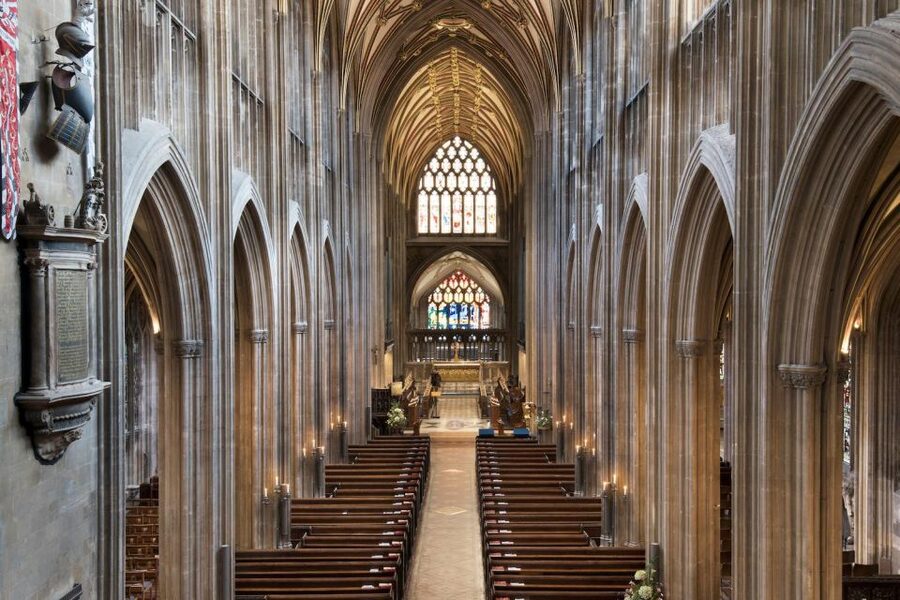
One of the tour’s strongest moments comes when you stand at the west end and look toward the chancel and altar. From here, the building’s proportions become clear. The pillars rise sharply, the vaulted ceiling draws your eye forward and the chancel seems to pull the entire church into one long composition.
Above you are more than 1,200 individual roof bosses. These carved groin stones vary in shape and decoration, so the ceiling rewards repeated glances. You may find yourself looking up while the guide is speaking, then looking up again after the explanation ends.
The pillars and vaulting are also important examples of English Perpendicular Gothic architecture. You do not need specialist knowledge to appreciate the effect. The style is marked by strong vertical lines, large windows and a sense of height that makes the church feel both orderly and dramatic.
This is the point where the building’s size can overwhelm a little. The tour helps by giving you smaller stories to hold onto, rather than asking you to absorb every architectural term at once.
The unidentified knight in the North Transept
In the North Transept, you will meet one of the church’s most intriguing objects, an effigy of an early medieval knight.
The figure has long been linked with Robert de Berkeley, who gave the church a water supply in 1190. But the identity is not certain. The effigy may even be older than the present church building.
That uncertainty is part of its appeal. Historic buildings are full of confident labels that later prove too simple. Here, you get a more honest explanation: this is an important medieval figure, but no one can say for certain whom it represents.
The North Transept also shows how the tour balances major sights with smaller mysteries. You are not simply being led from one famous window to another. You are encouraged to notice objects whose stories remain partly unresolved.
The Lady Chapel and its later stained glass
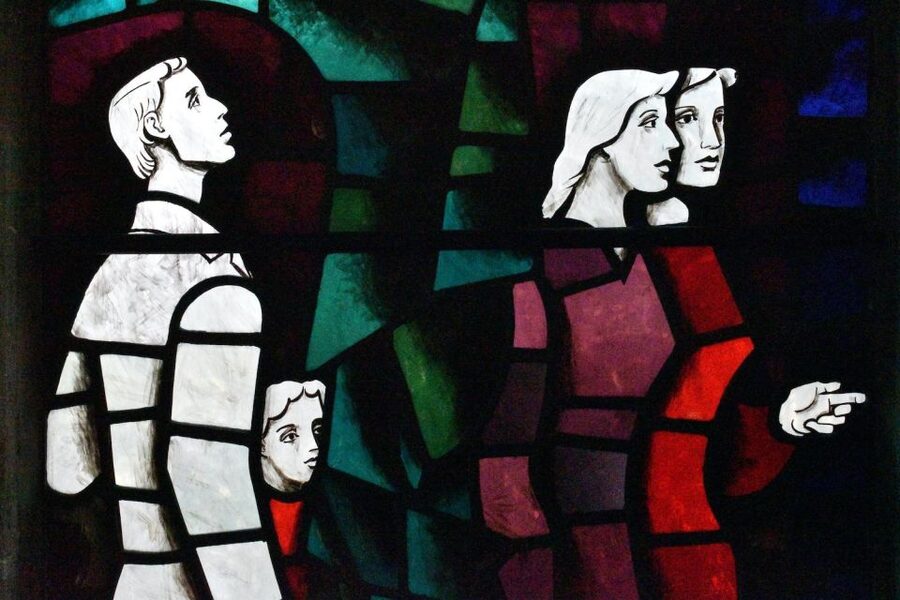
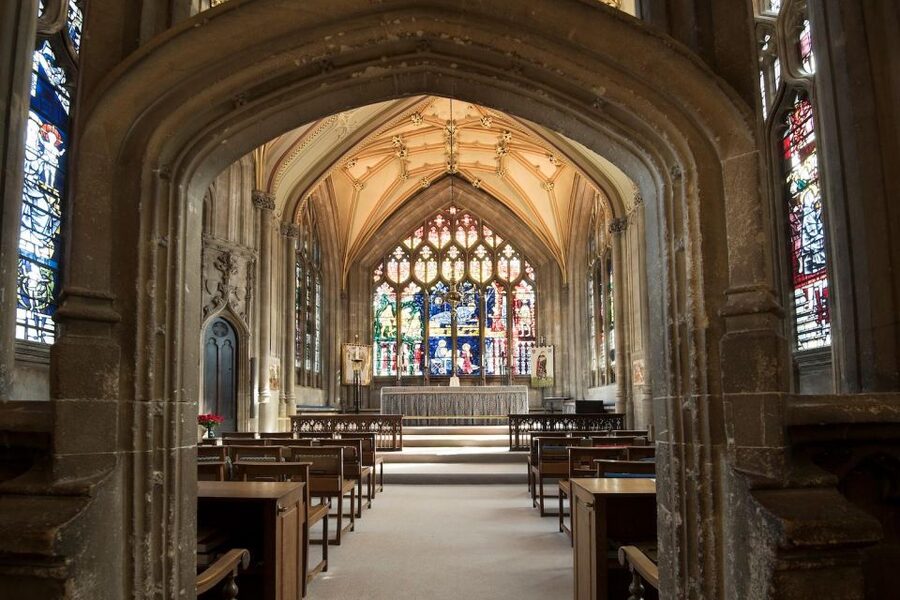
The 14th-century Lady Chapel offers a different mood. Its Gothic screen gives the space a more enclosed character, while the stained glass windows bring in a much later artistic voice.
The windows were designed by Harry Stammers in the early 1960s. That date matters because it shows that St Mary Redcliffe is not frozen in the medieval past. The church contains work from several periods, and the later glass sits within an older architectural frame.
I like this contrast. It keeps the visit from becoming a lesson only about medieval England. You can see how later generations continued to repair, alter and reinterpret the building.
William Canynges and Bristol’s merchant princes
In the South Transept, the polychrome stone altar tomb of William Canynges II and his wife Joan gives the church’s merchant story a human focus.
Canynges was an MP and mayor of Bristol. He is credited with helping rebuild the church in the 15th century after the lightning strike destroyed part of the nave. His tomb is not just a memorial to a wealthy local figure. It reflects the way Bristol’s commercial success helped shape one of its major churches.
The painted or colored stone makes the tomb especially worth seeing. Over time, many people imagine medieval churches as plain gray spaces, but color was an important part of medieval decoration. The tomb helps correct that flat picture.
Your guide also draws attention to other monuments, carvings and effigies around the building. If you like social history, this is where the church becomes a record of status, money, devotion and local power.
Medieval graffiti hiding in plain sight
The medieval graffiti may be the most rewarding feature for visitors who enjoy small discoveries. Marks and merchants’ signs have been left on the church walls for around 800 years, although many are only now being identified and studied more closely.
These marks offer a direct connection with ordinary use of the building. A grand tomb tells you about a prominent person. A scratched sign or symbol can suggest how people moved through, worked in or claimed a place over time.
The marks are easy to miss without guidance. You may walk past them during a self-guided visit and never know what you were looking at. This is a good example of where the tour earns its modest price: the guide changes what you see.
Inside the Chatterton Room
The final hidden space is the Chatterton Room, located high above the North Porch. It takes its name from Bristol poet Thomas Chatterton, who lived from 1752 to 1770 and is widely recognized as an early figure in English Romantic literature.
The room adds another layer to the church’s story. After seeing medieval carvings, maritime objects and merchant memorials, you reach a space linked with a young Bristol writer and the city’s literary past.
Getting there requires climbing a 75-step spiral staircase. That is the main physical challenge of the tour, and it should be taken seriously. If you have difficulty with stairs, you can still join the main part of the experience, since most of the route is in the accessible main body of the church. The tour welcomes people who cannot make the climb, but you should be prepared to miss this room.
The staircase also means you should wear sensible shoes and avoid treating the tour as a quick stop between other activities. Ninety minutes gives you time to look, listen and climb without rushing.
The organ, cope chest and unexpected extras
The advertised highlights focus on architecture and history, but the tour can include extra details depending on the guide and the group’s interests.
Bryan Anderson has opened the church’s large cope chest, made inside St Mary Redcliffe in 1593. It contains historic fabrics and offers a practical glimpse into the church’s ceremonial life. He has also demonstrated the organ, restored in 2009 at a cost of £800,000.
The organ has five keyboards, 71 stops and 4,327 pipes, with the largest pipes reaching 34 feet. A short demonstration gives you a better sense of the building’s acoustics than a spoken explanation can. It is worth asking politely if musical details interest you, though a demonstration should not be treated as guaranteed on every departure.
Small personal details can appear as well. One guide pointed out the grave of Tom the cat, a memorable touch for anyone who likes local stories that sit outside the official account.
Price, pace and who will enjoy it
At $8, the tour is strong value. You receive 90 minutes with a live English-speaking guide, access to areas normally closed to the public and a guided explanation of artwork, architecture, maritime links and local figures.
The value is not only in the number of sights. It is in the access and interpretation. A free church visit can show you the building, but this tour can take you above the North Porch, explain the graffiti and connect objects across several centuries.
The pace suits people who want time to look. Several visitors found the presentation well paced and not rushed, while one person became so absorbed in the talk that there was little time for photographs during the route. I suggest taking a few pictures at the beginning, then listening while the guide is explaining the key spaces.
This tour is best for:
- Anyone interested in medieval architecture and English church design
- People curious about Bristol’s merchants and maritime connections
- Visitors who enjoy art, stained glass, monuments and unusual details
- Repeat visitors who have seen the church before but want to understand it better
- Anyone who appreciates lively storytelling rather than a silent audio guide
It may be less suitable if you want a short, independent walk-through or cannot climb the spiral staircase and feel that visiting the Chatterton Room is essential.
Practical details before you go
The meeting point is inside the church near the main entrance, beside the visitor desk. The guide will meet you there, so allow enough time to enter the building and find the desk before the tour begins.
The tour is in English and lasts 90 minutes. Most of the route takes place on level ground in the main body of the church, with access through the south entrance for those who need it. The Chatterton Room is the exception because of its staircase.
You can cancel up to 24 hours before the tour for a full refund. You can also reserve your place and pay later, which is useful if your Bristol plans are still moving around.
Should you book St Mary Redcliffe’s guided tour?
Book it if you want to see more than the church’s impressive exterior and main interior. The $8 price is easy to justify, especially for the hidden spaces, medieval graffiti and close look at objects such as the Cabot whalebone, Canynges tomb and uncertain knight effigy.
I would give this tour priority if you already enjoy churches, historic buildings, stained glass or local history. It is also a smart choice for a repeat visit, since the guide can reveal details you probably missed the first time.
Skip it only if you want complete freedom to wander silently, have very limited time or cannot climb the 75 steps and would be disappointed not to enter the Chatterton Room. For most people, the combination of access, storytelling and price makes this one of Bristol’s better small-scale history experiences.
FAQ
Where does the St Mary Redcliffe guided tour begin?
The meeting point is inside the church near the main entrance, by the visitor’s desk. The guide will meet you there.
How long does the tour last?
The guided walking tour lasts 90 minutes.
How much does the tour cost?
The price is $8 per person.
What language is the tour conducted in?
The tour is conducted in English with a live tour guide.
Can I visit the Chatterton Room?
Yes, the tour includes a visit to the Chatterton Room, which is normally closed to the public. It is reached by a 75-step spiral staircase.
Is the entire tour accessible without stairs?
Most of the tour takes place on level ground in the main body of the church. The Chatterton Room is not accessible to anyone unable to climb its staircase, but people may still join the main part of the tour.
What historical objects will I see?
The tour includes John Cabot’s 15th-century whalebone, a model of The Matthew, medieval stained glass, monuments, effigies, carvings and the polychrome tomb of William Canynges II and Joan.
Will I see medieval graffiti?
Yes. The guide points out medieval graffiti and merchants’ marks found on the church walls, some of which have been there for around 800 years.
Can I cancel the booking?
You can cancel up to 24 hours in advance for a full refund. You can also reserve now and pay later.
Recently added around Bristol
- Bristol: The Best Of Bristol, Guided Bike Tour★ 4.8 · 68 reviews
- Bristol Paddleboarding Tour★ 5.0 · 92 reviews
- Guided Walking Tour Suspension Bridge Clifton Splendour & City.★ 5.0 · 100 reviews
- Fun, Flexible Treasure Hunt Around Bristol with Cryptic Clues & Hidden Gems★ 5.0 · 101 reviews
- Fully guided Bristol Ghost Tours★ 5.0 · 130 reviews
- Stonehenge and Cotswold Villages Full-day Tour from Bristol★ 5.0 · 140 reviews
- Bristol: Self-Guided Sightseeing Audio Tour★ 4.4 · 151 reviews
- Bristol: Wake The Tiger Amazement Park Entry Ticket★ 4.3 · 156 reviews
Bristol Tours, compared.

Blackbeard to Banksy – The Ultimate Walking Tour of Bristol
Read our review →
Air Raid Shelter + St. Nicholas Market Walking Tour
Read our review →

(9pm) The House Magicians Comedy & Magic Show – Smoke & Mirrors
Read our review →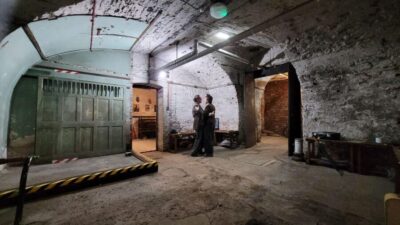
Air Raid Shelter & St. Nicholas Market Walking Tour
Read our review →
West Country Games – the most popular group activity in the South West!
Read our review →
The House Magicians’ Comedy Magic Show at Smoke & Mirrors in Bristol (Sat 7pm)
Read our review →Browse the lists this tour appears in