
Reviewed · BEATLES TOURS
Beatles London Walking Tour of Marylebone and Abbey Road
The Beatles left clues all over London. This 2.5-hour walking tour links ten of them across Marylebone and St. John’s Wood, ending at the famous Abbey Road zebra crossing. I like the mix of film locations, former homes, courtrooms, studios, and music-world stories. I also like the 2:30 p.m. start, which leaves your morning free for museums or markets.
The main caution is simple: this is a real walking tour, not a bus sightseeing ride. You also need a Zone 1 Travelcard, Oyster card, or contactless payment method for a short bus trip, and the pace can be tough if you walk slowly or need frequent rests.
In This Review
- Key points about the Marylebone and Abbey Road tour
- Starting at the London Beatles Store on Baker Street
- Montagu Square and the stories behind the addresses
- Marylebone Station and the film version of the Beatles
- Jane Asher’s former home and Paul McCartney’s Marylebone years
- The walking pace, standing time, and neighborhood stops
- Paul McCartney’s St. John’s Wood connection
- Abbey Road Studios and the album-cover crossing
- What the guides add to the experience
- Price, timing, and what you really receive
- Who should book this Beatles walk
- FAQ
- Where does the Beatles London walking tour begin?
- What time does the tour start?
- How long does the tour last?
- Where does the tour finish?
- Is transportation included?
- Can I go inside Abbey Road Studios?
- Is the tour suitable for people with limited mobility?
- Should you book the Abbey Road walking tour?
Key points about the Marylebone and Abbey Road tour
- Start at the London Beatles Store: Begin at 231 to 233 Baker Street, with a special discount on tour merchandise.
- Ten Beatles-related sites: The route covers Marylebone, Montagu Square, Marylebone Station, St. John’s Wood, and Abbey Road.
- Paul McCartney connections: See the former home where McCartney lived with Jane Asher and wrote Yesterday, plus another home close to Abbey Road Studios.
- A Hard Day’s Night locations: Marylebone Station helped provide one of the film’s memorable London settings.
- The famous zebra crossing: Finish at Abbey Road Studios, where you can attempt your own version of the album cover photograph.
- Guide quality matters: Guides such as Spencer Gibbons, Charlie, Michael, Tim, Rob, and Meg have been praised for strong stories and entertaining delivery.
Starting at the London Beatles Store on Baker Street
The tour begins outside the London Beatles Store at 231 to 233 Baker Street. You get about ten minutes here, and admission is free. The store also offers a special discount on merchandise for tour participants, which gives you a chance to browse before setting off.
This is a sensible meeting point. Baker Street is easy to reach by public transport, and the location gives you a clear place to gather before the group moves into Marylebone. If you are buying souvenirs, do it before or after the walk rather than counting on time during the stops.
The opening section sets the tone. This is not a tour of museum displays or private interiors. You are walking through ordinary London streets and stopping where a Beatles connection took place. Some locations are visually modest, so the guide’s storytelling is a major part of the experience.
That makes your guide important. Spencer Gibbons receives especially warm praise for his first-hand links to the band’s early years and for stories about Hamburg and the wider 1960s music scene. Charlie, Michael, Tim, Rob, and Meg are also singled out for lively, informed guiding. The best guides turn a regular street corner into a useful piece of Beatles history.
More Walking Tours in London
- Magical London: Harry Potter Guided Walking Tour
★ 4.7 · 22,044 reviews - London: The Original Jack the Ripper Walking Tour
★ 4.7 · 7,833 reviews - Tour for Muggles The Ultimate Harry Potter Walking Tour in London
★ 5.0 · 4,684 reviews
Montagu Square and the stories behind the addresses
The first major stop is Montagu Square, where you spend about ten minutes. This address is linked to several famous names: John Lennon, Ringo Starr, and Jimi Hendrix all had connections with the building.
You also hear about Lennon’s drug bust there. That detail gives the stop a darker edge, and it shows how the Beatles story was tied to the legal and social pressures of 1960s London. The address itself is not a Beatles attraction in the usual sense. You are looking at a residential location, so the guide’s explanation carries most of the weight.
This is one of the tour’s useful qualities. It places the band in a real neighborhood instead of keeping the story inside a concert hall or recording studio. You see where musicians lived, worked, socialized, and sometimes got into trouble.
Expect to stand while the guide talks. Several stops involve a block of storytelling rather than a quick photo opportunity. That format suits fans who want anecdotes, but it can feel slow if you prefer constant movement.
Marylebone Station and the film version of the Beatles
At Marylebone Station, the tour points out one of the locations used in A Hard Day’s Night. You also hear how the Beatles were chased by adoring fans in this part of London.
For a Beatles fan, this is a fun bridge between music and film. A Hard Day’s Night helped turn the band into screen characters, and seeing one of its London settings adds a physical sense of place to scenes you may already know.
The station is also a good reminder that the Beatles’ public life was not carefully controlled at every moment. Railway stations, streets, and homes became part of the band’s story simply because fans followed them everywhere.
The stop lasts about ten minutes. It is worth having the film in mind before you come, since the connection will mean more if you recognize the setting. You do not need to be an expert, but a quick viewing of A Hard Day’s Night can make this part of the walk more enjoyable.
Jane Asher’s former home and Paul McCartney’s Marylebone years
The Marylebone section is the longest single part of the tour, at roughly 25 minutes. You pass the former home of Jane Asher, where Paul McCartney lived for several years and wrote Yesterday.
That is one of the most meaningful stops on the route. Yesterday is among McCartney’s best-known songs, and linking it to a specific home gives the songwriting story a more personal scale. You are not just hearing about a song’s release. You are seeing the place tied to the period when it was written.
The walk also passes the former site of the Apple Store. This was an important part of the Beatles’ business and cultural world, and it helps broaden the tour beyond the band members’ homes. You get a sense of how the Beatles moved from pop group to major creative and commercial force.
The route then points out places connected with John Lennon and Yoko Ono’s court appearance, as well as the location where Paul McCartney married Linda Eastman. These details create a dense cluster of Beatles connections within Marylebone.
This section is likely to be one of the best for serious fans, but it also shows the tour’s limits. Several locations are former sites or private residences. You may see a building or street rather than an attraction you can enter. The reward comes from the story, not from a dramatic interior.
More Beatles Tours:
- London: Beatles and Abbey Road Tour with Richard Porter
★ 4.6 · 543 reviews - Liverpool and The Beatles Day Tour from London
★ 4.5 · 303 reviews - A Ticket to Ride: Beatles in London Tour
★ 4.6 · 272 reviews - London: Beatles In My Life Walking Tour with Richard Porter
★ 4.7 · 215 reviews
The walking pace, standing time, and neighborhood stops
The tour covers a lot on foot. Much of the route is described as level, but level does not mean effortless. You walk between points, listen while standing, and keep pace with a group that can reach 30 people.
I would wear comfortable shoes and plan for changing weather. One guide continued the tour in the rain, and rain can make the long outdoor stops less pleasant. You should also be ready for stretches where little is happening visually while the group moves to the next address.
The experience works best if you enjoy walking with a purpose. You are not simply ticking off photo stops. You are moving through Marylebone while the guide explains how each location fits into the Beatles story.
If you use walking poles, walk slowly, or need regular breaks, think carefully before booking. Some people have found the pace difficult, and a large group can make it harder to pause without falling behind. A smaller group would make it easier to hear and easier for the guide to keep everyone together.
There is another practical point: plan your bathroom break before the tour begins. No regular facility break is included in the route, and the tour finishes at Abbey Road Studios rather than at a dedicated visitor center.
Paul McCartney’s St. John’s Wood connection
The route continues into St. John’s Wood, where you see a home Paul McCartney has lived in since his Beatles days. It is close to Abbey Road Studios, which makes the location a natural lead-in to the final part of the tour.
This is a good example of how the walk connects the Beatles’ past with the present. You are seeing a private residence from the outside, so do not expect access. The interest comes from the length of McCartney’s connection with the area and from its closeness to the studio.
The stop lasts about ten minutes. It is less about a grand landmark than about placing McCartney within the neighborhood where the band recorded much of its work. For fans, that proximity gives the final section a satisfying sense of arrival.
Please remember that these are residential areas. The tour is designed for viewing and explanation from public streets. Good conduct matters, especially around private homes.
Abbey Road Studios and the album-cover crossing
The high point for most people is Abbey Road Studios. The Beatles recorded most of their music there, making this the most important musical site on the route.
The studio itself is not presented as an interior tour. If you expect to go inside and see recording rooms, you may be disappointed. The experience is centered on the exterior and the famous crossing nearby.
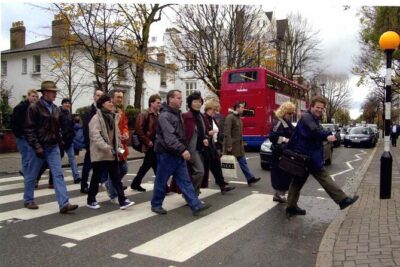
The zebra crossing is where you recreate the Abbey Road album cover photograph. This sounds easy until you arrive. The road remains in use, and getting a clean photo takes patience, timing, and cooperation from whoever is taking the picture. Several people have found the photography more challenging than expected.
Do not treat the crossing like a quiet photo set. Watch traffic, follow the guide’s instructions, and accept that your first attempt may not be the best one. You may need to try more than once, and other people will also be taking photographs.
The tour ends at Abbey Road Studios, close to St. John’s Wood Station. That is convenient for continuing your day, but it also means you should understand the route before booking. The final destination is the studio exterior and crossing, not an indoor museum visit.
What the guides add to the experience
The guide can make or break this tour. The strongest guides do more than point at buildings. They connect addresses, songs, films, legal troubles, friendships, and the wider rock scene.
Spencer Gibbons is particularly praised for stories drawn from his own experience around the Beatles’ early days. His accounts of Hamburg and his links to other musicians give the tour a broader music setting. Other guides have been praised for humor, careful group management, and willingness to answer questions.
That personal delivery is valuable because many of the stops are subtle. A former home may look like any other London residence. A court location may not have a sign explaining its connection to John and Yoko. A guide with a strong command of the story helps you understand why each place matters.
The tradeoff is that guide quality can vary. Some guides focus tightly on Beatles facts and may not be able to answer wider questions about the neighborhood. If you want a general Marylebone walking tour as well as a Beatles tour, this may feel narrow.
Large groups can also affect the experience. With up to 30 people, hearing every word may be difficult in noisy streets, and there is no mention of a portable microphone. Stay close to the guide and move toward the front when possible.
Price, timing, and what you really receive
At $23.48 per person, this is a reasonably priced specialist tour. You are paying for a guide, route planning, and access to a concentrated set of Beatles stories rather than for admissions to museums or private sites.
The value is strongest if you would otherwise spend time locating these addresses yourself. The guide adds context that is difficult to get from a quick map search, especially at Montagu Square, Jane Asher’s former home, the Apple Store site, and the court locations.
The price does not include your short bus journey. Bring a Zone 1 Travelcard, Oyster card, or contactless card. That extra transport cost is small compared with the tour price, but it should be made clear in your planning.
The 2:30 p.m. start is useful. You can visit another London sight in the morning, eat lunch, and then head to Baker Street. The advertised duration is about two hours and 30 minutes, although the walking, standing, group pace, and photo attempts can make the outing feel longer. Leave some flexibility afterward rather than booking a tight evening appointment.
The tour is offered in English and uses a mobile ticket. Confirmation arrives when you book. Free cancellation is available if you cancel at least 24 hours before the start time. Late cancellations and changes are not accepted for a refund.
Who should book this Beatles walk
I would recommend this tour to Beatles fans who want places connected to daily life, songwriting, films, and recording sessions. It is especially good for people who enjoy personal stories and do not mind that several stops are ordinary streets or private exteriors.
It also suits a visitor who wants Abbey Road without giving up a full morning. The afternoon schedule leaves room for other London plans, and the end near St. John’s Wood Station makes it easy to continue sightseeing.
I would be more cautious if you want a relaxed, slow-paced stroll, an indoor studio visit, or a general tour of Marylebone. You should also reconsider if long periods of walking and standing are hard for you, or if you need guaranteed bathroom stops.
FAQ
Where does the Beatles London walking tour begin?
The tour begins at the London Beatles Store, 231 to 233 Baker Street, London NW1 6XE.
What time does the tour start?
The scheduled start time is 2:30 p.m.
How long does the tour last?
The tour lasts approximately two hours and 30 minutes.
Where does the tour finish?
The tour finishes at Abbey Road Studios, 3 Abbey Road, London NW8 9AY. St. John’s Wood Station is a short walk away.
Is transportation included?
A short bus journey is part of the route, but you must provide a Zone 1 Travelcard, Oyster card, or contactless card for the fare.
Can I go inside Abbey Road Studios?
The tour takes you to the studio and the famous zebra crossing, but an interior studio visit is not included.
Is the tour suitable for people with limited mobility?
Participants should have a moderate level of physical fitness. The tour includes substantial walking and standing, so it may be difficult for anyone who walks slowly or needs frequent rest.
Should you book the Abbey Road walking tour?
Book it if the Beatles are a real priority on your London trip. The route gives you far more than the famous crossing, with McCartney’s Marylebone years, Lennon and Yoko Ono’s legal connection, Montagu Square, A Hard Day’s Night, and several music-world stories along the way.
Go in with the right expectations. You will walk through public streets, not tour a recording studio interior. Bring contactless payment for the bus, wear sturdy shoes, allow extra time, and prepare to stand in the open air.
For the right fan, the best reward is not a grand attraction. It is hearing a sharp story at an unremarkable address, then ending at Abbey Road with your own attempt at that famous four-step photograph.
Recently added around London
- PRIVATE HIRE 45 min Speedboat Tour – Embankment/Westminster Pier★ 5.0 · 55 reviews
- Private Tour of London’s Historic Pubs★ 5.0 · 55 reviews
- From London: Glastonbury and Cheddar Gorge Guided Day Trip★ 4.8 · 55 reviews
- Gatwick Airport Taxi – Private Transfer to/from London★ 5.0 · 55 reviews
- London: Kew to Westminster River Thames Cruise★ 4.2 · 55 reviews
- London by Night – Tootbus Sightseeing Tour★ 3.5 · 55 reviews
- London: Tower of London After Hours Tour and Key Ceremony★ 4.8 · 56 reviews
- From London: Cotswolds Guided Trip Including Bourton-on-the-Water★ 4.5 · 56 reviews
Beatles Tours, compared.
City & Beatles Tour with Live Guide & Live Music
Read our review →

Private 3-Hour Guided Beatles Classic Tour of Liverpool
Read our review →
Mad Day Out Beatles Taxi Tours in Liverpool, England
Read our review →Browse the lists this tour appears in