
Reviewed · WALKING TOURS
Chester: The Heart of Chester Walking Tour
Chester reveals its secrets on foot. This 90-minute walk brings together Roman traces, medieval streets, grand civic buildings, and the city’s famous Rows, with local guides Phil or Caroline adding the stories that make the architecture stick. I like the compact route and the strong sense of place. I also like that it covers both major sights and tucked-away lanes, rather than simply marching between postcard views. The main consideration is that historic interiors are not included, and the route has stairs and uneven walking.
The meeting point at the steps of the Chester Visitor Information Centre is easy to find in Town Hall Square. From there, you move through the city center at a measured pace, stopping often for explanations, questions, and photographs. Past guests have singled out Phil and Caroline for their clear storytelling, local tips, humor, and ability to connect Chester’s Roman, Saxon, Viking, medieval, and modern chapters.
In This Review
- Key Points Before You Book
- Why a 90-Minute Walk Works So Well in Chester
- Starting at Town Hall Square and Chester Town Hall
- Chester Cathedral and the Stories Behind It
- Saint Werburgh Street, Godstall Lane, and Chester Cross
- The Chester Rows on Watergate Street
- Booth Mansion and Bridge Street’s Grander Face
- Eastgate Street and the Chester Grosvenor
- The City Walls and Eastgate Clock
- The Guides Make the Difference
- Price, Pace, and Practical Limits
- Who Should Take This Chester Walk?
- Final Verdict: Is It Worth Booking?
- FAQ
- Where does the Chester walking tour start?
- Where does the tour finish?
- How long does the tour last?
- What sights are included?
- Are historic building admissions included?
- Is the tour suitable for wheelchair users?
Key Points Before You Book
- Ninety minutes in central Chester: The route is short enough for a day trip but long enough to give you a useful framework for exploring on your own.
- Phil and Caroline lead the walk: Both guides are praised for clear explanations, local knowledge, friendly delivery, and good pacing.
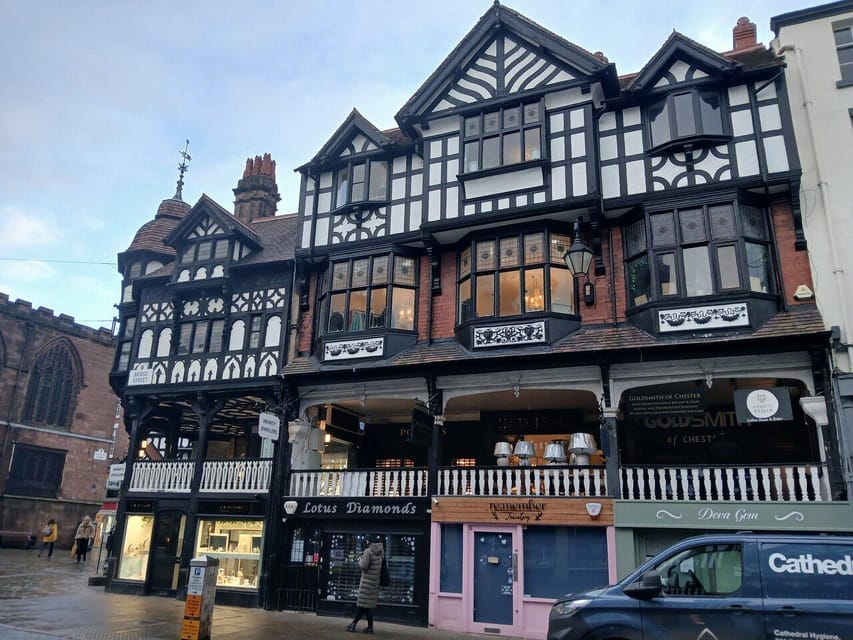
- The Chester Rows are a major feature: You see the distinctive two-level shopping galleries along historic streets, including Watergate Street and Bridge Street.
- The route mixes famous sights with quieter corners: Godstall Lane, back lanes, medieval houses, and the city walls add texture beyond the main monuments.
- Outdoor sightseeing only: You see Chester Cathedral, Booth Mansion, the Eastgate Clock, and other landmarks from outside. Building admission is not included.
- A small group helps: The group format makes it easier to hear the guide, ask questions, and stop without clogging the narrow streets.
Why a 90-Minute Walk Works So Well in Chester
Chester is compact, but its story is not. Roman soldiers, Saxons, Vikings, a Mercian princess, Norman rule, the Dissolution of the monasteries, and Victorian rebuilding all left marks within a fairly small area.
That makes a guided walk especially useful. You can see an old wall or timber-framed building by yourself, but you may not know why it matters. A good guide links each stop to the next period, so the city feels less like a collection of handsome façades and more like a place that kept being rebuilt, reused, and adapted.
The 90-minute length is one of the tour’s strongest features. You get a solid introduction without giving up half your day. One past participant described the timing as ideal for seeing and learning a lot before continuing independently. That is a good way to use it: take the tour early, then return to the places that caught your interest.
The pace also seems carefully judged. Phil has been praised for stopping regularly while keeping the group moving, and Caroline has received similar comments for an even, comfortable rhythm. You will be on your feet, but this is not designed as a forced march through the city.
More Walking Tours:
- Fascinating Walking Tours Of Roman Chester With An Authentic Roman Soldier
★ 5.0 · 1,232 reviews - Medieval Walking Tour of Chester
★ 5.0 · 155 reviews - The Heart of Chester Walking Tour – Guided Walk
★ 5.0 · 83 reviews
Starting at Town Hall Square and Chester Town Hall
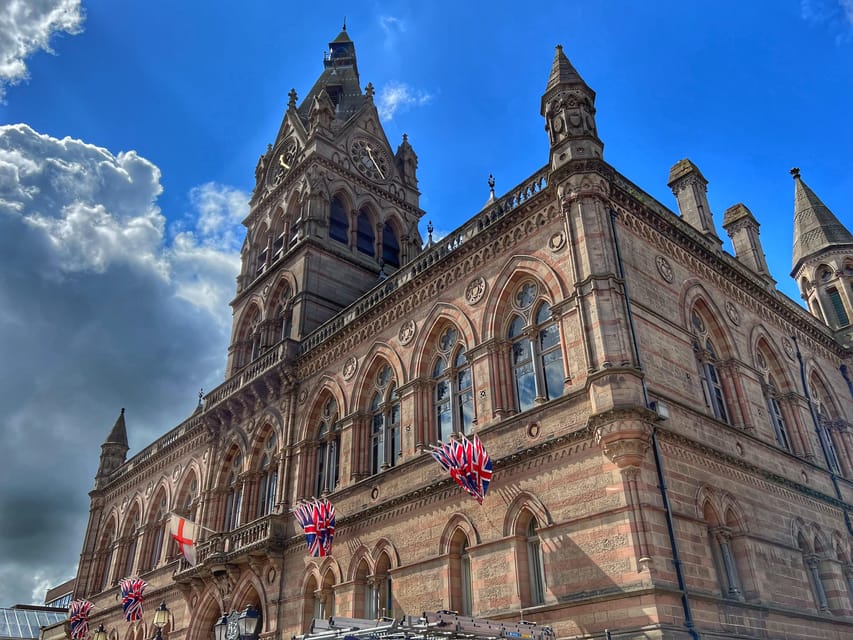
Meet at the bottom of the steps of the Chester Visitor Information Centre in Town Hall Square. This central starting point puts you right beside Chester Town Hall, the first major stop.
The Town Hall gives the guide a useful platform for explaining Chester as a civic center. Here, the story moves away from individual monuments and toward the way the city functions today. You begin to see how old buildings continue to house public offices, shops, hotels, bars, and restaurants.
The stop at the Town Hall is brief, about five minutes. That is enough time to set the scene without using up the tour before you reach the older parts of the center.
From there, the route heads along Northgate Street. Expect a short guided section of about three minutes, with attention to the street’s architecture and place within Chester’s historic core. If you enjoy spotting details above shop level, keep looking up. The most interesting parts of Chester are not always at eye height.
Chester Cathedral and the Stories Behind It
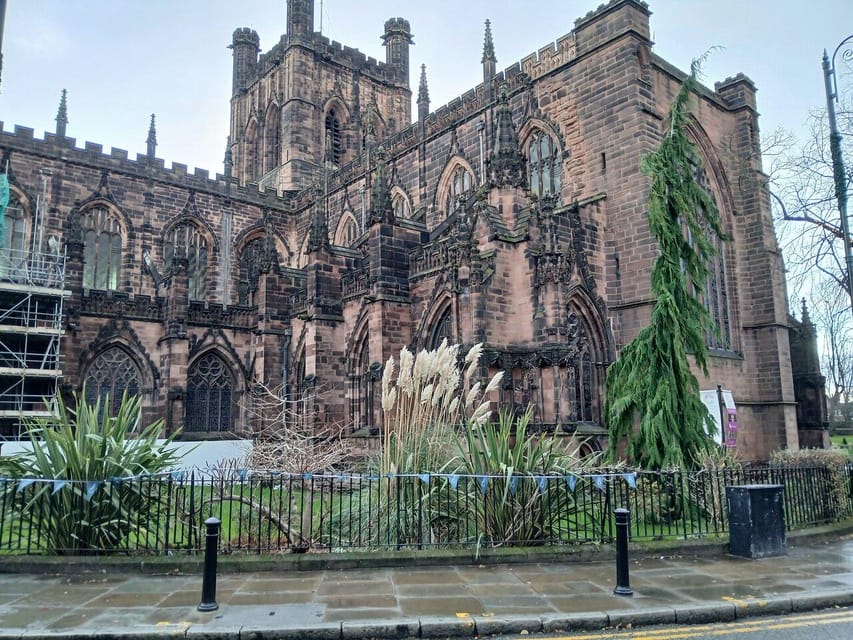
Chester Cathedral receives one of the longer early stops, about ten minutes. That gives the guide time to explain how a medieval abbey became the cathedral you see today.
The story includes a Norman earl and the wolf associated with the power to make and break laws. It also reaches into the Dissolution of the monasteries, when many religious houses were closed, and the later Victorian changes that gave parts of Chester a new appearance.
You should expect to view the cathedral from the outside rather than take a formal interior visit. Admission to historic buildings is not part of the tour, so anyone hoping to explore the cathedral inside will need to plan that separately.
Even from outdoors, the cathedral makes a strong anchor for the walk. It shows how Chester’s religious and political importance changed across the centuries. The guide’s job here is not simply to point at stonework, but to explain why this building survived while so much else changed.
The stop also suits people who like layered stories. You hear about medieval religious life, powerful landowners, ordinary residents, and later restoration in one location. That broad time span is a recurring strength of the tour.
Saint Werburgh Street, Godstall Lane, and Chester Cross
After the cathedral, you turn into Saint Werburgh Street for a short, three-minute explanation. The street helps connect the cathedral precinct with the commercial center around Chester Cross.
Next comes Godstall Lane, another brief stop. This is the sort of narrow route that is easy to miss if you are exploring without a guide. Past participants have particularly valued the back lanes and lesser-seen corners, and this part of the walk explains why a local escort adds value even in a small city.
Godstall Lane is not presented as a single grand monument. Its appeal is in the close-up view of Chester, where the scale shifts from cathedral and civic buildings to lanes, shopfronts, and older domestic structures.
At Chester Cross, the tour pauses again. This central point helps you understand how the main streets meet and why the city center developed as it did. It is also a useful place to orient yourself for later independent exploring.
The guide may tell stories involving everyday medieval life, local customs, and the odd strange character, including the famous talking goose from Chester’s colorful store of local tales. The humor matters here. It keeps a long sequence of dates and rulers from becoming a school lesson.
A few more trips worth a look before you book
- Chester: Chester Zoo Entry Ticket
★ 4.5 · 967 reviews - Admission Ticket to Sick To Death in Chester
★ 4.5 · 384 reviews - Chester: City Sightseeing Hop-On Hop-Off Bus Tour
★ 4.6 · 274 reviews - Chester: Half-Hour City Cruise
★ 4.6 · 231 reviews
The Chester Rows on Watergate Street
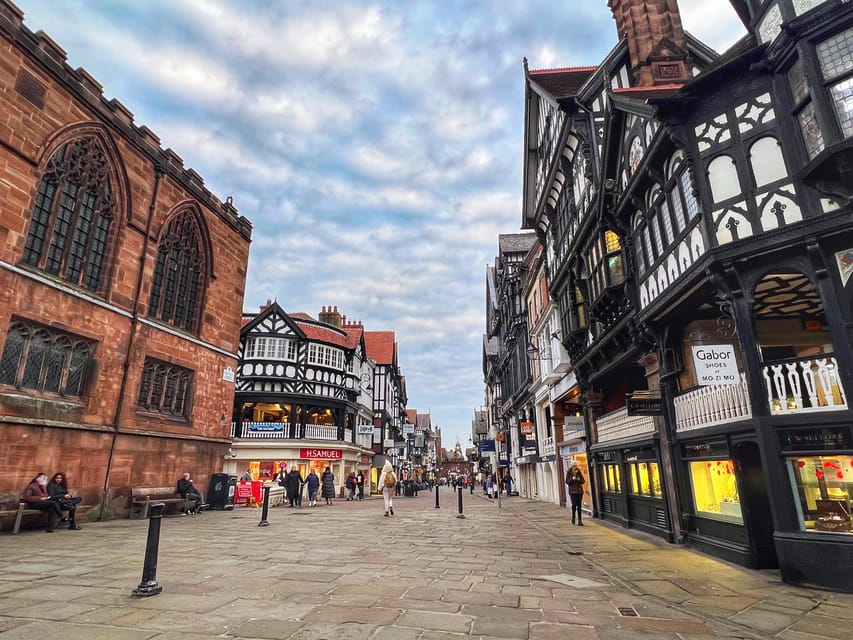
Watergate Street receives about eight minutes, making it one of the most substantial stops on the route. This is where you get a close look at Chester’s famous Rows.
The Rows are unusual two-level galleries lined with shops and businesses. Their upper walkways give the streets a second layer, while the buildings themselves preserve traces of medieval and later commercial life.
You will probably want photos here, but try to do more than photograph the timber frames. Look at how the upper level connects the buildings and how modern businesses occupy historic spaces. The guide can explain how these structures relate to the city’s growth and changing fortunes.
Watergate Street also gives you a clear sense of Chester’s present-day character. It is not a museum street sealed off from daily life. Shops, restaurants, and bars continue to use these old buildings, so the past and present sit side by side.
The stop lasts long enough to make the Rows understandable, but not long enough for a detailed interior tour. If you want to browse shops or inspect individual buildings, save that for after the walk.
Booth Mansion and Bridge Street’s Grander Face
Booth Mansion is the next featured stop, with about five minutes of guided explanation. This is where the tour shifts toward the homes of wealthier residents and the townhouses built to display status.
The contrast with the earlier lanes and medieval houses is useful. Chester’s streets were not shaped only by kings, soldiers, and churchmen. They also reflect merchants, landed families, and the people who could afford impressive homes in town.
At Booth Mansion, you can expect architectural detail to carry much of the story. The point is not just that the building looks grand, but what that grandeur tells you about wealth and social position in historic Chester.
Bridge Street follows, with another five-minute stop. Here, the Rows and commercial architecture continue to show how the city’s old center worked as a place for trade and movement.
This section is good for people who prefer social history to a list of battles. You hear about how ordinary people lived alongside the more powerful residents, and how medieval houses, townhouses, and mansions occupied the same compact city.
Eastgate Street and the Chester Grosvenor
The route continues along Eastgate Street for around six minutes. This is another chance to see Chester’s layered streetscape, where old buildings now support modern shopping and dining.
The Chester Grosvenor receives a short three-minute stop. Its presence adds another look at Chester’s polished, high-status side, alongside the cathedral, civic buildings, and private mansions already seen.
You should not expect an interior hotel visit or a long architectural lecture at this point. The stop works as part of the wider pattern: Chester’s historic center continues to serve modern purposes.
That connection is one of the most useful things about the walk. You are not being shown ruins in isolation. You are being shown a working city, where historic buildings have been adapted for new uses.
The City Walls and Eastgate Clock
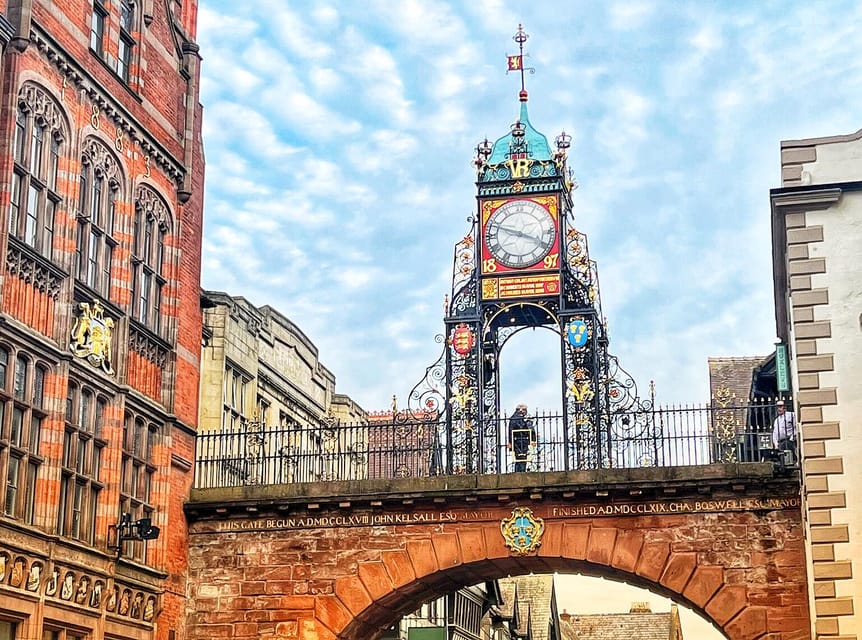
The Eastgate Clock is the visual high point for many people. The tour allows about five minutes here, with time to take photographs and hear how this famous landmark fits into Chester’s story.
The clock sits on the Eastgate, one of the city’s best-known viewpoints. From here, the guide can explain the walls, which began as defensive works and later became a promenade.
That change in purpose tells you a great deal about Chester. Walls that once kept enemies out eventually became a place for walking, sightseeing, and enjoying the city. The same stonework serves a different public life.
The route includes time on the city walls, but this is still a walking tour rather than a full wall circuit. Do not expect to cover every section. Instead, you get a well-placed taste of the walls and a strong view of the Eastgate Clock.
The clock is one of the tour’s best photo opportunities, so have your camera ready. You may also want a moment to look beyond the landmark and notice how the old defensive line meets the current city center.
The Guides Make the Difference
The strongest part of this experience is the human delivery. Phil is repeatedly praised for his enthusiasm, humor, clear explanations, and ability to answer questions. Caroline receives similar praise for being friendly, well informed, engaging, and helpful with local recommendations.
That matters because Chester has a lot of information packed into a small area. A guide who simply recites dates could make the walk tiring. Here, the emphasis appears to be on linking periods together and adding the extra details that help you remember what you saw.
One participant noted that the guide connected Chester’s history from pre-Roman times through to the present. Another appreciated the practical suggestions for places to eat, drink, and explore after the walk. Those local tips can be especially useful if you have only one day in Chester.
The small-group format also helps. It is easier to hear and see everything, especially in narrow streets and around busy public places. One minor caution is worth noting: a past participant wished the guide had spoken a little louder. If the group is spread out or street noise rises, move nearer to the guide.
Price, Pace, and Practical Limits
At $16 per person, the tour offers good value if you want a clear introduction to Chester rather than a simple stroll. You are paying for 90 minutes of guided context, a planned route, and access to local stories that would be difficult to assemble alone.
The value is strongest for a first visit, a short city break, or a day trip. If you already know Chester well, you may prefer a specialist visit to one building or a self-guided walk focused on a single period.
Wear comfortable shoes. The tour runs in all weather, so dress for rain, wind, or bright sun rather than trusting the forecast alone. There are some stairs, and the experience is not suitable for wheelchair users or people with mobility impairments.
The itinerary can change. That is normal for a city-center walk, where crowds, events, weather, and access can affect the route. You should also remember that historic building admission is not included. The tour shows you the exterior highlights, then leaves you free to choose which interiors deserve your time and money.
Free cancellation is available up to 24 hours before the start, and you can reserve now and pay later. The tour is in English with a live guide.
Who Should Take This Chester Walk?
I would recommend it most strongly to first-time visitors, day trippers, couples, families with older children, and anyone who wants history delivered in plain language. It is also a smart first activity for a longer stay because it gives you a map in your head.
You will get the most from it if you enjoy architecture, local stories, city history, and photographs. It suits people who like a steady pace with regular stops rather than a long lecture in one place.
I would be more cautious if you need step-free access, dislike outdoor activities in poor weather, or want to go inside every major building. This is an exterior-focused orientation walk. Its strength is range, not detailed access to individual sites.
Final Verdict: Is It Worth Booking?
Yes, for most first-time visitors to Chester. The route fits a lot into 90 minutes without trying to cover the whole city, and the cost is modest for a small-group walk led by a local guide.
Book it if you want to understand the city before exploring on your own, especially if you have only one day. Phil and Caroline’s friendly, story-led style appears to be the main reason the tour works so well.
Skip it only if you already know Chester’s center or need a fully accessible route. Otherwise, bring good shoes, leave room in your schedule for a little independent wandering afterward, and let the walk point you toward the buildings, lanes, shops, and restaurants worth a closer look.
FAQ
Where does the Chester walking tour start?
It starts at the bottom of the steps of the Chester Visitor Information Centre in Town Hall Square.
Where does the tour finish?
The walk finishes at Chester Cathedral.
How long does the tour last?
The tour lasts 90 minutes.
What sights are included?
The route includes Chester Town Hall, Northgate Street, Chester Cathedral, Saint Werburgh Street, Godstall Lane, Chester Cross, Watergate Street, Booth Mansion, Bridge Street, Eastgate Street, the Chester Grosvenor, and Eastgate Clock. It also includes part of Chester’s city walls.
Are historic building admissions included?
No. The tour shows historic buildings from outside, but admission fees are not included.
Is the tour suitable for wheelchair users?
No. The tour is not suitable for wheelchair users or people with mobility impairments. Some stairs are part of the walking route.
Recently added around Chester
- From Chester: North Wales and Caernarfon Castle Tour★ 4.7 · 56 reviews
- The Heart of Chester Walking Tour – Guided Walk★ 5.0 · 83 reviews
- From Chester: Full-Day Guided North Wales Sightseeing Tour★ 4.8 · 114 reviews
- CHESTER: North Wales Adventure – Sightseeing Day Trip Tour★ 4.5 · 137 reviews
- Medieval Walking Tour of Chester★ 5.0 · 155 reviews
- Fun, Flexible Treasure Hunt Around Chester with Cryptic Clues & Hidden Gems★ 5.0 · 162 reviews
- City Sightseeing Chester Hop-On Hop-Off Bus Tour★ 4.5 · 147 reviews
- Chester Food Tour: Unique Food With Drinks & Sightseeing★ 5.0 · 152 reviews
Walking Tours, compared.

Magical London: Harry Potter Guided Walking Tour
Read our review →
Underground Vaults Walking Tour in Edinburgh Old Town
Read our review →

Oxford University Walking Tour With University Alumni Guide
Read our review →
Edinburgh Castle: Guided Walking Tour with Entry Ticket
Read our review →
Edinburgh Castle Guided Walking Tour in English
Read our review →
Tour for Muggles The Ultimate Harry Potter Walking Tour in London
Read our review →
University and City Walking Tour with Alumni Guide
Read our review →Browse the lists this tour appears in