
Reviewed · WALKING TOURS
The Heart of Chester Walking Tour – Guided Walk
Chester hides centuries beneath your feet. This 90-minute walk makes the city’s Roman fortress, medieval streets, cathedral, and famous Rows easier to understand. I especially like the small group limit of 15 and the way the route combines major sights with stories about ordinary people, merchants, soldiers, and local life. The chance to see Roman remains beneath modern buildings is another strong point.
The main drawback is that this is an outdoor overview, not a ticketed tour of Chester’s interiors. You will pass historic buildings and may see Roman remains, but admission is not included. There are also steps, so comfortable shoes and moderate fitness matter.
At $16.65 per person, this is a sensible first activity in Chester. Guides Caroline and Phil receive repeated praise for clear explanations, humor, local knowledge, and a steady pace. The tour is in English, begins at 1:00 pm, and ends near the city centre, making it easy to continue exploring afterward.
In This Review
- Key points to know before you book
- Why this short Chester walk earns its place
- Starting at Northgate Street and Town Hall Square
- Chester Cathedral and the stories behind it
- Watergate Street and Chester’s social divide
- Four streets leading to the Cross
- Eastgate Clock and the city walls
- The Chester Rows and their unusual design
- The Cross and Chester’s public life
- Eastgate Street, Bridge Street, and the city’s romantic side
- The guides, pace, and group size
- Is $16.65 good value?
- Who should book this walk?
- Should you book The Heart of Chester Walking Tour?
- FAQ
- How long is The Heart of Chester Walking Tour?
- Where does the tour start?
- Where does the tour finish?
- What time does the tour start?
- Is admission to Chester Cathedral or other historic buildings included?
- How many people can join the tour?
Key points to know before you book
- Roman Chester is part of the story: Learn how the city functioned as a legionary base and major trading centre.
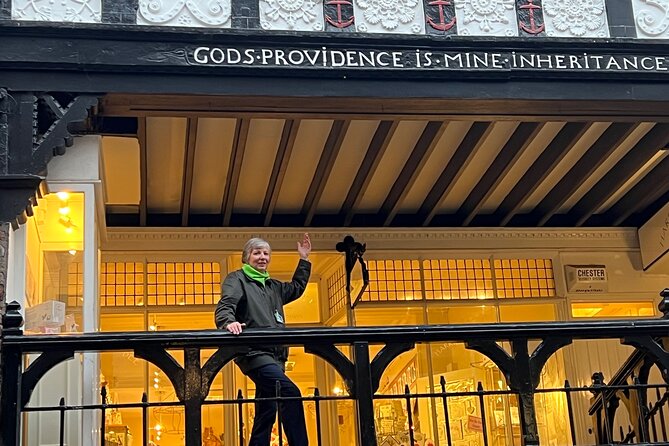
- The Rows are explored from above: Walk through Chester’s unusual medieval galleries and learn how merchants used them.
- The route covers the city centre efficiently: Eight stops fit into roughly 90 minutes, with time for photographs.
- Caroline and Phil are the main strength: Their clear delivery and local insight are praised again and again.
- The group stays intimate: A maximum of 15 people makes it easier to hear and ask questions.
- You finish in a useful location: The walk ends on Bridge Street, close to shops, cafés, bars, and restaurants.
Why this short Chester walk earns its place
Chester can look compact on a map, but its story is layered. Roman military planning, medieval trade, religious change, Georgian and Victorian building work, and modern city life all sit close together. Without context, you might simply admire the black-and-white buildings and move on. With a guide, the streets begin to explain themselves.
I like this tour because it gives you a clear framework without taking half a day. The walk lasts about one hour and 30 minutes, long enough to cover the central sights but short enough to fit around lunch, shopping, or a visit to Chester Cathedral.
The route also helps you get your bearings. You start at Town Hall Square and finish near the Cross, so you will have a useful mental map of the central streets. Afterward, you can return to the places that caught your attention instead of wandering at random.
The 4.9 rating from 83 reviews, along with a 99 percent recommendation rate, reflects the experience’s strongest feature: the guides. Caroline and Phil are praised for making a large sweep of history easy to follow. Caroline is also noted for speaking slowly and clearly, which helps if English is not your first language.
More Walking Tours:
- Fascinating Walking Tours Of Roman Chester With An Authentic Roman Soldier
★ 5.0 · 1,232 reviews - Medieval Walking Tour of Chester
★ 5.0 · 155 reviews - Chester: The Heart of Chester Walking Tour
★ 4.8 · 57 reviews
Starting at Northgate Street and Town Hall Square
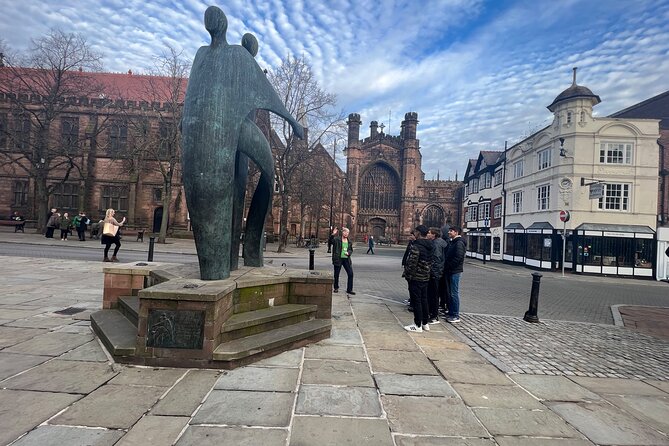
The meeting point is Chester Visitor Information Centre beside the Town Hall on Northgate Street. This is a practical place to begin because Town Hall Square brings several periods of Chester together in one view.
Your guide introduces the Roman fortress, the medieval abbey, and the city’s Gothic-style town hall. That opening sets the pattern for the whole walk. Instead of treating Chester as a collection of attractive façades, you begin to see how the city changed purpose over time.
The first stop lasts about 10 minutes. That may sound brief, but it keeps the opening focused. You get the basic layout and historical setting before moving into the streets.
This is also a good place to arrive a little early. The stated start time is 1:00 pm, and the meeting point is in the city centre near public transportation. The mobile ticket makes entry straightforward, but you still need to locate the guide at the visitor centre.
Chester Cathedral and the stories behind it
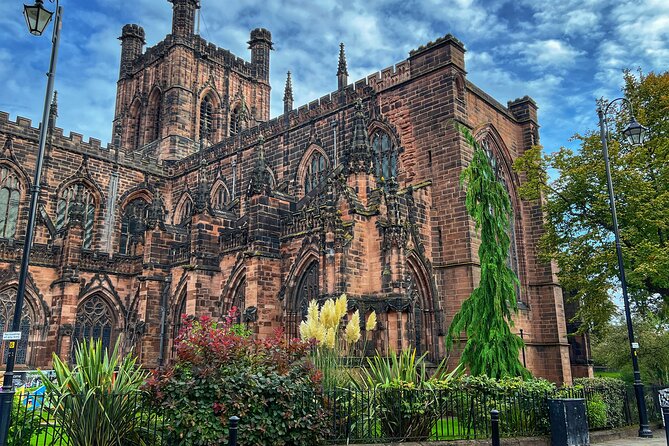
The cathedral stop brings a different kind of history. Here the guide connects the building and surrounding area with a Mercian princess, a talking goose, a Norman earl, and the Wolf with the power to make and break laws.
Those unusual details matter. They prevent the cathedral from becoming a dry list of dates and architectural terms. You hear how legend, politics, religion, and civic power shaped this part of Chester.
The cathedral has also survived major change. Its story includes the Dissolution, when monasteries and religious houses were dismantled, followed by a Victorian facelift. That gives you a useful reminder that old buildings are rarely untouched time capsules. They often carry repairs, alterations, and competing ideas about the past.
The tour does not include admission to the cathedral or other historic interiors. You should treat this stop as an introduction from the outside and surrounding streets. If you want to explore inside, plan that separately and check opening arrangements for your date.
Watergate Street and Chester’s social divide
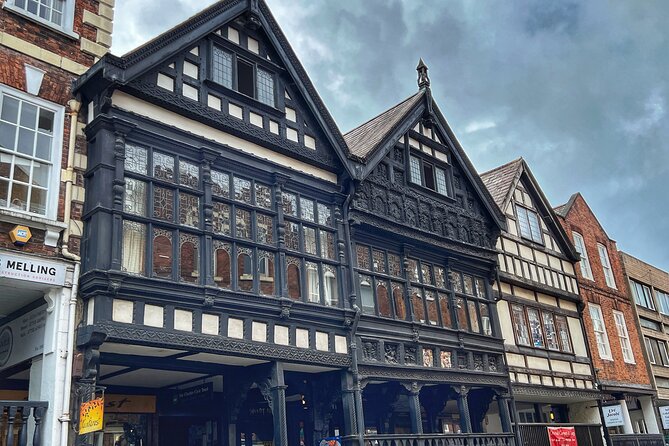
Watergate Street shifts the focus from institutions to housing and daily life. The guide explains the medieval buildings associated with everyday folk, then contrasts them with townhouses and mansions built for the landed gentry.
This is one of the most useful parts of the walk because it gives the buildings a human scale. You are not only looking at timber frames and upper floors. You are considering who lived there, who worked there, and how money changed the appearance of a street.
The 10-minute stop is enough to point out examples and explain the pattern. You may want to take photographs here, but listen before reaching for your phone. The value comes from seeing the relationship between the buildings rather than collecting isolated pictures.
Watergate Street also helps explain why Chester feels visually distinctive. Older domestic and commercial structures remain closely tied to the modern centre, so shopping and dining take place in buildings with much older origins.
A few more trips worth a look before you book
- Chester: Chester Zoo Entry Ticket
★ 4.5 · 967 reviews - Admission Ticket to Sick To Death in Chester
★ 4.5 · 384 reviews - Chester: City Sightseeing Hop-On Hop-Off Bus Tour
★ 4.6 · 274 reviews - Chester: Half-Hour City Cruise
★ 4.6 · 231 reviews
Four streets leading to the Cross
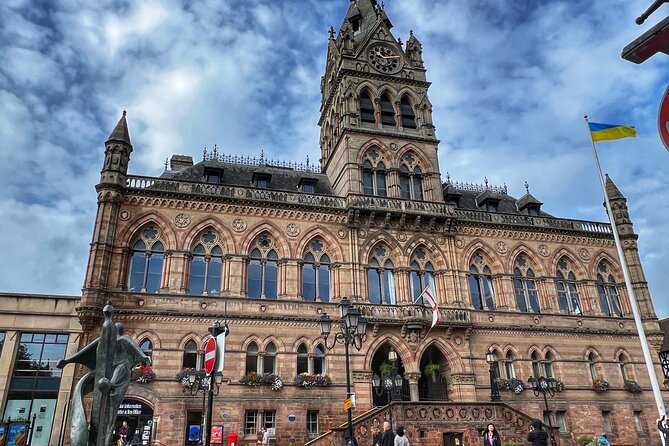
The walk then brings together Chester’s four main streets, which lead toward the Cross. This is the point where the city’s roles become especially clear.
You hear about Chester as a medieval city, a major trading hub, a fortress for a Roman legion, and a base for armies. Those identities overlap in the same central area. A street used for trade could also be part of a military settlement, and a medieval market area could later serve a modern city.
I appreciate this broad view because it stops the tour from becoming a parade of individual buildings. The guide explains how the streets worked as part of a city system. That makes it easier to understand why the centre developed in its particular shape.
This section also gives you a chance to notice modern Chester. Shops, cafés, restaurants, and bars occupy spaces shaped by much older needs. The tour connects past and present without pretending the city is only a museum.
Eastgate Clock and the city walls
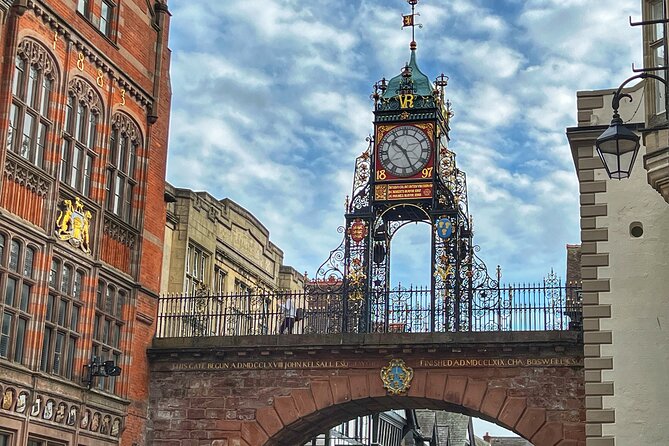
Eastgate and its famous clock are among Chester’s most recognizable sights. The clock sits above the old Eastgate area and is one of the city’s classic photo stops.
The guide also takes you onto the city walls. These walls began as defence, designed to keep enemies out. Later, they became a grand promenade. That change says a lot about Chester’s changing fortunes. A structure built for danger eventually became a place for walking and viewing the city.
You should expect steps on the tour. The walls are not a flat street-level path, so this is important if stairs are difficult for you. The stated physical requirement is moderate fitness, and comfortable footwear will make the hour and a half more pleasant.
This part of the route is especially useful for orientation. From the walls, you get a better sense of the compact centre and the way the main streets relate to one another. Allow yourself a moment for photographs, but keep the group moving at the guide’s pace.
The Chester Rows and their unusual design
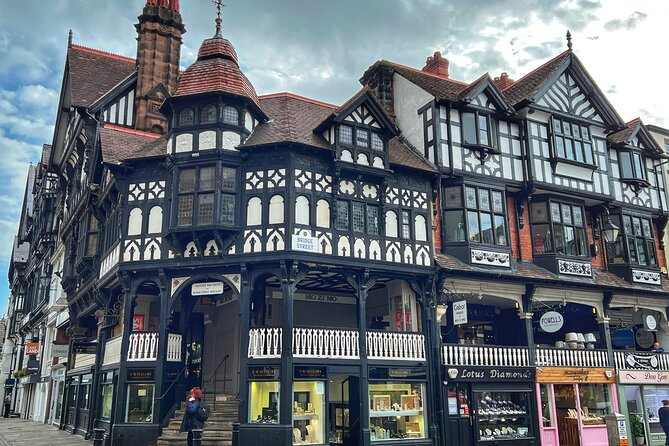
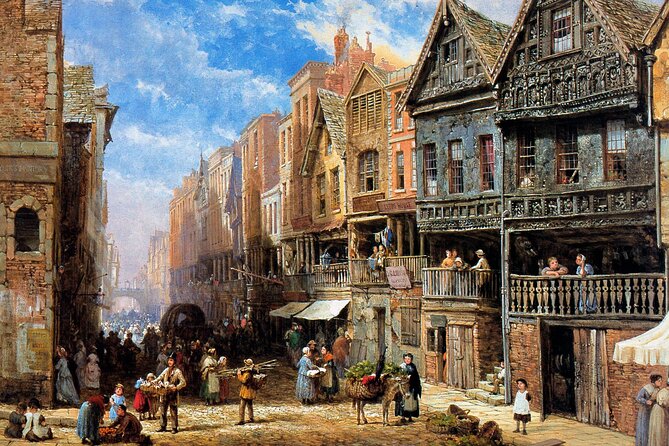
The Rows are probably the tour’s most distinctive architectural feature. These raised galleries run through parts of the historic centre and are closely linked with Chester’s identity.
The guide explains how the Rows worked and how merchants used the spaces. You are not simply looking up at old façades. You are walking through an arrangement shaped by trade, access, and limited urban space.
Several people praise this section because it makes the Rows easier to understand. Without an explanation, the upper-level walkways can seem attractive but puzzling. Once you hear how they relate to shops and medieval houses, their design becomes more practical.
There is also a chance to see evidence of Chester’s Roman past below modern life. Roman ruins and undercrofts appear in places where you might otherwise expect a café or shop. That contrast is one of the strongest moments of the tour: you can be standing in a present-day commercial space while traces of an older city remain below.
The Rows are also a good place for pictures, though steps and uneven movement may require care. If you want more time to inspect details, note the locations during the walk and return later at your own pace.
The Cross and Chester’s public life
The Chester Cross is the meeting point of the main streets and a natural place to discuss public life. Here the guide covers medieval markets, colorful cock-and-bull stories, the Roman headquarters, and the buskers who entertain people today.
This stop shows how the city’s central gathering place has changed while keeping its basic role. Markets, official business, storytelling, and street performance all belong to the life of a busy crossroads.
The Cross is also a useful pause in the route. After several historical periods and architectural details, you get a strong sense of how the centre functions now. The setting is not preserved in silence. It remains part of everyday Chester.
If you prefer quiet sightseeing, this may feel busier than the cathedral or city walls. That is part of its appeal, but it can also make listening harder if the surrounding streets are active. The group size of no more than 15 helps, though you should stay close to the guide.
Eastgate Street, Bridge Street, and the city’s romantic side
The final section follows Eastgate Street and Bridge Street, described on the tour as the heart of Chester’s romantic character. The route ends at 2 Bridge Street, close to the centre’s shops, bars, and restaurants.
This is a pleasant way to finish because you remain in a useful part of town. You can continue with a meal, revisit the Rows, explore the cathedral, or simply walk the streets again with your new sense of place.
The phrase City of Love is part of the tour’s storytelling, but the stronger point is the way these streets connect architecture and human lives. The guide brings together stories of adversity, adventure, and love, giving the final section a warmer tone after the military and political material earlier in the walk.
The endpoint is not at the original meeting place, so make a note of that if you have a timed booking afterward. The walk ends in the city centre, not at a distant attraction or transport stop.
The guides, pace, and group size
The strongest feedback focuses on Caroline and Phil. Both are praised for their command of Chester’s past, but also for how they present it. Their style is described as clear, friendly, humorous, and easy to follow.
Caroline receives specific praise for a measured pace and slow, understandable speech. That can make a real difference on a history walk, particularly if English is not your first language. Phil is praised for answering questions and for making the long story of Chester interesting rather than heavy.
A maximum of 15 people is another practical advantage. You are less likely to be lost in a crowd, and there is a better chance to hear explanations at street corners. It also makes it easier to ask a question without holding up a large group.
The pace is designed for a range of visitors, but this remains a walking tour. You will cover central streets, climb steps, and spend most of the time outside. Wear shoes suited to pavement and stairs, and consider the weather before booking.
Is $16.65 good value?
At $16.65, the tour is priced as an affordable introduction rather than a full-day historical program. The guide’s fee gives you 90 minutes of structure, local interpretation, and access to viewpoints you might otherwise pass without understanding.
The value is strongest if this is your first visit to Chester. You get the central layout, the main historical themes, the Rows, the clock, the walls, the cathedral area, and a look at Roman remains. That would take more effort to assemble on your own.
The price is less compelling if you want long visits inside buildings or detailed specialist study of one period. Admission is not included, and the route moves on after roughly 10 minutes at each stop. You are paying for a guided overview, not extended time at each site.
I would book it early if your schedule is fixed. It is booked an average of 23 days ahead, suggesting that planning ahead is sensible, especially for a small group with limited places.
Who should book this walk?
I would recommend it to first-time visitors, couples, solo sightseers, families with older children, and anyone who wants a quick historical orientation before exploring independently. It is also useful if you live nearby but have never connected Chester’s buildings and streets into one story.
The tour suits you if you enjoy hearing why a place looks the way it does. It is less suitable if you dislike outdoor walking, need step-free access, or want admission to historic interiors included in the price.
The English-language format is clear and measured. Caroline’s slow delivery is especially helpful for people who are not fluent English speakers, though the regular tour is offered only in English. Private tours in other languages can be requested, according to the provider’s information.
You can cancel for a full refund up to 24 hours before the 1:00 pm start time. Cancellations or changes made within 24 hours are not refunded or accepted.
Should you book The Heart of Chester Walking Tour?
Yes, if you want an affordable, well-paced introduction to central Chester. The guide is the real reason to choose it. Caroline and Phil turn Roman military remains, medieval trade, cathedral politics, city walls, and modern street life into a connected story.
Book it early in your Chester visit, then use the remaining day to return to the places that interest you most. Skip it only if you need a fully accessible route, a private language option, or extended indoor visits. For most people who want to understand Chester rather than only photograph it, this 90-minute walk is a strong value.
FAQ
How long is The Heart of Chester Walking Tour?
The guided walk lasts approximately one hour and 30 minutes.
Where does the tour start?
It starts at the Chester Visitor Information Centre beside the Town Hall on Northgate Street, Chester CH1 2HJ.
Where does the tour finish?
The tour ends at 2 Bridge Street, Chester CH1 1NP, in the heart of the city centre.
What time does the tour start?
The stated start time is 1:00 pm.
Is admission to Chester Cathedral or other historic buildings included?
No. The experience is a guided walking tour, and admission to historic buildings is not included.
How many people can join the tour?
The group has a maximum of 15 travelers.
Recently added around Chester
- From Chester: North Wales and Caernarfon Castle Tour★ 4.7 · 56 reviews
- Chester: The Heart of Chester Walking Tour★ 4.8 · 57 reviews
- From Chester: Full-Day Guided North Wales Sightseeing Tour★ 4.8 · 114 reviews
- CHESTER: North Wales Adventure – Sightseeing Day Trip Tour★ 4.5 · 137 reviews
- Medieval Walking Tour of Chester★ 5.0 · 155 reviews
- Fun, Flexible Treasure Hunt Around Chester with Cryptic Clues & Hidden Gems★ 5.0 · 162 reviews
- Chester: Half-Hour City Cruise★ 4.6 · 231 reviews
- City Sightseeing Chester Hop-On Hop-Off Bus Tour★ 4.5 · 147 reviews
Walking Tours, compared.

Magical London: Harry Potter Guided Walking Tour
Read our review →
Underground Vaults Walking Tour in Edinburgh Old Town
Read our review →

Oxford University Walking Tour With University Alumni Guide
Read our review →
Edinburgh Castle: Guided Walking Tour with Entry Ticket
Read our review →
Edinburgh Castle Guided Walking Tour in English
Read our review →
Tour for Muggles The Ultimate Harry Potter Walking Tour in London
Read our review →
University and City Walking Tour with Alumni Guide
Read our review →Browse the lists this tour appears in