
Reviewed · HISTORICAL TOURS
St Andrews Old Course History Tour, for the Golfer
Golf legends begin on ordinary ground. This walking tour makes the Old Course easier to understand, even if your golf knowledge is limited. I especially like the chance to walk across part of the Old Course and the stories from Richard, a retired Old Course caddie who knows the course from the inside. At $25, the price is modest for a 75-minute introduction to one of golf’s most famous places.
I also like that this is a small shared tour, capped at 15 people, so you are not part of a giant crowd. The main drawback is the guide’s quick delivery. Richard’s energy and humor win many people over, but several guests found him hard to follow, especially near the start. A very good command of English is essential.
In This Review
- Key points before you book
- Starting at Hotel du Vin on The Scores
- The Links and the early game of golf
- The Royal and Ancient Golf Club, Old Tom, and the caddie shack
- Grannie Clark’s Wynd and the road to 18 holes
- The 1st and 18th fairways at Rusacks St Andrews
- Swilcan Bridge and the included photographs
- The Road Hole and the Jigger Inn
- How much golf do you really see?
- The guide’s style and the small-group setting
- Value at $25 per person
- Who should book this Old Course walk?
- Weather, timing, and what to bring
- Should you book the St Andrews Old Course History Tour?
- FAQ
- How long does the St Andrews Old Course History Tour last?
- How much does the tour cost?
- Where does the tour begin?
- Where does the tour finish?
- Are photographs at Swilcan Bridge included?
- Is the tour suitable for non-golfers?
- Is the tour offered in languages other than English?
- Can children and people with limited mobility join?
Key points before you book
- Richard’s caddie experience: The guide’s personal work around the Old Course adds practical stories to the dates and facts.
- A rare course-side walk: You can walk across the fairway around the 1st and 18th holes when play allows, rather than viewing the course only from the pavement.
- Swilcan Bridge photos included: Professionally taken photographs are included, except on tournament days such as the Open or Dunhill events.
- Golf history in a compact tour: In about 75 minutes, you cover the origins of golf, Old Tom Morris, course changes, famous moments, and the Road Hole.
- A good choice for mixed groups: Golfers get course detail, while non-golfers get local history, stories, scenery, and a manageable walk.
- Plan for Scottish weather: The route is outdoors, and a sunny start can turn cold quickly. Bring a waterproof layer and dress warmly.
Starting at Hotel du Vin on The Scores

Your tour begins outside Hotel du Vin St Andrews at 40 The Scores. Arrive early. This is a public tour, and the guide will not wait for late arrivals.
The opening five minutes provide a quick introduction to St Andrews itself, including the town’s early story and the 1123 Links charter. That detail matters because the Old Course is not an isolated sports attraction. It grew alongside the town, its links, its institutions, and the people who used the ground long before golf became an international game.
The first stop is brief, but it helps you place the Old Course in context. You are not simply heading to a famous fairway. You are following the development of a town and a stretch of common coastal ground that gradually became central to golf.
More History Tours:
- London Small Group Tour of Historical Pubs
★ 5.0 · 10,422 reviews - A History of Terror – Belfast City Centre Walking Tour
★ 5.0 · 2,883 reviews - Old Town Walking Tour History and Tales in Edinburgh
★ 5.0 · 2,168 reviews
The Links and the early game of golf
At The Links, the guide turns to golf’s early development. You hear about stick-and-ball games in the Low Countries during the 13th century, golf in Edinburgh by 1744, and the reasons St Andrews earned its title as the Home of Golf.
This part suits history buffs as much as committed golfers. You do not need to know the difference between a mashie and a mashie niblick to follow the story. The useful point is how the game changed as players, clubs, rules, and courses developed.
Richard’s storytelling is a major part of the experience here. He has a lively style, a strong sense of humor, and years of local experience. His best moments connect broad golf history with specific corners of St Andrews, making the past feel close rather than abstract.
The trade-off is pace. Richard can speak rapidly and sometimes continues with his planned story instead of pausing for questions. If English is not comfortable for you, this tour may be difficult. The operator specifically says that slow speech or translation is not enough, so take that warning seriously before booking.
The Royal and Ancient Golf Club, Old Tom, and the caddie shack
The next 15 minutes focus on the Royal and Ancient Golf Club of St Andrews and the way the Old Course helped shape modern golf. This is where the tour begins to explain why the course looks and plays as it does.
You learn about the development of fairways and bunkers, notable golfing moments, Old Tom Morris, and the old caddie shack. These details give meaning to features that can otherwise seem like simple parts of a course.
Old Tom Morris is especially important to the story. His work helped shape the Old Course and the wider development of golf course design. The tour does not treat him as just a name on a plaque. Instead, you get a sense of how practical changes to the course affected the way the game was played.
The Royal and Ancient Golf Club is also a useful visual reference point. Even if you are not studying the building itself, its presence helps explain the close relationship between golf’s governing traditions and this particular course.
Grannie Clark’s Wynd and the road to 18 holes
Grannie Clark’s Wynd brings the tour into one of the Old Course’s most interesting chapters. Here you hear about The Open Championship, the Dunhill Cup, and the course’s change from 12 holes to 10 and then to 18.
That sequence is worth paying attention to. The Old Course was not created in one finished design. It changed over time as the game expanded and players needed a different kind of course. The familiar 18-hole round was part of a long process, not an original feature waiting unchanged for modern golfers.
This stop also helps you understand the importance of the sites around the 18th hole. The course is famous for its tournament drama, but the drama makes more sense when you know how the layout developed and why certain holes became so demanding.
For a golfer, this is the point where the tour can add new meaning to televised moments. For a non-golfer, it offers a clear example of how sport, land use, and tradition can shape a town over centuries.
A few more trips worth a look before you book
- St Andrews Must-Sees Daily Walking Tour (11am & 2pm)
★ 5.0 · 478 reviews - St Andrews: Golf Origins and Old Course History Tour
★ 4.7 · 322 reviews - St Andrews: Top Sights Guided Walking Tour
★ 4.7 · 223 reviews - St Andrews: Town, Golf, and Old Course History Tour
★ 4.7 · 162 reviews
The 1st and 18th fairways at Rusacks St Andrews
Near Rusacks St Andrews, the route reaches the 1st and 18th fairways. You hear about the farmers who once used the land, the Rusacks hotel, the Mannings, the original 1st tee, and the 18th hole.
This is one of the most memorable sections because you are seeing the area where rounds begin and end. The 1st tee and 18th hole sit close together, creating the unusual spectacle of golfers setting off while others finish nearby.
The tour also explains how early caddies and ladies led Old Tom Morris to create what is described as the world’s first putting green. That story gives the course a human scale. Golf was not shaped only by famous champions and club officials. Everyday needs, local habits, and the people around the course mattered too.
The route is not a long hike. It is a steady stroll with frequent stops, and the overall pace is comfortable for people with moderate physical fitness. Still, you should expect to be on your feet outdoors for the full hour and 15 minutes.
Swilcan Bridge and the included photographs
Swilcan Bridge is the emotional high point for many people, including those who know little about golf. The small stone bridge is one of the game’s most photographed landmarks, and the tour gives you time for a photo session there.
Professionally taken photos are included, which adds real value to the $25 price. You are not left trying to frame a rushed phone picture while the group moves on. The guide has also shared additional images with groups, and one of the most appreciated touches has been taking photos for everyone.
The bridge sits between the 1st and 18th fairways, so the setting carries more meaning after the earlier explanations. You can watch golfers begin a round and finish one in the same general area. That visual link between departure and arrival is part of what makes the Old Course feel different from a standard golf resort.
Access can change on tournament days. The included bridge photo opportunity excludes events such as The Open and the Dunhill Cup. Course access also depends on play and instructions from course marshals. You must not interrupt golfers, and the route may be adjusted when events are taking place.
The Road Hole and the Jigger Inn
The final part of the walk takes you toward the Road Hole, the 17th green of the Old Course. This is where the guide discusses dramatic moments connected with one of golf’s most famous holes.
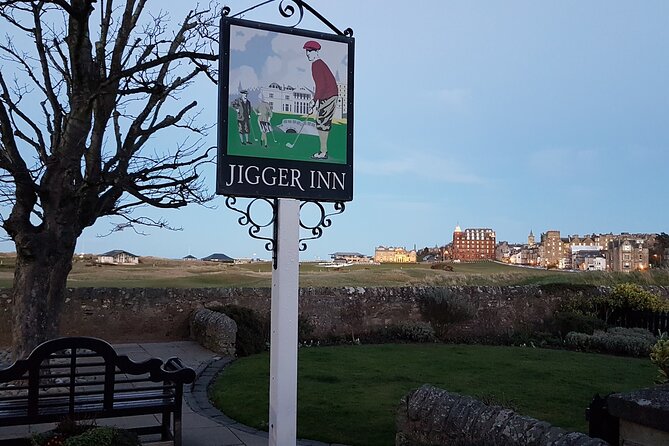
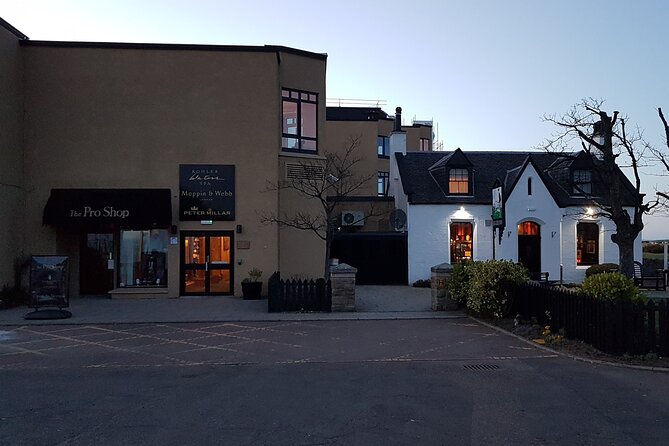
The tour finishes near the Old Course Jigger Inn, beside the 17th fairway. Food and drinks are not included, but the location gives you a pleasant option after the walk. One guide helped a group find memorable fish and chips there, and it is an easy place to continue the afternoon with a drink or meal.
Pay attention to the meeting and finishing details. You start at Hotel du Vin on The Scores and finish near the Jigger Inn, rather than returning to the starting point. The supplied information also identifies Swilcan Bridge as an end point, but the practical finish is described as the Road Hole area near the Jigger Inn. Plan your onward route from there.
How much golf do you really see?
This is a history walk with access to parts of the Old Course, not a round of golf and not a guaranteed full-course tour. You see the 1st and 18th areas, walk across the fairway when conditions permit, visit Swilcan Bridge, and finish near the 17th.
That distinction is important. If you expect to play the Old Course, this tour will not replace a tee time. If you want to understand the layout, hear stories, take photographs, and experience the ground beneath your feet, it offers a much easier and less expensive route into St Andrews golf.
Public access is possible in places as long as you do not interrupt play, but the guide adds structure and context. You learn where to look and why a particular patch of ground matters. That is the real benefit.
The guide’s style and the small-group setting
Richard receives the strongest praise for his humor, local background, and ability to tell stories. His experience as a retired caddie gives the tour a practical voice. He can explain the course not just as a map, but as a place connected to working caddies, famous rounds, changing traditions, and local life.
The small group, with a maximum of 15 people, helps. You can usually stay close enough to hear and see the guide, and the route includes regular stops. One group was given earbuds so everyone could hear clearly, though you should not assume that equipment is guaranteed every time.
There is a clear limitation. Richard’s delivery can be fast, and he sometimes follows his own sequence rather than stopping for many questions. One person found the material interesting but felt it could have been delivered in half the time. If you prefer a quiet, flexible walk with long pauses for conversation, this may not be your ideal format.
The overall rating is 4.7 from 150 reviews, with 91 percent recommending it. That fits the pattern of the experience: strong on personality, stories, and golf context, but less suitable for anyone who needs slow speech or extensive back-and-forth discussion.
Value at $25 per person
At $25, this is good value if the Old Course is a major reason for your visit. A private guide would cost more, while wandering around alone gives you little of the course’s background. The included professional photographs improve the value, especially for a golfer treating St Andrews as a special trip.
The tour is also efficient. In about 75 minutes, you cover the town’s early links history, the origins of golf, course design, Old Tom Morris, famous events, the 1st and 18th, Swilcan Bridge, and the Road Hole. You can then spend more time around St Andrews on your own.
I would not book it solely for the promise of walking freely over the course. Play, tournaments, weather, and course instructions affect access. Book it for the combination of guided history, local stories, course views, and a well-timed visit to famous landmarks.
Who should book this Old Course walk?
This tour works especially well for:
- Golfers making a first visit to St Andrews: You get the basic structure and history before trying to watch play or explore independently.
- Mixed groups: A non-golfer can follow the town history, stories, and scenery without needing technical golf knowledge.
- History fans: The links charter, early golf, course changes, and local characters provide plenty beyond tournament trivia.
- Photographers and families with older children: Swilcan Bridge offers a clear photo moment, though the tour is not suitable for children under five.
You should think twice if you need a stroller, wheelchair-style mobility scooter, crutches, or a walking frame. There is nowhere to leave those items, and the route is not suitable for them. The tour also is not recommended for people with new knee or hip replacements, sprained ankles, or similar injuries.
Service animals are allowed, and the starting point is near public transportation. The experience requires moderate physical fitness, and all participants need a fluent command of English.
Weather, timing, and what to bring
This is an outdoor walk in St Andrews, so weather can change the feel of the experience quickly. One group began in fair conditions and ended up feeling the cold when the weather shifted. Wear warm layers and a waterproof jacket, even if the forecast looks kind.
Arrive before the stated start time at Hotel du Vin. Since this is a shared public tour, late arrivals may miss the group entirely. Comfortable shoes are sensible, and leave golf clubs and bulky mobility equipment elsewhere because there is no storage during the walk.
The tour is offered in English only. That is more than a minor booking note because much of the value comes from fast-moving stories and historical connections. If you need translation, this particular experience is unlikely to work well.
Should you book the St Andrews Old Course History Tour?
Book it if you want a reasonably priced, story-filled introduction to the Old Course, especially if you are traveling with someone who does not play golf. Richard’s caddie background, the Swilcan Bridge photos, and the chance to walk near the 1st, 18th, and 17th make this more useful than a simple photo stop.
Skip it if you need a slow-paced guide, guaranteed course access during an event, or a tour built around extended questions. For most first-time visitors with good English and moderate mobility, it is a smart way to give St Andrews context before exploring the town and course area on your own.
Free cancellation is available up to 24 hours before the start time. If poor weather or too few bookings force a cancellation, you are offered another date or a full refund.
FAQ
How long does the St Andrews Old Course History Tour last?
The tour lasts approximately 1 hour and 15 minutes.
How much does the tour cost?
The price is $25 per person.
Where does the tour begin?
It begins outside Hotel du Vin St Andrews, at 40 The Scores, St Andrews, KY16 9AS.
Where does the tour finish?
The practical finish is near the Road Hole, the 17th green, beside the Old Course Jigger Inn. Food and drinks at the Jigger Inn are not included.
Are photographs at Swilcan Bridge included?
Yes. Professionally taken photos at Swilcan Bridge are included, except on tournament days such as The Open and Dunhill events.
Is the tour suitable for non-golfers?
Yes. The tour includes the history of St Andrews and the development of golf, so people who do not play can still follow the stories and enjoy the setting.
Is the tour offered in languages other than English?
No. It is offered in English, and all participants need a fluent command of English.
Can children and people with limited mobility join?
Children under five are not suitable for the tour. It is also not suitable for strollers, crutches, walking frames, mobility scooters, or people with new knee or hip replacements, sprained ankles, or similar injuries.
Recently added around the UK
- Cairngorms & Whisky Day Tour from Inverness Including Admission★ 5.0 · 55 reviews
- PRIVATE HIRE 45 min Speedboat Tour – Embankment/Westminster Pier★ 5.0 · 55 reviews
- From Edinburgh: Islay and The Whisky Coast 4-Day Tour★ 4.9 · 55 reviews
- Fantastic Creatures of Edinburgh, and where to find them!★ 4.5 · 55 reviews
- E-bike excursion exploring the Purbecks★ 5.0 · 55 reviews
- ‘A Wee Pedal’s’ Family Friendly Cycle Tour to Edinburgh’s Coast★ 5.0 · 55 reviews
- Private Tour of London’s Historic Pubs★ 5.0 · 55 reviews
- From London: Glastonbury and Cheddar Gorge Guided Day Trip★ 4.8 · 55 reviews
Historical Tours, compared.
A History of Terror – Belfast City Centre Walking Tour
Read our review →
Old Town Walking Tour History and Tales in Edinburgh
Read our review →
Shadows of York: Ghost Walk and Horrible History.
Read our review →
Multi-Sensory Small-Group Historic Vaults Tour in Edinburgh
Read our review →
Browse the lists this tour appears in