
Reviewed · CANTERBURY TOURS
The Canterbury Classic Tour
Canterbury rewards curious walkers. This 90-minute guided walk links famous landmarks with odd little details, from Chaucer and Thomas Becket to a dove flying into a pope’s ear. I like the very small group, capped at 10, and the guide Sam’s lively way of mixing facts, legends, architecture, and local stories. The main drawback is simple: this is an outdoor walking tour, so cold or changeable weather can affect your comfort.
The $19.44 price is easy to justify if you are new to Canterbury and want useful bearings before exploring on your own. You will not enter most of the buildings, and the stops are brief, usually about five minutes each, so book this for context and storytelling rather than long museum visits or an in-depth cathedral tour.
In This Review
- Why this Canterbury walking tour is worth your time
- Starting at The Beaney, Canterbury’s useful town-center launch point
- Chaucer and the man who made Canterbury famous
- Westgate Towers and a medieval city under threat
- Christopher Marlowe near the modern Marlowe Theatre
- Christ Church Gate and a Tudor misunderstanding
- Roman Canterbury, found again after wartime destruction
- Thomas Becket, the city’s defining medieval figure
- Saint George’s Tower and a clock with a past
- What the guide adds to the experience
- Is $19.44 good value for 90 minutes?
- Who will enjoy this walk most?
- Booking timing, group size, and cancellation
- My verdict on the Canterbury Classic Tour
- FAQ
- Where does the Canterbury Classic Tour start?
- Where does the tour end?
- How long does the tour last?
- How much does the tour cost?
- How many people can join the tour?
- Is the tour offered in English?
- Are attraction admission fees included?
- Can service animals join the tour?
- What is the cancellation policy?
Why this Canterbury walking tour is worth your time
- Small groups capped at 10: You can ask questions and hear the guide without fighting through a crowd.
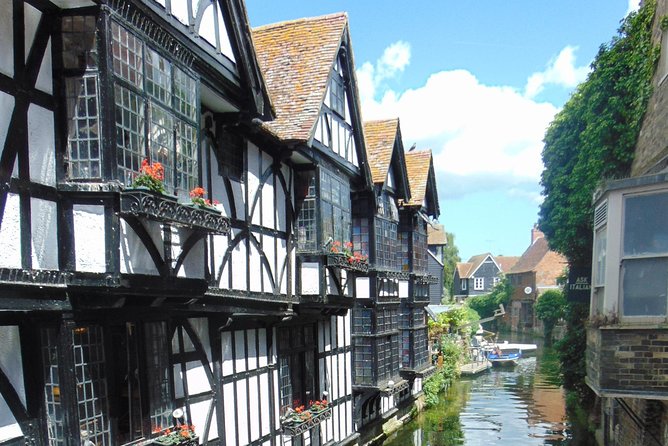
- A compact route through central Canterbury: The walk begins at The Beaney House of Art and Knowledge and ends at Saint George’s Tower.
- History with a quirky edge: Expect stories about a medieval gate, a bull’s head, an unusual clock tower, and a dove linked with Pope Gregory the Great.
- Christopher Marlowe gets his due: The tour adds the playwright’s life as a hard-partying writer and spy to the usual Canterbury story.
- Strong family appeal: Sam has kept children aged 6, 10, 11, and teenagers interested during the walk.
- An affordable first look: At $19.44, it gives you a useful city introduction before you decide where to spend more time.
Starting at The Beaney, Canterbury’s useful town-center launch point
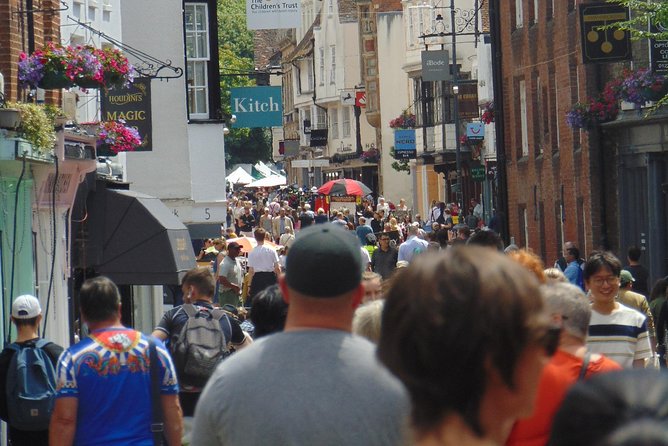
The tour begins outside The Beaney House of Art and Knowledge at 18 High Street. This is a practical meeting point in the city center, with facilities available before the walk begins.
That detail matters. You do not need to hunt for an obscure street corner or arrive in a remote part of town. If you are meeting a guide after arriving by public transport, the central location makes the start fairly straightforward. The tour ends at Saint George’s Tower, so you finish in another central area rather than being carried back to the starting point.
The Beaney itself is part of the opening setting, even though the tour does not appear to include a visit inside. The route uses the city as its classroom. You will look at buildings, street details, statues, gates, and church remains while Sam explains how the pieces fit together.
I especially like this approach for a first visit. A map can show you where Canterbury’s main sights are, but a guide can explain why they matter and point out things you might walk past without noticing.
A few more trips worth a look before you book
- Canterbury: Walking Tour with Green Badge Guide
★ 4.8 · 709 reviews - Official Canterbury Guided Walking Tour – 11.00 Tour
★ 5.0 · 422 reviews - Canterbury Cathedral: Entry Ticket with Audio Guide
★ 4.6 · 266 reviews
Chaucer and the man who made Canterbury famous
The first formal stop is the statue of Geoffrey Chaucer. You get about five minutes here to learn about the author of The Canterbury Tales, the work most closely tied to the city’s medieval image.
This is a smart opening stop. Chaucer’s pilgrims traveled toward Canterbury, and his stories made the journey part of English literary culture. The tour uses the statue to establish a link between the city you see today and the city imagined through medieval storytelling.
Do not expect a long literary lecture. The stop is short, and the strength of the walk comes from the way each brief pause adds another layer. You may leave with a clearer sense of why Canterbury attracts both history fans and people interested in English literature.
Westgate Towers and a medieval city under threat
Next comes Westgate Towers, described as the largest surviving medieval city gate in the United Kingdom. The guide explains how the structure worked in a time when attack and defense shaped city design.
The useful part here is not just the age of the stone. You hear about the methods used to protect the entrance and why the tower was considered innovative in its time. That makes the gate easier to read. Instead of seeing only a grand old gateway, you begin to see a working part of a defended city.
The Westgate Museum and viewpoint are not included in the tour price, so you should treat this as an exterior explanation rather than a museum visit. The walk gives you a reason to return inside if the tower interests you. One particularly memorable local detail is the story of Westgate’s use as a prison, which adds a darker chapter to its role in the city.
The five-minute stop is enough for a strong introduction, but not enough for a full examination of the museum. If you want to climb, inspect displays, or spend time on the viewpoint, plan a separate visit.
Christopher Marlowe near the modern Marlowe Theatre
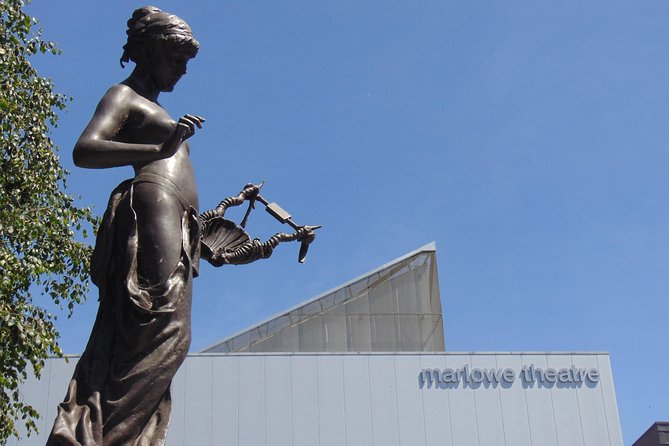
The route then passes the modern Marlowe Theatre. The building provides a sharp contrast with the medieval streets and gives Sam a chance to tell the story of Christopher Marlowe.
Marlowe is presented as more than a playwright. He was also a spy and a man with a hard-partying reputation, which makes for a lively change from the usual parade of kings, bishops, and saints. His connection with Canterbury also shows how the city’s story reaches beyond medieval pilgrimage.
You will hear about the influence of the written word on Canterbury. That thread connects Marlowe with Chaucer, though the two belonged to very different periods. It also helps broaden the tour beyond stones and dates. Canterbury is presented as a place shaped by books, drama, religion, politics, and public memory.
The theatre itself is a pass-by stop, not a performance visit. Admission is not included. Think of it as a short cultural interlude on the walking route.
A different sort of outing around the UK:
- London: The London Eye Entry Ticket
★ 4.6 · 35,875 reviews - From London: Harry Potter Warner Bros Studio Tour
★ 4.7 · 26,588 reviews - London: Westminster to Greenwich River Thames Cruise
★ 4.5 · 22,836 reviews - Magical London: Harry Potter Guided Walking Tour
★ 4.7 · 22,044 reviews
Christ Church Gate and a Tudor misunderstanding
Christ Church Gate brings the tour back to ceremony, religion, and royal history. The gate was completed to commemorate a Tudor prince and his Spanish bride, but the story is not about the prince you may first assume.
That small tease is typical of the walk. Rather than offering a flat list of dates, Sam uses a question or surprise to make you look more closely at the building. You also learn how the gate changed over time, which is important because historic structures are rarely frozen exactly as their original builders intended.
This is another exterior stop, with about five minutes for explanation. You should not expect an extended architectural study, but you will gain a useful framework for understanding Christ Church Gate and its place near Canterbury Cathedral.
The cathedral is an important presence in this part of the city, but the Classic Tour is not a cathedral entry tour. Admission to Christ Church Gate is not included, and the walk does not replace time inside the cathedral precincts.
Roman Canterbury, found again after wartime destruction
Outside the Canterbury Roman Museum, Sam explains the Roman city and how it was rediscovered because of the Second World War. This is one of the most useful historical shifts in the route.
Roman Canterbury can be easy to miss when the cathedral and medieval streets take most of the attention. The story of rediscovery gives you a better sense of how much of the city lies beneath later layers. War damaged parts of Canterbury, but the destruction also exposed remains and helped reveal the Roman past.
The tour stops outside the museum, so admission is not included. If Roman archaeology interests you, you can use the walk as a preview and decide if the museum deserves a longer visit. The guide provides the setting, while the museum can provide the displays and artifacts.
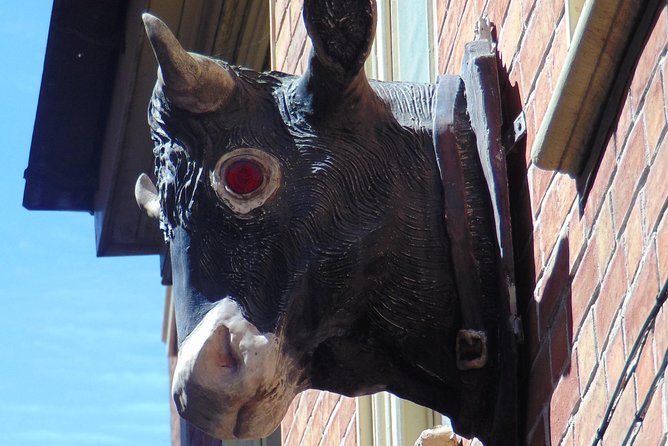
In Butchery Lane, the route gathers several small details in one area: the Bell Harry Tower of the cathedral, Canterbury’s coat of arms, and a bull’s head. This is where the walk’s attention to odd visual clues becomes particularly useful. You are not simply moving from one major monument to the next. You are being trained to look upward, sideways, and into the edges of the street scene.
Thomas Becket, the city’s defining medieval figure
At St Thomas of Canterbury Roman Catholic Church, the focus turns to Thomas Becket. The guide tells the full story of the man who did not come from Canterbury but became arguably the city’s most famous figure.
Becket’s murder and the pilgrimage that followed shaped Canterbury for centuries. Even if you already know the broad outline, a guide can make the local connections clearer by showing where the story sits within the city.
This stop also brings in the men who stayed in Canterbury before killing Becket. That detail gives the event a physical setting. History can feel distant when it is reduced to a textbook paragraph, but it becomes easier to grasp when you connect it to actual streets and buildings.
The stop includes a wonderfully strange question: why does Pope Gregory the Great have a dove flying into his ear? You get the explanation at no extra charge, and it is exactly the kind of unusual detail that helps the tour remain light during heavier religious and political stories.
Saint George’s Tower and a clock with a past
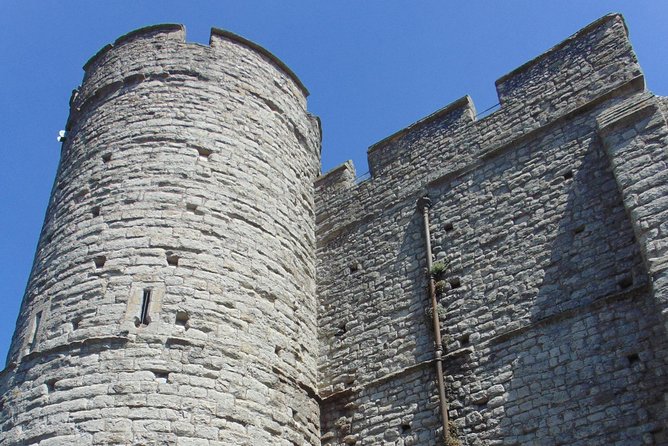
The walk ends beneath Saint George’s Tower at 27 St George’s Street. The former St George’s Church is now part of a shopping area, but the clock tower preserves a visible reminder of what came before.
This is a fitting final stop. The tour has moved from Roman remains and medieval defense to modern city life, and the tower shows how old Canterbury survives within its newer commercial setting. Sam explains how the curious clock tower became a link to the past.
The ending point is useful for independent exploring. You can continue through central Canterbury after the tour, return to sights that caught your attention, or use the guide’s suggestions to shape the rest of your visit. The tour does not loop back to The Beaney, so keep the end location in mind if you have a timed appointment afterward.
What the guide adds to the experience
Sam is the guide most often associated with this tour, and his strengths are clear from the feedback provided. People praise his humor, calm manner, ability to answer questions, and enthusiasm for Canterbury.
That matters more than a long list of stops. Each location receives only a few minutes, so the guide has to make those minutes count. Sam’s approach appears to rely on short stories, surprising facts, and links between buildings rather than a heavy stream of dates.
I also like the range of subjects he brings together. You may move from art and architecture to prisons, spies, sewage, religious conflict, legends, and literature. One detailed account of the walk included the Beaney, Westgate’s prison past, the synagogue and its connection with the Knights Templar, the Buttermarket, and the historic use of the river as a sewer.
Not every one of those subjects is listed as a formal stop, so you should see them as examples of the wider stories that may arise along the route. The small group makes that possible. With a maximum of 10 people, you have a better chance of asking about a building or detail that catches your eye.
Is $19.44 good value for 90 minutes?
At $19.44 per person, this is a fairly modest way to get an introduction to central Canterbury. You are paying for a guide’s interpretation, not entry to several attractions.
The value is strongest if you are visiting for the first time. In 90 minutes, you get an outline of Roman Canterbury, medieval defense, pilgrimage, literature, Tudor royal history, local religion, and the city’s modern street life. That is a lot of useful orientation for the price.
The value is less clear if you want to spend long periods inside museums or monuments. Westgate Towers Museum, the Marlowe Theatre, Christ Church Gate, and the Canterbury Roman Museum do not form part of an included admission package. You will mainly view places from outside and hear the stories.
Still, that can be an advantage. You are not locked into a rushed museum schedule. The walk helps you decide where your own time and admission money should go next.
The tour is also recommended by 100 percent of the 100 ratings supplied, with a five-star overall score. That does not guarantee a perfect day for every person, but it fits the recurring strengths: clear storytelling, an enjoyable pace, strong local detail, and a guide who keeps the walk engaging.
Who will enjoy this walk most?
I would choose this tour for a first visit, especially if you like cities best when someone explains the small clues. It suits couples, solo visitors, families, and small groups of friends.
Families should take note. Sam has kept children aged 6 and 11 involved, and teenagers have also enjoyed the tour. The odd stories and visual details give younger walkers something to watch for, while the route avoids a long indoor lecture.
It also suits visitors who want a gentle city walk. Canterbury is described as flat and compact, and the tour stays in the central area. Most people can participate, and service animals are allowed. It is near public transportation, which makes the meeting point practical.
You should think twice if you dislike outdoor tours, need long indoor breaks, or want a detailed visit inside the cathedral and museums. The walk is about seeing the city through stories. It is not a substitute for every major attraction.
Wear shoes suitable for walking and check the weather before you set out. The route has been enjoyable even on a freezing morning and during unpredictable weather, but comfort will depend on your clothing and tolerance for the conditions.
Booking timing, group size, and cancellation
The tour is often booked about 33 days ahead, so reserve early if your Canterbury dates are fixed. The maximum group size is 10, and that limit is one of the best practical features because it keeps the guide within easy speaking range.
A mobile ticket is provided, and the tour is offered in English. Confirmation arrives when you book. The activity offers free cancellation up to 24 hours before the start time, with the local time used for the cutoff. Cancellations or changes made inside that 24-hour window are not accepted for a refund.
My verdict on the Canterbury Classic Tour
Book it if you want a friendly, story-led introduction to Canterbury before exploring on your own. The route covers the city’s major themes without turning the walk into a long lecture, and the small group gives Sam room to answer questions.
I particularly like the mix of Chaucer, Becket, Marlowe, Roman remains, medieval defense, and strange street details. At $19.44, the tour offers good value for a first look, provided you understand that most stops are outside and brief.
Skip it only if you already know central Canterbury well or want admission-based sightseeing rather than guided orientation. For nearly everyone else, this is a smart way to get your bearings and learn why the city is far more than its cathedral.
FAQ
Where does the Canterbury Classic Tour start?
It starts outside The Beaney House of Art and Knowledge at 18 High Street, Canterbury CT1 2RA, UK.
Where does the tour end?
The tour ends beneath Saint George’s Tower at 27 St George’s Street, Canterbury CT1 2LE, UK.
How long does the tour last?
The walking tour lasts approximately 1 hour and 30 minutes.
How much does the tour cost?
The listed price is $19.44 per person.
How many people can join the tour?
The group is limited to a maximum of 10 people.
Is the tour offered in English?
Yes. The tour is offered in English.
Are attraction admission fees included?
No. Admission is not included for places such as Westgate Towers Museum, the Marlowe Theatre, Christ Church Gate, and the Canterbury Roman Museum. Several stops are exterior viewpoints or free public locations.
Can service animals join the tour?
Yes. Service animals are allowed.
What is the cancellation policy?
You can cancel up to 24 hours before the experience start time for a full refund. Cancellations or changes made less than 24 hours before the start time are not accepted for a refund.
Recently added around the UK
- Cairngorms & Whisky Day Tour from Inverness Including Admission★ 5.0 · 55 reviews
- PRIVATE HIRE 45 min Speedboat Tour – Embankment/Westminster Pier★ 5.0 · 55 reviews
- Fantastic Creatures of Edinburgh, and where to find them!★ 4.5 · 55 reviews
- E-bike excursion exploring the Purbecks★ 5.0 · 55 reviews
- From Edinburgh: Islay and The Whisky Coast 4-Day Tour★ 4.9 · 55 reviews
- ‘A Wee Pedal’s’ Family Friendly Cycle Tour to Edinburgh’s Coast★ 5.0 · 55 reviews
- Private Tour of London’s Historic Pubs★ 5.0 · 55 reviews
- From London: Glastonbury and Cheddar Gorge Guided Day Trip★ 4.8 · 55 reviews
Canterbury Tours, compared.
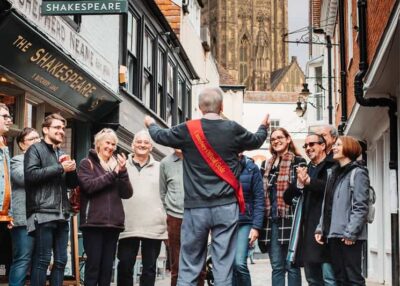
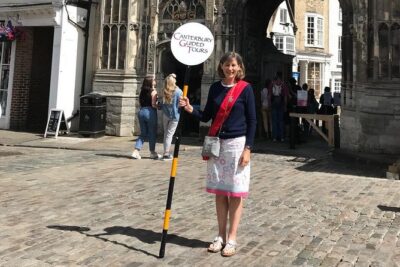
Official Canterbury Guided Walking Tour – 11.00 Tour
Read our review →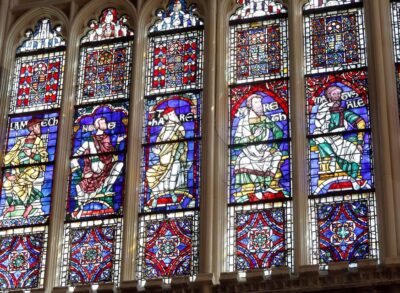
Canterbury Cathedral: Entry Ticket with Audio Guide
Read our review →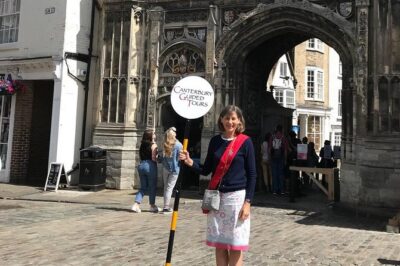
Official Canterbury Guided Walking Tour – 14.00 Tour
Read our review →

Cultural Homestay Exploring London, Oxford and National Parks
Read our review →Browse the lists this tour appears in