
Reviewed · BIRMINGHAM TOURS
Birmingham: Victorian Canals and Modern-Day Birmingham Tour
Birmingham’s best stories run beside its canals. This two-hour walk links the city’s industrial past with its bold new buildings, beginning at the Library of Birmingham and covering about 3 kilometers. I like the clear route through Centenary, Oozells, Victoria, and Chamberlain Squares, and I like the way the guide connects canals, public art, music, architecture, and civic reform rather than treating each sight as an isolated stop.
The live commentary is another strong point. You borrow an audio receiver, so you can hear the guide above city noise, even when the group spreads out along the canal. Guides such as Jonathan and Michael Harrison have earned especially warm praise for their humor, energy, and command of Birmingham’s story. The main drawback is practical: you spend two hours outdoors, and the open canal sections can feel cold and windy in poor weather.
In This Review
- Key points at a glance
- Why this Birmingham walk works so well
- Starting at the Library of Birmingham in Centenary Square
- The Library, the ICC, and Symphony Hall
- Following James Brindley’s canal into Birmingham
- Brindleyplace and the city’s Victorian civic ambition
- Oozells Square and Victoria Square
- Chamberlain Square and public art
- The guide and audio equipment
- Weather, walking pace, and what to bring
- Is $20 a fair price?
- Who should book this tour?
- Should you book the Victorian Canals and Modern-Day Birmingham Tour?
- FAQ
- Where does the tour start?
- Where does the tour finish?
- How long does the tour last?
- How far do you walk?
- What language is the tour conducted in?
- Are headphones needed?
- Is an audio receiver provided?
- What does the tour visit?
- What is included in the price?
- Can I cancel the booking?
Key points at a glance
- Starts at the Library of Birmingham: Meet at the front entrance in Centenary Square, usually beside a pop-up stand.
- Covers about 3 kilometers: The route takes two hours and returns to the Library of Birmingham.
- Connects canals with civic reform: You learn how waterways supported industry, then how Victorian leaders tackled housing, water, and education.
- Includes major city squares: Centenary, Oozells, Victoria, and Chamberlain Squares bring together old civic buildings, modern design, and public art.
- Uses a borrowed audio receiver: Bring headphones so you can follow the live English commentary clearly.
- Costs $20 per person: That is a fair price for a guided introduction, an audio setup, and a tourist guide book.
Why this Birmingham walk works so well
Birmingham can be hard to read at first glance. Its center mixes Victorian stone, postwar rebuilding, new glass, large public institutions, canals, sculpture, and busy commercial streets. A casual stroll may show you plenty, but it may not explain why the city looks this way.
This tour gives you that missing thread. You begin with the birth of Birmingham as an industrial center, follow the canals that helped move goods, and then look at the civic changes that came with rapid growth. By the end, modern buildings and public art feel less random.
I particularly like the balance between old and new. This is not a tour that points only at statues and grand façades. You also spend time looking at modern architecture, concert halls, regenerated waterways, and the ways Birmingham continues to reshape itself.
The route is short enough for a first afternoon in town. At roughly 3 kilometers over two hours, it is not a punishing walk, but you should still wear sensible shoes. The pace includes regular stops for explanation, so the time does not pass as one long march.
A few more trips worth a look before you book
- Entry ticket to Hoo Zoo and Dinosaur World in Telford
★ 5.0 · 591 reviews - Cadbury World Entry Ticket
★ 3.0 · 524 reviews - Birmingham Walking Tour: Canals, Victorians & Today (1:30pm)
★ 5.0 · 346 reviews
Starting at the Library of Birmingham in Centenary Square
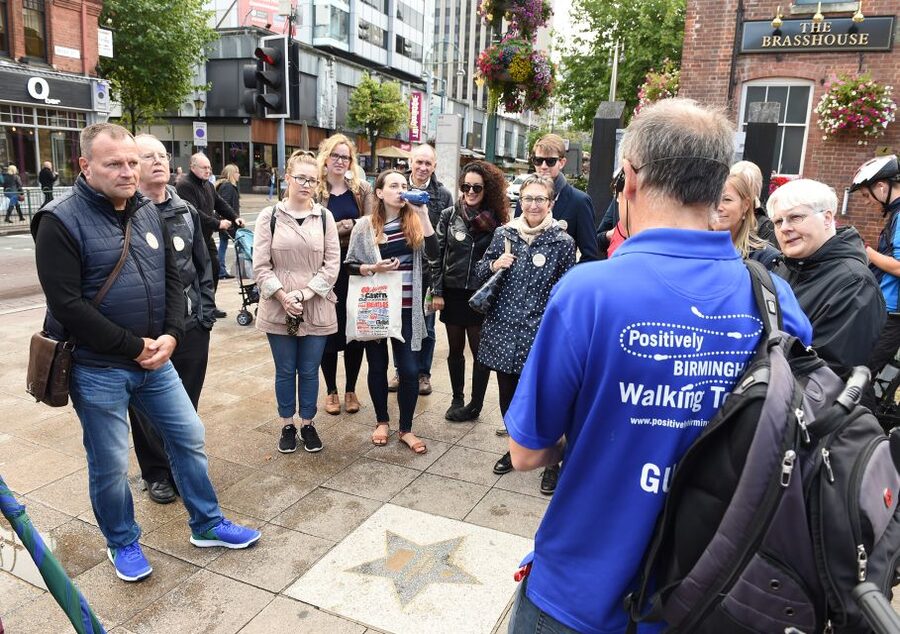
The meeting point is the front entrance of the Library of Birmingham. A pop-up stand usually marks the spot, which makes the start easier to find in a large central square.
Centenary Square provides a useful opening lesson. The Library is a modern civic building, and the square’s public art offers early clues about Birmingham’s industrial and social past. Instead of rushing straight toward the canal, the guide uses this space to show how the city presents itself today.
This opening also gives you a sense of Birmingham’s scale. Buildings around the square point to the city’s strength in arts, business, learning, and public life. You begin to see that Birmingham is not simply an old manufacturing center preserved for sightseeing. It is a working city that keeps adding new layers.
The square can be exposed to the weather. If the forecast is cold or wet, bring a coat that can handle wind. One February participant specifically praised the guide for adjusting the walk when conditions changed, but good clothing will still make the experience easier.
The Library, the ICC, and Symphony Hall
From Centenary Square, the walk heads through the International Convention Centre. This part of the route shifts the focus from public space to modern cultural institutions.
Symphony Hall is a major stop. The guide explains why its acoustics are regarded as among the finest in the world. You do not attend a concert during the walk, but the building becomes more meaningful when you understand that Birmingham’s modern identity includes serious music and performance, not only factories and canals.
This is one of the tour’s useful habits: it gives buildings a job in the city’s story. The convention center reflects Birmingham’s role in conferences and commerce. Symphony Hall shows its investment in culture. The Library represents public access to knowledge and civic life.
You may already know these buildings from a guidebook, but the live explanation helps place them in relation to one another. The route is not simply a collection of photo stops. It asks you to consider how a city once shaped by manufacturing now uses culture, public institutions, and design to define itself.
Following James Brindley’s canal into Birmingham
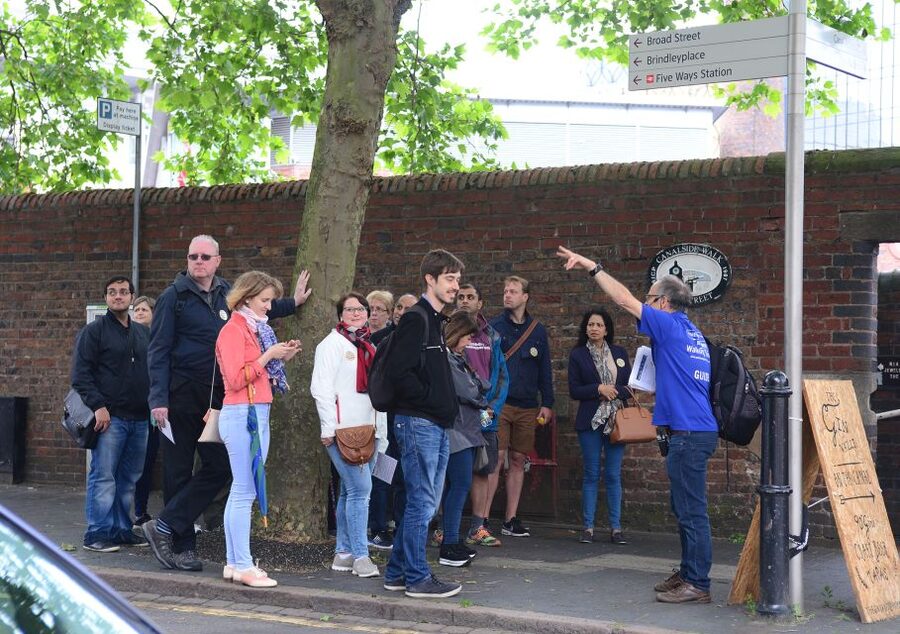
The canal section is the historical heart of the walk. The guide explains why the arrival of James Brindley’s canal into Birmingham in the 1770s mattered so much.
Canals gave the growing town a more practical way to move goods. That change helped support industry and trade, making Birmingham better connected and more productive. You are not just looking at water beside brick walls. You are seeing an essential piece of the system that allowed the town to grow.
The renewed waterways also reveal how the city has changed its attitude toward its canals. Areas once tied closely to industrial work now have new uses. The canal edges form part of a central city experience, with modern buildings and public places close by.
I like this part because the water provides a calm route through a dense urban center, while the commentary keeps the setting tied to economics and engineering. You get a physical sense of movement: goods once traveled along these channels, and now people walk beside them.
Do not expect a long rural canal walk. This is a city route, with architecture and streets close at hand. That is the point. The canal is shown as part of Birmingham’s urban machinery and its modern public life.
A different sort of outing around Birmingham:
- Discovering Birmingham 2 hour Walking Tour to the Jewellery Quarter
★ 5.0 · 333 reviews - Birmingham Slogging Gangs Walking Tour with Edward Shelby
★ 4.5 · 306 reviews - Birmingham City Centre Daily Walking Tour (10:30am & 2pm)
★ 5.0 · 265 reviews - Birmingham: Cadbury World Entry Ticket
★ 4.4 · 230 reviews
Brindleyplace and the city’s Victorian civic ambition
Brindleyplace brings the industrial and modern themes together. The area reflects the city’s renewed canal frontage, but the guide also uses it to explain the ambitions of Victorian Birmingham.
As the town expanded, leaders faced serious problems connected with fast urban growth. The tour introduces the Civic Gospel and the Municipal Revolution, a period of effort aimed at improving public life through education, clean water, and better housing.
This is where the walk moves beyond easy industrial nostalgia. Birmingham’s success created wealth, but rapid growth also created poor living conditions. Civic reform was an attempt to make the city healthier and more orderly.
That context helps you look at the built environment with sharper eyes. Grand public buildings were not only decorative statements. They could express a belief that local government should provide useful services and improve daily life.
The guide’s interpretation matters here. A list of dates would be dull. The best moments come when policy, buildings, and ordinary city life are linked together. Several guides have been praised for bringing energy and humor to these explanations, and that style suits a two-hour walk with many different themes.
Oozells Square and Victoria Square
The route continues through Oozells Square and Victoria Square, two places that help you compare different periods of Birmingham’s development.
Oozells Square is part of the modern canal-side city, where older industrial connections meet later redevelopment. The setting gives you a chance to see how former working areas have been adapted for contemporary uses. The guide draws attention to the buildings and public spaces around you, rather than treating the canal as the only attraction.
Victoria Square shifts the mood toward civic architecture and public ceremony. Here, the tour considers how the city expresses authority, pride, and public identity through buildings and open space.
The value of these stops is the comparison. Birmingham does not offer one tidy architectural style. You may see Victorian details, later rebuilding, contemporary structures, and public art within a short walk. The guide helps explain why those contrasts exist.
If you enjoy architecture, this tour should be especially rewarding. Michael Harrison, described as a former history of architecture lecturer, has been praised for his strong grasp of Birmingham’s development. Jonathan is also frequently singled out for making architectural and historical details lively rather than dry.
Chamberlain Square and public art
Chamberlain Square is another important point on the route. Along with Centenary, Oozells, and Victoria Squares, it shows how Birmingham uses public space to connect its past with its present.
Public art receives proper attention here. That matters because sculpture and other installations can be easy to overlook when you are focused on transport, shopping, or finding your next café. The guide encourages you to read these works as part of the city’s story.
You also get another look at the mix of architectural styles. Birmingham’s center is not a museum piece, and the route does not pretend otherwise. New buildings sit near older ones, sometimes in harmony and sometimes in sharp contrast.
That honest mix is part of the appeal. You are encouraged to notice the city’s changes, including the awkward bits, instead of being shown only a polished version. The result is a more useful introduction if you plan to spend several days in Birmingham.
The guide and audio equipment
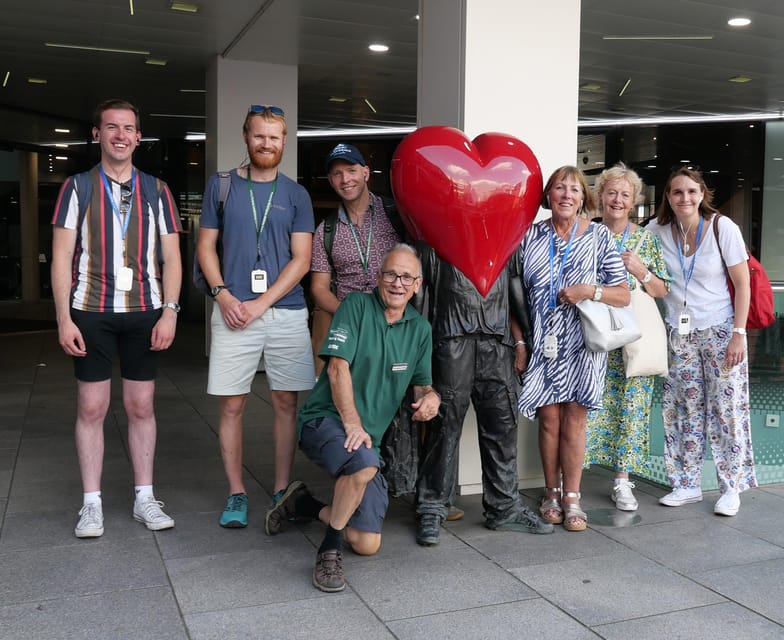
The guide is central to the experience. The strongest praise has gone to Jonathan, who is described as funny, friendly, energetic, and able to answer questions during the walk. He also points out sights that may not appear in standard guidebooks and offers suggestions for places to eat and other landmarks to visit.
Michael Harrison brings a different strength, with a background in architectural history. The important thing is that the tour is led live in English, not delivered as a fixed recording.
The borrowed audio receiver is a smart practical touch. City streets create traffic noise, groups spread out, and canal paths can make it difficult to hear someone speaking at the front. The receiver helps solve that problem. Bring your own headphones, as they are listed as necessary.
The equipment has generally been easy to use, though you should arrive ready to connect your headphones and listen as you walk. It also helps you avoid crowding around the guide, so you can pause at the edge of a square or canal path and still follow along.
Weather, walking pace, and what to bring
The distance is about 3 kilometers, completed in two hours. The route includes city streets, squares, and canal-side sections, with stops for commentary.
The walk is manageable for many people who are comfortable on their feet, but the weather deserves attention. Cold wind was a challenge on one March walk and another participant described conditions as chilly and windy. The guide may adjust the route or pacing when weather changes, but you should bring a warm layer and waterproof protection when needed.
Headphones are the key item to pack. The tour also includes a tourist guide book, which gives you something useful to keep after the walk.
Because this is an outdoor experience, it is less appealing if you want a warm indoor activity or a fast sightseeing circuit. Its value comes from moving through the city slowly enough to notice connections. Allow the full two hours, even though one walk finished just under that mark.
Is $20 a fair price?
At $20 per person, this is good value for a focused introduction to central Birmingham. You receive a live English-speaking guide, a borrowed audio receiver, and a tourist guide book. More importantly, the route joins several subjects that would otherwise require separate research: canals, industry, architecture, public art, civic reform, music, and modern redevelopment.
The price makes particular sense if this is your first visit. You get orientation as well as history, and the guide can point out places to return to later. It is also useful for people who have passed through Birmingham for trains, conferences, or motorway trips without seeing the center properly.
The value is less obvious if you already know the central sights and want specialist detail on one narrow subject. This is a broad city introduction rather than an in-depth canal engineering study or a dedicated architecture seminar.
Flexible booking terms add some comfort. You can cancel up to 24 hours before the start for a full refund, and you can reserve now and pay later. Check the available start times when booking.
Who should book this tour?
I would choose this walk for a first-time visitor who wants context before exploring alone. It is also a good fit for local residents, since the route includes public art, modern buildings, and smaller details that can be easy to miss on familiar streets.
Architecture fans should enjoy the range of styles and the attention given to city planning. People interested in social history will appreciate the Civic Gospel, clean-water efforts, housing reform, and education story.
Families with older children may find the canals and public art more engaging than a long indoor lecture, though the group must be ready to walk for two hours. The humorous style praised in the strongest feedback should help keep the material moving.
You might skip it if you dislike outdoor walking, have difficulty covering 3 kilometers, or want a tour conducted in a language other than English. The format depends on a live English guide and changing city conditions.
Should you book the Victorian Canals and Modern-Day Birmingham Tour?
Yes, if you want a compact, reasonably priced introduction to Birmingham that explains how the city became what it is today. I especially like the route’s balance: canals are paired with civic reform, Victorian buildings with modern architecture, and public art with practical city history.
Book it early in your Birmingham stay so you can use the guide’s suggestions for later sightseeing and food stops. Bring headphones, wear weather-ready clothing, and expect a thoughtful walking pace rather than a rapid checklist of attractions.
Jonathan’s friendly delivery appears to be a major strength, while Michael Harrison offers a strong architectural angle. The experience is not weatherproof and it will not cover every corner of the city, but for two hours and $20, it gives you a clear way to start understanding Birmingham.
FAQ
Where does the tour start?
The tour starts at the front entrance of the Library of Birmingham in Centenary Square. A pop-up stand usually marks the meeting point.
Where does the tour finish?
The walk returns to the Library of Birmingham.
How long does the tour last?
The guided walk lasts two hours.
How far do you walk?
The total distance is about 3 kilometers.
What language is the tour conducted in?
The live tour guide commentary is in English.
Are headphones needed?
Yes. Bring headphones to use with the audio receiver loaned during the tour.
Is an audio receiver provided?
Yes. An audio receiver is loaned so you can hear the live guide commentary above city noise.
What does the tour visit?
The route includes the Birmingham canals, Centenary Square, Oozells Square, Victoria Square, Chamberlain Square, Brindleyplace, the International Convention Centre, Symphony Hall, and modern public art and architecture along the way.
What is included in the price?
The price includes the tour guide, a loaned audio receiver, and a tourist guide book.
Can I cancel the booking?
You can cancel up to 24 hours in advance for a full refund. You can also reserve now and pay later.
Recently added around Birmingham
- Birmingham: Legoland Discovery Centre Entry Ticket★ 4.1 · 74 reviews
- Digbeth, Public Art & Peaky Film★ 5.0 · 91 reviews
- Alton Towers Resort: Entrance Ticket★ 4.2 · 96 reviews
- Skip the Line: House and Garden Admission Ticket★ 4.5 · 122 reviews
- Birmingham: Guided City Center Walking Tour (10:30am & 2pm)★ 4.8 · 147 reviews
- From Birmingham: Stonehenge & Bath Day Tour★ 4.6 · 158 reviews
- Fun, Flexible Treasure Hunt Around Birmingham with Cryptic Clues & Hidden Gems★ 5.0 · 167 reviews
- Birmingham: Winterbourne House and Garden Admission Ticket★ 4.7 · 199 reviews
Birmingham Tours, compared.

Entry ticket to Hoo Zoo and Dinosaur World in Telford
Read our review →
Birmingham Walking Tour: Canals, Victorians & Today (1:30pm)
Read our review →
Discovering Birmingham 2 hour Walking Tour to the Jewellery Quarter
Read our review →
Birmingham Slogging Gangs Walking Tour with Edward Shelby
Read our review →
Birmingham City Centre Daily Walking Tour (10:30am & 2pm)
Read our review →

Browse the lists this tour appears in