
Reviewed · MUSEUMS
British Museum Guided Tour with Priority Timeslots(Small Group)
The British Museum can overwhelm even serious museum fans. This two-hour tour gives you a clear route through its greatest sights, with small-group attention and a guide who adds stories beyond the display labels. I like the efficient pace, and I like the included headset option, which helps you follow the commentary when the galleries fill up. The main tradeoff is simple: two hours can only cover a fraction of a museum holding more than 8 million objects.
You will see famous pieces such as the Rosetta Stone, Parthenon sculptures, Egyptian mummies, and the Assyrian winged bull. Guides including Daniel, James, Joey, Tara, Tony, Antonio, and Rebekka have led highly praised visits, with Daniel receiving especially frequent approval for his humor, clarity, and command of the collection. At $48.60 per person, this is not the cheapest way into a free museum, but it can be good value if you have limited time or want help deciding what deserves your attention.
In This Review
- Key points at a glance
- Why the British Museum needs a plan
- Starting at Great Russell Street
- The opening route through Egypt and Mesopotamia
- The Rosetta Stone and the power of one object
- Parthenon sculpture and difficult museum questions
- Sutton Hoo, the Lewis Chessmen, and the collection’s wide reach
- How the guides shape the visit
- The value of headsets in a crowded museum
- What happens after the two-hour route
- Is $48.60 a fair price?
- Who should book this British Museum tour?
- Practical details before you book
- Should you book it?
- FAQ
- How long does the British Museum guided tour last?
- What language is the tour offered in?
- How many people can join the tour?
- Does the tour include entry to the British Museum?
- Is the British Museum itself free to enter?
- Are headsets included?
- Where does the tour begin and end?
- Can I cancel for a full refund?
Key points at a glance
- Two hours, carefully focused: See major objects across several galleries without trying to conquer the entire museum.
- A maximum of 15 people: The smaller group makes it easier to hear, ask questions, and keep moving together.
- Priority timeslot at the main entrance: Your booking includes an entry timeslot for the British Museum at Great Russell Street.
- Headsets can matter: The listening equipment helps you hear live commentary in crowded rooms.
- Big-name objects included: Expect the Rosetta Stone, Egyptian statues and mummies, Parthenon sculpture, the Lewis Chessmen, Sutton Hoo, and more.
- Time to continue alone: After the guided route, you can keep exploring at your own speed.
Why the British Museum needs a plan
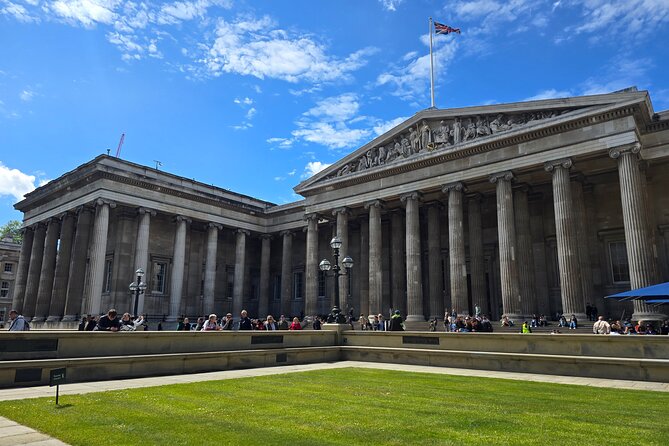
The British Museum is free to enter, yet free does not mean easy. Its collection spreads across more than 70 galleries, and the sheer choice can leave you wandering past important objects without understanding why they matter.
That is where this tour earns its fee. You are not paying for access to a rare private collection. You are paying for a route, interpretation, crowd navigation, and a human voice that helps connect objects separated by thousands of years and miles.
I particularly like this format for a first visit. You get a usable introduction instead of a random march through rooms. The guide points out major pieces, explains the larger story, and gives you a sense of how the museum is organized. After that, you can return to the galleries that caught your interest.
The museum’s scale also explains why the two-hour limit is both a strength and a weakness. The short format keeps the visit lively and manageable. It also means you should not expect a close look at every department or a long pause at every famous object.
More Museum Visits in London
- Tower of London and Crown Jewels Exhibition Ticket
★ 4.5 · 6,677 reviews - London: Chelsea Football Club Stadium and Museum Tour
★ 4.8 · 4,576 reviews - Chelsea FC Stadium Tours and Museum
★ 5.0 · 1,908 reviews
Starting at Great Russell Street
The tour begins at the British Museum, Great Russell Street, London WC1B 3DG. The meeting point is practical because you do not need to travel across London to reach a separate tour office or starting attraction.
Your booking includes entry through the main entrance with a priority timeslot. That is useful when your day is built around a firm museum visit, though you should still arrive ready for normal entrance procedures and possible crowds. The tour is offered in English.
The group can include up to 15 people. That is not a private tour, but it is far more workable than a large procession. A smaller group lets the guide maintain a steady pace and makes it more realistic to ask about an object that catches your eye.
Good communication matters here. The museum can be crowded, and the group may need to pause, move aside, or regroup. The strongest guides in the feedback, including Daniel, James, Joey, and Antonio, were praised for clear directions and smooth movement through busy areas.
The opening route through Egypt and Mesopotamia
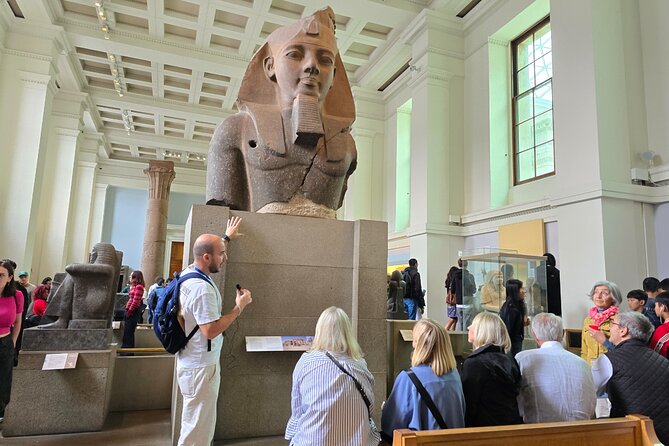
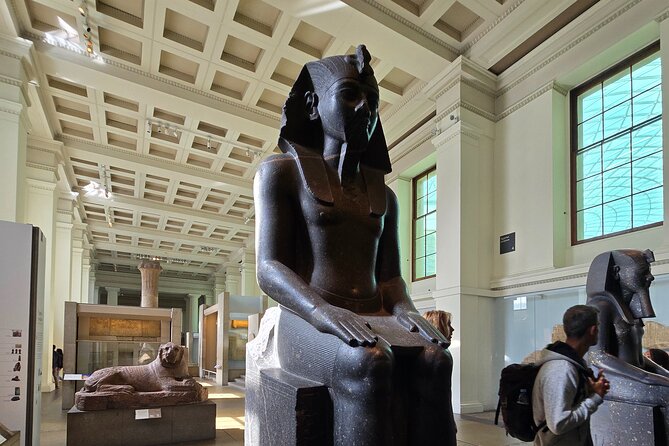
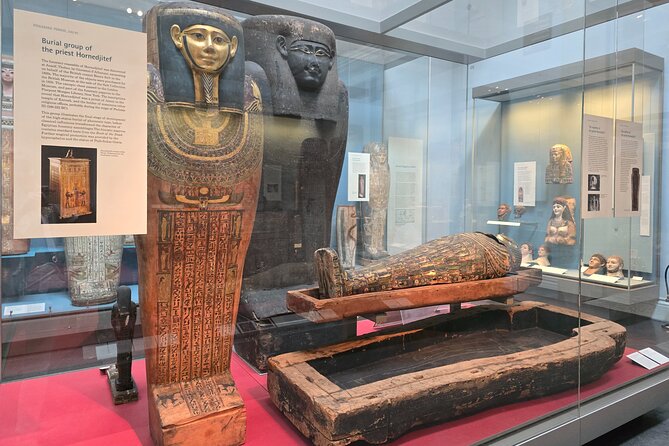
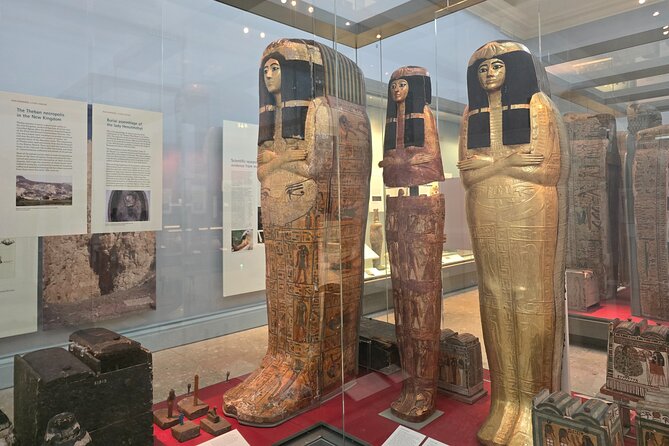
The first part of the visit typically establishes the museum’s broad range through ancient Egypt and the Near East. You might see Egyptian statues, mummies, and the bust of Ramesses II, along with Assyrian objects such as the winged bull.
These displays work well early in a guided visit because they are visually striking and easy to connect to larger questions about kingship, burial, religion, and empire. A good guide can turn a stone statue or carved relief into a piece of evidence rather than just another impressive object.
Daniel received repeated praise for making the exhibits feel alive through stories and answers to questions. James was also praised for presenting the museum as a connected story rather than a list of dates. That difference matters. Museum labels can tell you what an object is, but a guide can explain what to look for and why the object changed the course of scholarship or shaped later ideas about the ancient world.
One point to watch is the balance of time. One family felt the tour spent a long stretch on Mesopotamia and would have preferred more attention to other periods. That is not necessarily a flaw, but it shows that the exact route can depend on the guide, group interests, and crowd conditions.
The Rosetta Stone and the power of one object
The Rosetta Stone is one of the British Museum’s essential stops. It is famous for carrying the same decree in three scripts, which helped scholars make progress in reading ancient Egyptian hieroglyphs.
You may already know the headline. The guide’s value comes in explaining the object’s role in a larger chain of events, along with the practical details that are easy to miss when you are surrounded by other tour groups. In a museum packed with famous names, the Rosetta Stone is an ideal place to see how one object can connect language, archaeology, and modern scholarship.
Crowds often gather around major sights. Your headset helps here, especially if you are standing a short distance from the guide rather than directly beside the case. One visitor specifically found the earpieces useful on a very busy day, and another called them necessary in crowded areas.
The equipment is described as an option, so confirm how it will be handled when you meet your guide. It is a small feature, but it can make a real difference when several voices compete in the same gallery.
A different sort of outing around London:
- London: The London Eye Entry Ticket
★ 4.6 · 35,875 reviews - From London: Harry Potter Warner Bros Studio Tour
★ 4.7 · 26,588 reviews - London: Westminster to Greenwich River Thames Cruise
★ 4.5 · 22,836 reviews - Magical London: Harry Potter Guided Walking Tour
★ 4.7 · 22,044 reviews
Parthenon sculpture and difficult museum questions
The Parthenon sculptures, also called the Elgin Marbles, are another major stop. They once formed part of the Parthenon in Athens and remain among the museum’s most discussed displays.
A visit here is more rewarding when the guide supplies architectural and historical context rather than simply pointing at the marble figures. You might learn how the sculptures fitted into the temple, what they show, and why their presence in London remains politically and culturally disputed.
This is one place where a live guide has an advantage over a basic audio track. You can ask a direct question, hear how the subject fits into the tour, and move on without getting stuck in a long recorded presentation. The tour does not promise a specialized debate on the ownership issue, so do not book it expecting a full seminar on repatriation. It does, however, provide a useful introduction to one of the museum’s most important displays.
Sutton Hoo, the Lewis Chessmen, and the collection’s wide reach
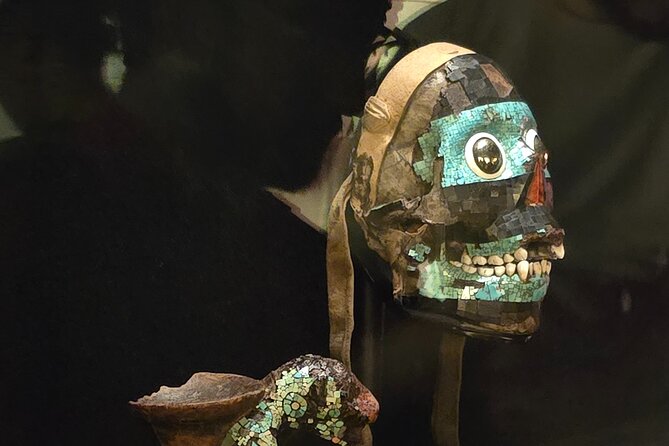
The route also reaches beyond Egypt, Mesopotamia, and classical Greece. Sutton Hoo, associated with an Anglo-Saxon ship burial, gives you a glimpse of early medieval Britain and the objects connected with elite burial customs.
The Lewis Chessmen offer a different kind of connection. These small carved figures are memorable because they look familiar and human, even though they come from a very different period. They show how an object can be historically important and immediately appealing at the same time.
The Easter Island Moai statue adds another geographic and cultural turn. Seeing objects from such different places in one building is part of the British Museum’s appeal, but it also raises questions about collecting, removal, ownership, and display. The guide may help place these objects in context, although the tour’s stated purpose is a broad highlights route, not a detailed treatment of every collection dispute.
This range is one of the tour’s best features. In two hours, you can move from ancient Egypt to Assyria, Greece, medieval Europe, Britain, and Easter Island. The danger is that each subject gets only a short treatment. I would see the tour as an introduction, not a substitute for spending an entire day with one culture.
How the guides shape the visit
The strongest praise focuses on the guides, not the ticketing. Daniel is repeatedly described as entertaining, warm, well informed, and able to keep the tour moving. James is praised for telling stories in a way that holds attention. Joey is noted for accommodating requests while still covering a broad section of the museum.
Other named guides include Tara, Tony, Antonio, and Rebekka. Tara was praised for clear instructions and vivid stories. Tony helped a short-on-time group see the key pieces and suggested areas to visit afterward. Antonio was credited with meeting the group clearly and guiding it through heavy crowds. Rebekka was praised for a logical route and strong communication.
No guide can control every part of a museum visit. Crowds may block a case, another group may occupy the best listening spot, or a particular room may take longer than planned. The feedback suggests that guides generally handle these limits well, but you should keep your expectations sensible. A live museum tour is a moving conversation, not a private audience with every artifact.
The small-group cap of 15 supports that style. You may still be part of a mixed group with different interests, but the guide can usually hear questions and adjust the explanation more easily than with a large crowd.
The value of headsets in a crowded museum
The headset option deserves more attention than it might usually receive. The British Museum is a busy public building, and the most famous objects attract several groups at once.
Without amplification, you may need to stand close to the guide, which can make it harder to see the object. With a headset, you can listen while looking at the display or standing slightly to one side. This is especially useful for families, anyone who has trouble hearing in noisy rooms, and people who prefer not to squeeze into the front row.
The equipment does not make the galleries quieter. It simply protects the guide’s commentary from the surrounding noise. You should still pay attention to where the group is moving and avoid drifting too far away.
What happens after the two-hour route
The tour ends back at the meeting point, and you are free to continue exploring on your own afterward. This is important because the guided portion cannot cover all 70-plus galleries.
I recommend treating the final part of the tour as a planning gift. If the guide points out a gallery you want to revisit, note its location before the group moves on. You can then retrace your steps with a better idea of what you are looking for.
Some guides also suggest extra areas after the formal route. That can be very useful if you still have time. You might return to a favorite display, explore a period the tour touched only briefly, or simply wander with more confidence.
Because admission to the museum itself is free, you do not need to choose between this tour and a later independent visit. You can use the tour as your orientation, then return another day if your schedule allows.
Is $48.60 a fair price?
At $48.60 per person, the price needs a clear explanation. The museum does not charge a general admission fee, so the ticket cost is paying for the guide, the reserved main-entrance timeslot, the small-group format, and the structure of the visit.
For someone with several days in London and a strong interest in museum displays, skipping the tour and exploring independently may be the better financial choice. You can enter for free and spend as long as you want.
For a short visit, the calculation changes. If two hours are all you have, a guide can save you from wasting the first 30 minutes finding the major galleries. You also receive context that a sign cannot always provide, plus a chance to ask questions. That makes the fee reasonable for many first-time visitors, especially those who feel museums are hard to approach without a plan.
I would also consider the cost of a poor museum visit. If you leave after wandering through random rooms and missing the Rosetta Stone or Parthenon sculptures, the free entry has not saved much in practical terms. This tour is best understood as a paid orientation inside a free institution.
Who should book this British Museum tour?
I would recommend it most strongly to:
- First-time British Museum visitors
- People with only two or three hours available
- Families who want a clear route through major objects
- Anyone who finds large museums confusing
- History fans who prefer stories and conversation to labels alone
- Visitors who want to see headline pieces before exploring independently
You may prefer independent entry if you already know the collection well, want to focus on one culture, or need a flexible schedule. A two-hour highlights route cannot give every object equal attention, and one guide’s priorities may not match yours.
The tour also suits people who enjoy a lively pace. Feedback repeatedly describes it as fast-moving, well paced, and easy to follow. If you want long stretches of quiet looking, this is not the right format.
Practical details before you book
Confirmation is provided when you book. The activity is near public transportation, and most people can take part. The maximum group size is 15, and the tour is offered in English.
Tips are not included. They are optional, so budget them only if you feel the guide added real value.
Free cancellation is available up to 24 hours before the start time for a full refund. Changes or cancellations inside that 24-hour window are not accepted for a refund. The activity can also be canceled if minimum attendance is not reached, or because of poor weather, with a different date or a full refund offered. Since the museum is indoors, the weather condition may seem unusual, but it is part of the stated policy.
Should you book it?
Book this tour if you want a strong first look at the British Museum without spending hours planning your route. The combination of a maximum 15-person group, a priority timeslot, live commentary, and optional headsets makes the visit easier to manage, while guides such as Daniel, James, and Joey add the human touch that museum labels cannot provide.
Skip it if your main goal is to save money or study one department at your own pace. The museum is free, and two hours will never cover more than a small portion of it.
For most first-time visitors on a tight London schedule, I think the tour earns its price. You see the famous objects, learn why they matter, and leave with a sensible plan for what to explore next.
FAQ
How long does the British Museum guided tour last?
The tour lasts approximately two hours.
What language is the tour offered in?
The tour is offered in English.
How many people can join the tour?
The activity has a maximum group size of 15 people.
Does the tour include entry to the British Museum?
Yes. The booking includes entry to the British Museum through the main entrance with a priority timeslot.
Is the British Museum itself free to enter?
The museum is free to the public, but this paid experience includes a guide, a priority timeslot, and the organized tour.
Are headsets included?
A headset option is available so you can hear the guide’s live commentary clearly.
Where does the tour begin and end?
The tour begins at the British Museum, Great Russell Street, London WC1B 3DG, UK, and ends back at the meeting point.
Can I cancel for a full refund?
Yes. You can cancel at least 24 hours before the experience start time for a full refund. Cancellations or changes made less than 24 hours before the start time are not refunded or accepted.
Recently added around London
- PRIVATE HIRE 45 min Speedboat Tour – Embankment/Westminster Pier★ 5.0 · 55 reviews
- Private Tour of London’s Historic Pubs★ 5.0 · 55 reviews
- From London: Glastonbury and Cheddar Gorge Guided Day Trip★ 4.8 · 55 reviews
- London: Kew to Westminster River Thames Cruise★ 4.2 · 55 reviews
- Gatwick Airport Taxi – Private Transfer to/from London★ 5.0 · 55 reviews
- London by Night – Tootbus Sightseeing Tour★ 3.5 · 55 reviews
- London: Tower of London After Hours Tour and Key Ceremony★ 4.8 · 56 reviews
- Palaces, Parliament & Power: A Walking Tour of London’s Royal City★ 5.0 · 56 reviews
Museums, compared.

Liverpool Football Club Museum and Stadium Tour
Read our review →
Tower of London and Crown Jewels Exhibition Ticket
Read our review →
Chelsea Football Club Stadium and Museum Tour
Read our review →




Browse the lists this tour appears in