
Reviewed · MUSEUMS
Crash course in archaeology at the British Museum
History comes alive one object at a time. This five-and-a-half-hour British Museum tour uses selected treasures from Egypt, Assyria, Greece, Rome, the Viking world, and the Aztec world to explain how human societies changed. I like the chronological storytelling and the guide’s focus on how archaeologists found, studied, and interpreted these objects. The main drawback is simple: you spend a long time on your feet, and this is not the tour for seeing every famous exhibit in the museum.
The tour begins at 9:45 a.m. near Russell Square and ends inside the British Museum. I also like that it leaves your afternoon open and limits the group to 25 people. The $83.34 price is fair if you want a serious, guided lesson in archaeology, but less attractive if your goal is to race through as many galleries as possible.
In This Review
- Key points to know before booking
- A five-hour route through human civilization
- Meeting at Russell Square
- Early humans, tools, and the first settled communities
- Egypt and the puzzle of written language
- Assyria, Mesopotamia, and the birth of cities
- The Rosetta Stone, decipherment, and archaeology as detective work
- Greece and Rome: beauty, power, and empire
- Vikings, Anglo-Saxons, and the making of Britain
- A look at the people behind the collection
- Breaks, lunch, and the reality of five and a half hours
- What the $83.34 price really buys
- Who should book this British Museum tour?
- Should you book it?
- FAQ
- Where does the tour start?
- What time does the tour begin?
- Where does the tour finish?
- How long does the experience last?
- Is admission to the British Museum included?
- Is lunch included?
- What language is the tour offered in?
- How large can the group be?
- Is the tour suitable for most people?
- Can I cancel for a full refund?
Key points to know before booking
- Five and a half hours of connected storytelling: The tour follows human development from early tools and hominids through villages, cities, empires, and early modern Britain.
- Rossa brings an archaeologist’s eye: His explanations focus not only on what an object is, but how it was found, decoded, and placed into the story of civilization.
- Selected objects matter more than sheer quantity: You may see fewer exhibits than on a standard highlights tour, but you get much more time and context at each stop.
- Morning timing works well: Meet at 9:45 a.m., then keep the afternoon for another London sight, a museum revisit, or a slower meal.
- Plan for standing: The museum provides small folding stools, and taking one early can make a major difference.
- Lunch is not included: Bring food or budget for a museum meal, since one break is built into the long visit.
A five-hour route through human civilization
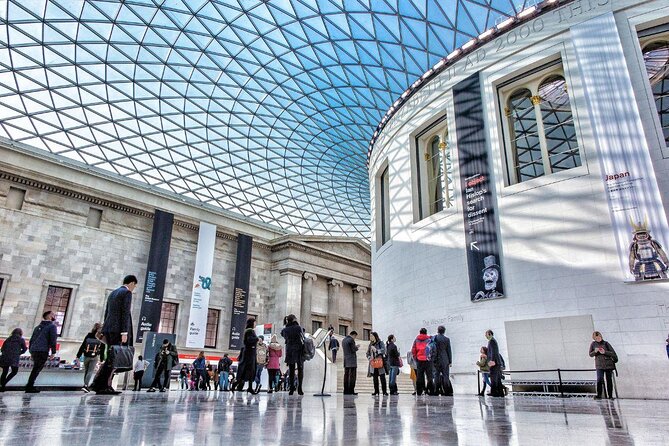
The British Museum can feel like four museums placed on top of one another. Its galleries spread across several floors and wings, and there is no realistic way to understand everything in one visit.
This tour solves that problem by choosing a route through time. You move from the earliest human ancestors and their tools toward settled life, writing, organized religion, empire, and the societies that shaped later Britain. The objects are the anchors, but the real subject is how people lived and how archaeologists learned about them.
That approach suits me far more than a quick march past twenty famous objects. You are not simply told that an artifact is old or important. You hear why it matters, who found it, what questions it answered, and how later evidence changed the interpretation.
The route moves through several sections of the museum rather than staying in one collection. That means you should expect plenty of walking between stops, along with periods of standing while the guide speaks. The group size can reach 25 people, so your position near the guide may shift from room to room.
More Museum Visits in London
- Tower of London and Crown Jewels Exhibition Ticket
★ 4.5 · 6,677 reviews - London: Chelsea Football Club Stadium and Museum Tour
★ 4.8 · 4,576 reviews - Chelsea FC Stadium Tours and Museum
★ 5.0 · 1,908 reviews
Meeting at Russell Square
The morning begins at Russell Square, on Bernard Street, at 9:45 a.m. The finish is at the British Museum on Great Russell Street, so the tour is arranged as a short approach to the museum followed by the main indoor experience.
This start point is useful if you are staying near Bloomsbury or arriving by public transport. The tour information says the meeting point is near public transportation, but it does not promise a particular station exit or route, so allow time to find Bernard Street without rushing.
The museum itself is free to enter, but this is a paid guided experience. Your fee pays for the archaeologist-led interpretation and the long structure of the visit, not for a separate museum admission charge.
Early humans, tools, and the first settled communities
The opening section looks far back, to early hominids and the tools associated with them. This gives the day a clear purpose from the start: you are studying evidence of human development, not merely collecting famous names and dates.
The guide uses the museum’s objects to explain the shift from mobile hunter-gatherer societies toward agriculture and permanent settlement. From there, the story moves through the first villages, towns, and cities.
This part is especially helpful if archaeology feels like a pile of disconnected subjects. A tool, a piece of pottery, or a burial object can seem modest on its own. Placed in a sequence, these objects show how people began to organize work, food, belief, trade, and power.
You may find this opening less visually dramatic than the monumental Egyptian sculpture or Assyrian reliefs later in the day. Give it time. The early objects provide the framework for everything that follows.
Egypt and the puzzle of written language
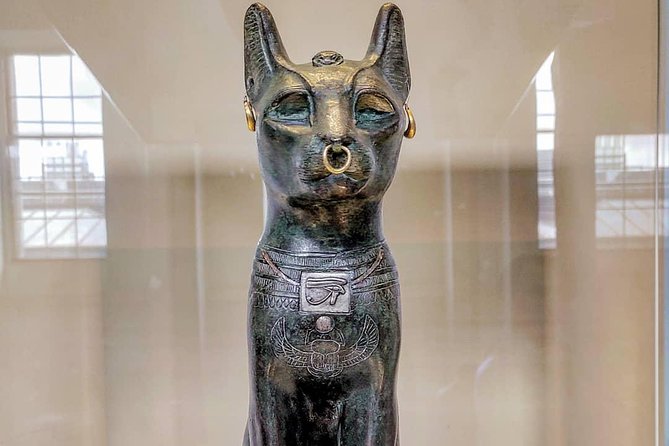
Ancient Egypt is one of the tour’s major stops, with royal figures, hieroglyphs, and the Rosetta Stone among the central subjects. The focus is not just on pharaohs. It is on the practical problem of reading a long-lost script.
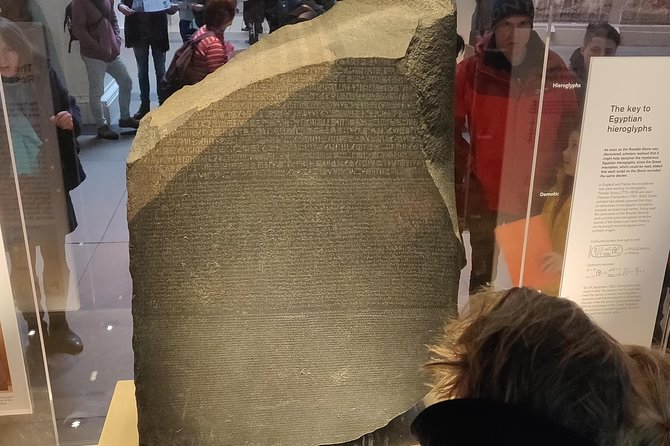
The Rosetta Stone helps explain how the same text in different scripts allowed scholars to work toward deciphering Egyptian hieroglyphs. That turns a famous object into a lesson in method. You begin to see archaeology as a process of testing clues rather than simply admiring old stone.
The Egyptian section also connects written records with political power, religion, and administration. A symbol on a wall or a name on a monument can reveal who ruled, what beliefs mattered, and how a society presented itself.
One review refers to Ramses II, and the day’s Egyptian material also includes discussion of the way objects became part of modern archaeological knowledge. If you already know Egypt well, you may want more time in individual galleries afterward. If you are new to the subject, this section gives you a strong start without treating Egypt as the whole story.
A different sort of outing around London:
- London: The London Eye Entry Ticket
★ 4.6 · 35,875 reviews - From London: Harry Potter Warner Bros Studio Tour
★ 4.7 · 26,588 reviews - London: Westminster to Greenwich River Thames Cruise
★ 4.5 · 22,836 reviews - Magical London: Harry Potter Guided Walking Tour
★ 4.7 · 22,044 reviews
Assyria, Mesopotamia, and the birth of cities
The Assyrian galleries bring a different mood. Monumental reliefs and royal imagery show how an empire recorded military victories, religious ideas, and court life.
Here the tour connects the museum’s collections to Mesopotamia, where cities, writing, administration, and early states developed in powerful ways. Cuneiform is an important part of that story. Like hieroglyphs, it needed to be deciphered before the written record could speak clearly.
The contrast between Egyptian hieroglyphs and Mesopotamian cuneiform is one of the tour’s best teaching tools. You see that writing did not take one universal form. Different societies created different systems for handling trade, law, religion, and government.
The guide also explains the role of archaeologists, explorers, and relic-hunters in building the museum’s collections. That history adds a necessary note of caution. The objects are remarkable, but the route by which they reached London is part of the story too.
This section rewards anyone who wants more than a list of ancient civilizations. You get a sense of how modern scholars reconstructed worlds from broken tablets, buried buildings, carved images, and partial texts.
The Rosetta Stone, decipherment, and archaeology as detective work
The tour repeatedly returns to the question of evidence. How do you know what an object meant? How do you identify a ruler? How do you tell a religious image from a political one? What happens when the written record gives only one side?
That detective-work angle is one of the strongest reasons to book. Rossa is praised for telling the story of how artifacts were found and who found them, rather than treating each display label as the end of the discussion.
You also learn about the people behind the discoveries. Archaeologists, explorers, and collectors helped fill the British Museum, but their methods and motives were not always the same. The tour gives the collection a human story, including the achievements and complications of the people who brought objects to public attention.
For me, this is more useful than memorizing a ruler’s name. You leave with a better idea of how historians build an argument from incomplete evidence.
Greece and Rome: beauty, power, and empire
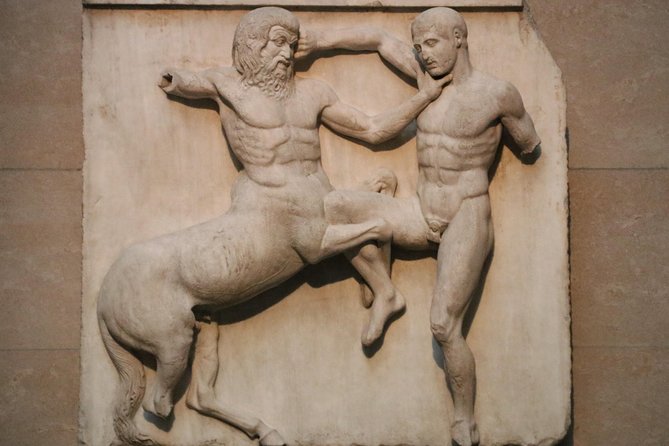
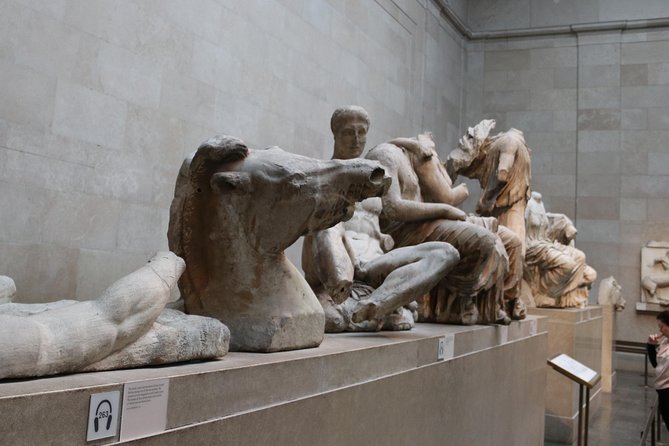
Greek and Roman objects show how art, politics, religion, and empire overlap. The Greek material includes the Elgin Marbles, a major museum highlight and one of the most debated collections in London.
The tour gives you a chance to think about the sculptures as ancient works of art, but also as objects shaped by excavation, removal, collection, and modern ownership debates. That makes the stop more useful than a quick look at marble figures followed by the next room.
Roman material broadens the story again. Rome did not simply create monuments. It built systems of administration, law, roads, military power, and cultural influence across a large empire.
The key benefit here is comparison. You can see how Greek ideas influenced Rome, how Roman power absorbed local traditions, and how later societies kept reusing the symbols of classical civilization.
Do not expect a full course in Greek or Roman art. The guide is choosing objects that serve the larger timeline, so a specialist may occasionally wish for more detail on one sculpture or inscription.
Vikings, Anglo-Saxons, and the making of Britain
Later parts of the route move toward northern Europe and early Britain. Viking material and Anglo-Saxon objects help replace the old image of a simple march from Rome to modern England.
This section puts migration, trade, warfare, belief, and craftsmanship into the same frame. It also helps explain why British history cannot be separated from wider European movement and exchange.
The Lewis Chessmen are a memorable stop. Their small size makes them easy to miss when you explore alone, but their design and cultural setting give the guide plenty to discuss. This is a good example of the tour’s method: an object does not need to be enormous to reveal a great deal.
The route may continue toward the Normans and early modern Britain, depending on the guide’s exact pacing. One account describes the timeline reaching Victorian London and Paris, while the published focus includes the path toward modern Britain. Expect a broad historical sweep rather than an exhaustive treatment of each period.
A look at the people behind the collection
The British Museum is not only a storehouse of ancient objects. It is also a record of changing ideas about discovery, ownership, scholarship, and public education.
The tour introduces archaeologists and explorers who helped build the collection, along with the practical work of excavation and interpretation. Stories involving figures such as Kathleen Kenyon and the excavations at Jericho add a personal dimension to the subject.
Jericho is especially useful for explaining what archaeologists can learn from layers of settlement. A city is not understood from one grand object alone. Its walls, tools, buildings, food remains, and repeated rebuilding can show how communities changed over time.
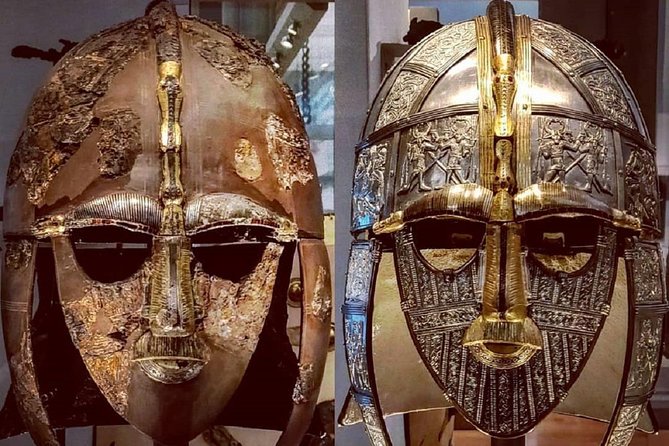
The route also includes Mrs Pretty and Sutton Hoo, a find linked with early medieval England. This helps connect field archaeology with museum display. Objects that seem isolated in a glass case once belonged to a burial, a household, or a working community.
That connection between excavation and display is one of the day’s most valuable ideas. You learn to ask what is missing, what survives, and how the museum’s arrangement shapes your understanding.
Breaks, lunch, and the reality of five and a half hours
Five and a half hours is a serious block of museum time. The good news is that the tour includes breaks. One schedule described a 40-minute lunch stop and a later 10-minute pause, with extra time used after an entry queue.
Lunch is not included, so bring your own food if you want to keep costs down. The museum food options can be limited and expensive, and a packed meal gives you more control over the break.
Standing is the bigger issue. Several accounts praise the small folding stools available inside the museum. If you need to sit regularly, look for one near the beginning of your visit and take it with you when practical.
The long format works because the guide keeps the story moving. Still, you should not book this expecting a relaxed lounge through the galleries. Wear comfortable shoes, keep water handy, and be honest about your tolerance for standing.
What the $83.34 price really buys
At $83.34 per person, this is not a cheap way to enter the British Museum. Since the museum itself has free admission, the value depends almost entirely on the guide and the structure.
I think the price makes sense for someone who wants a serious introduction to archaeology and ancient civilization in one morning. You are paying for five and a half hours of interpretation, a planned route across several departments, and the chance to ask questions while the objects are in front of you.
It is weaker value if you already know the museum well and prefer to set your own pace. You could spend nothing on admission, choose a few galleries, and read at leisure.
The tour’s high rating, 4.9 from 96 reviews, reflects how strongly it suits its target audience. The most praised features are Rossa’s passion, his storytelling, the chronological structure, and the amount of context. Those are exactly the qualities that justify the fee.
Who should book this British Museum tour?
I would choose this experience if you enjoy history, archaeology, ancient writing, and the stories behind discoveries. It is also a smart choice for a first visit if the museum feels intimidating and you want someone to give the collections a clear order.
It suits adults and older teenagers who can focus for long stretches. The official information says most people can participate, service animals are allowed, and the group can include up to 25 people.
I would not choose it if your main goal is a fast checklist of the Rosetta Stone, Elgin Marbles, Egyptian mummies, and other famous sights. You will see major highlights, but the pace is built around explanation, not speed.
You should also think twice if standing for long periods is difficult. A folding stool can help, and the tour includes pauses, but this remains a lengthy museum lesson.
Should you book it?
Book it if you want the British Museum to make sense. Rossa’s approach links early tools, city life, cuneiform, hieroglyphs, empire, Viking culture, and early Britain into one story, and that is difficult to create on your own in a single visit.
Skip it if you want freedom to linger over every gallery or if five and a half hours feels too long. For serious history fans, though, the price buys far more than a guided walk past famous objects. It gives you a way to understand why those objects matter.
FAQ
Where does the tour start?
It starts at Russell Square, on Bernard Street, London WC1N 1LJ.
What time does the tour begin?
The start time is 9:45 a.m.
Where does the tour finish?
It finishes at the British Museum on Great Russell Street, London WC1B 3DG.
How long does the experience last?
The tour lasts approximately five hours and 30 minutes.
Is admission to the British Museum included?
The museum admission is listed as free. The paid experience includes the qualified archaeologist guide.
Is lunch included?
No. Lunch is not included.
What language is the tour offered in?
The tour is offered in English.
How large can the group be?
The maximum group size is 25 people.
Is the tour suitable for most people?
The activity information says most travelers can participate. Service animals are allowed, and the meeting area is near public transportation.
Can I cancel for a full refund?
Yes, if you cancel at least 24 hours before the local start time. Cancellations made less than 24 hours before the start time are not refunded, and late changes are not accepted.
Recently added around London
- PRIVATE HIRE 45 min Speedboat Tour – Embankment/Westminster Pier★ 5.0 · 55 reviews
- Private Tour of London’s Historic Pubs★ 5.0 · 55 reviews
- From London: Glastonbury and Cheddar Gorge Guided Day Trip★ 4.8 · 55 reviews
- London: Kew to Westminster River Thames Cruise★ 4.2 · 55 reviews
- Gatwick Airport Taxi – Private Transfer to/from London★ 5.0 · 55 reviews
- London by Night – Tootbus Sightseeing Tour★ 3.5 · 55 reviews
- London: Tower of London After Hours Tour and Key Ceremony★ 4.8 · 56 reviews
- Palaces, Parliament & Power: A Walking Tour of London’s Royal City★ 5.0 · 56 reviews
Museums, compared.

Liverpool Football Club Museum and Stadium Tour
Read our review →
Tower of London and Crown Jewels Exhibition Ticket
Read our review →
Chelsea Football Club Stadium and Museum Tour
Read our review →




Browse the lists this tour appears in