
Reviewed · MUSEUMS
London: British Museum Archaeology Course and Guided Tour
Ancient games make the past feel close. This 5.5-hour British Museum tour turns a visit into a clear story of human civilization, led by qualified archaeologist Rossa, whose lively explanations connect objects to the people who made and used them. I especially like the chronological route, from early human tools to Egypt, Assyria, Greece, Rome, the Vikings, and the Aztecs. I also like the practical archaeology lessons, including how ancient writing was decoded and how objects are dated.
The main drawback is time. Five and a half hours gives you a strong framework, but the British Museum is far too large to see in one sitting. You will spend much of the day standing and listening, so comfortable shoes, water, and a folding stool from the museum entrance can make a real difference.
In This Review
- Key points at a glance
- Why this British Museum tour is different
- Meeting at Russell Square Station
- From early humans to the first cities
- Egypt, hieroglyphs, and the Rosetta Stone
- Assyria, cuneiform, and the problem of interpretation
- Greece, Rome, and the Parthenon Marbles
- The Royal Game of Ur and active learning
- Vikings, Sutton Hoo, and the Lewis Chessmen
- The Aztecs and the wider human story
- What the archaeology lessons add
- Is $81 a fair price?
- Comfort, pace, and accessibility
- Who should book this experience?
- Should you book the British Museum archaeology course?
- FAQ
- Where does the tour begin?
- How long does the experience last?
- Where does the tour finish?
- Is British Museum entrance included?
- Is lunch included?
- What should I bring?
- Is the tour wheelchair accessible?
Key points at a glance
- Human history in one clear route: Move from Stone Age tools and early African origins to the first cities, ancient empires, and later civilizations.
- Rossa brings archaeology to life: His energetic storytelling has kept both adults and 13-year-olds engaged for the full session.
- Famous objects with useful context: See the Rosetta Stone, Parthenon Marbles, Sutton Hoo Helmet, Lewis Chessmen, and other major pieces.
- More than a highlights tour: Learn how archaeologists date remains, interpret buried sites, and work out what ancient objects meant.
- A rare chance to play history: Try the Royal Game of Ur, a Mesopotamian board game whose rules were reconstructed by British Museum scholars.
- Good value for serious museum visitors: At $81 per person, the tour costs more than the museum’s free general admission, but it supplies expert teaching and a structured route.
Why this British Museum tour is different
The British Museum can be thrilling and bewildering in equal measure. You enter a grand collection filled with famous objects, then quickly face a practical problem: where should you begin, and how do you make sense of thousands of years of material?
This course solves that problem with a storyline. Rather than racing from one famous case to another, you follow the development of human societies. A tool, tablet, statue, helmet, or game board becomes part of a larger question: how did people live, organize themselves, record information, worship, trade, fight, and remember the dead?
I like this approach because it helps you see the museum as more than a display of beautiful things. You learn why the objects matter, what evidence they provide, and what remains uncertain. That is useful if this is your first visit, but it also works well if you have already wandered through the galleries and felt that the information panels only gave you fragments.
Rossa is the named guide associated with this experience. He is a qualified archaeologist and presents the material with enough energy to hold attention over a long day. His style combines archaeology, culture, folklore, language, and personal stories about discovery. The strong praise for his storytelling is important here, since five and a half hours can feel long when a guide simply recites dates and names. This tour depends on an active, engaging presentation, and Rossa’s approach appears to be one of its greatest strengths.
More Museum Visits in London
- Tower of London and Crown Jewels Exhibition Ticket
★ 4.5 · 6,677 reviews - London: Chelsea Football Club Stadium and Museum Tour
★ 4.8 · 4,576 reviews - Chelsea FC Stadium Tours and Museum
★ 5.0 · 1,908 reviews
Meeting at Russell Square Station
The tour begins outside Russell Square Station. Arrive 10 minutes early and look for the guide holding an iPad showing the local partner’s name.
From the station, you walk for about five minutes to the British Museum. This short start is simple, but it matters in central London, where a wrong exit or a late arrival can easily create stress. Give yourself enough time to find the correct station exit and meeting spot.
The route ends at the British Museum, so you do not need to return to Russell Square. That makes it easy to continue exploring Bloomsbury, walk toward Covent Garden, or use the museum as the next stop in a full day around central London.
The museum itself has free general admission, and entrance is included here. You also receive access through a separate entrance intended to help you skip the main line. The tour does not include lunch, so plan for that before you arrive. A 40-minute break is built into the long session, but it passes quickly if you need to queue for food.
Large bags and luggage are not allowed. Bring only what you need for the day. A small day pack has been suitable for past participants, but avoid arriving with a suitcase or oversized backpack.
From early humans to the first cities
The course begins with the origins of humanity and early tools. You consider early human development in Africa and the evidence that archaeologists use to reconstruct a world with no written records.
This section is valuable because it sets the rules for the rest of the visit. Before you can understand a royal statue or an ancient inscription, you need to know how archaeologists work with incomplete evidence. A stone tool may look plain beside gold jewelry or carved marble, yet it can reveal important changes in technology, diet, movement, and social life.
The story then moves toward Mesopotamia and the rise of the first cities. Here, the museum’s objects help explain how settled communities became larger and more organized. Writing, administration, trade, religion, and government all become easier to study once people begin leaving written records.
You should expect a fast-moving presentation rather than a full academic course on every civilization. The strength is the connection between each period. You are not simply told that one empire followed another. You are shown how new tools, systems of writing, urban life, and political power changed the human story.
Egypt, hieroglyphs, and the Rosetta Stone
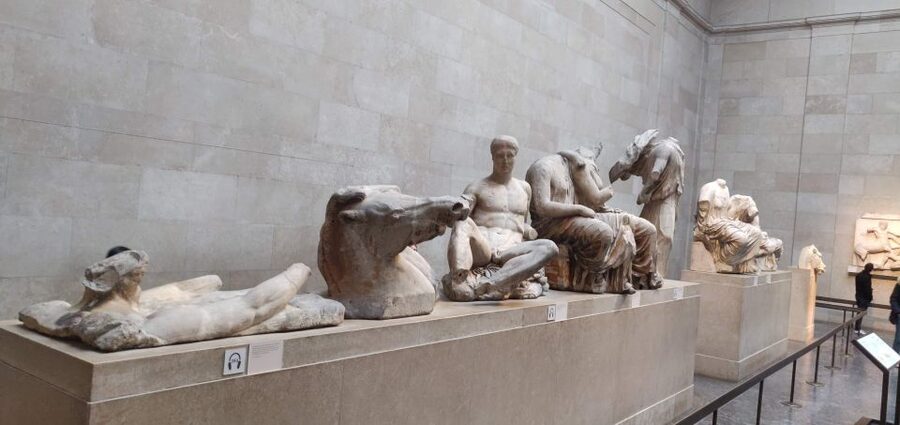
Ancient Egypt is one of the museum’s major draws, and the tour uses it to explain both the civilization itself and the work required to understand it.
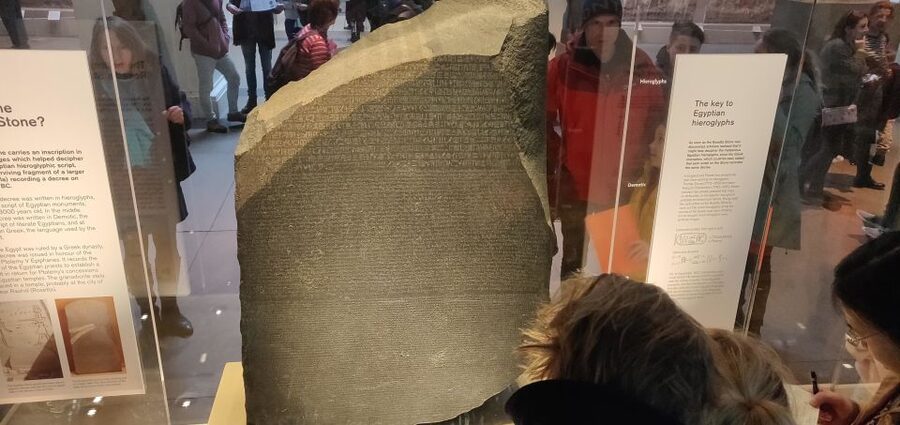
The Rosetta Stone is the obvious star. It is famous because its inscriptions helped scholars decipher Egyptian hieroglyphs, but the important point is not just to see the stone and hear its name. You learn how a single object containing multiple scripts gave researchers a way to compare languages and recover the meaning of a writing system that had become unreadable.
That lesson turns the Rosetta Stone from a famous slab into evidence of a long intellectual process. Decipherment did not happen by magic. It required careful comparison, persistence, and the work of scholars who recognized how the different versions of the text could be used together.
I like that this tour treats language as part of archaeology. Written records are not automatically clear. They must be read, translated, dated, and placed in their cultural setting. The same idea returns later with Sumerian cuneiform, described as the world’s earliest written language.
The Egyptian galleries can be busy, and you may not have time to study every case. That is the tradeoff for taking a guided route. You gain a strong explanation of selected objects, but you give up the freedom to stop wherever you like.
A different sort of outing around London:
- London: The London Eye Entry Ticket
★ 4.6 · 35,875 reviews - From London: Harry Potter Warner Bros Studio Tour
★ 4.7 · 26,588 reviews - London: Westminster to Greenwich River Thames Cruise
★ 4.5 · 22,836 reviews - Magical London: Harry Potter Guided Walking Tour
★ 4.7 · 22,044 reviews
Assyria, cuneiform, and the problem of interpretation
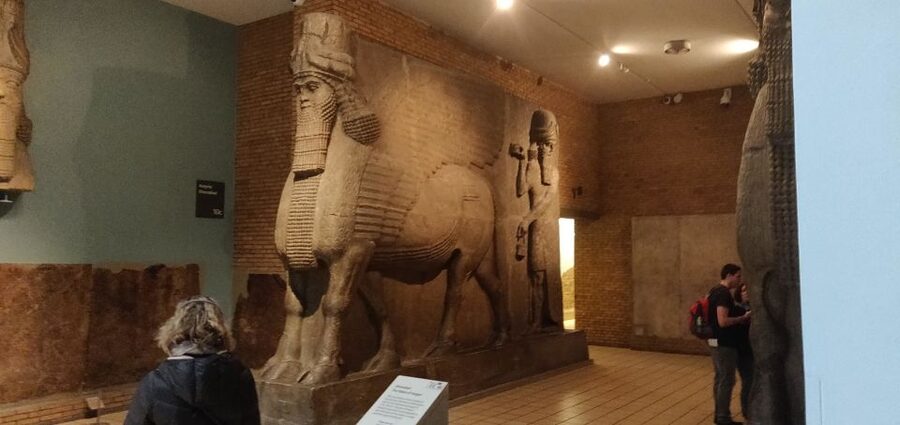
The Assyrian galleries extend the story of early states, writing, warfare, and imperial power. They also offer a chance to see how archaeology depends on fragments.
Cuneiform tablets and carved reliefs do not tell a complete story on their own. They reflect the people who made them, including rulers and administrators with their own reasons for recording events. Rossa’s archaeological approach helps you think about what the objects reveal and what they may leave out.
The decipherment of Sumerian cuneiform makes this part especially useful. You see how scholars recovered meaning from marks pressed into clay, and why the earliest forms of writing were tied to practical needs such as record keeping and administration.
This is where the course feels different from an ordinary highlights walk. You are not only shown a remarkable object. You are also introduced to the methods used to interpret it. That distinction can change the way you look at every later gallery.
Greece, Rome, and the Parthenon Marbles
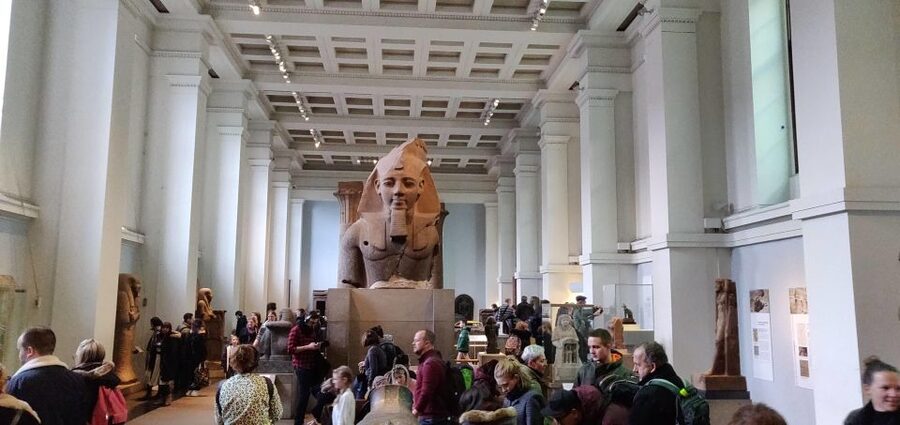
The tour continues into Ancient Greece and Rome, two sections that can easily fill an entire museum visit by themselves.
The Parthenon Marbles are among the museum’s best-known objects. On a standard visit, you might admire the scale, carving, and missing pieces before moving on. With an archaeologist leading the discussion, you get more help placing the sculptures within the history of Greek art, religious buildings, and later collecting.
The Roman material then expands the story from city-state culture to imperial rule. The course follows the broad sequence of civilization rather than treating Greece and Rome as isolated subjects. That gives you a clearer sense of how ideas, artistic styles, political systems, and military power moved across the ancient world.
This part can be demanding because the subject matter is dense. If you want a slow examination of every sculpture, inscription, and architectural fragment, a self-guided return visit will be necessary. The guided session gives you the main framework, then leaves you better prepared to explore alone.
The Royal Game of Ur and active learning
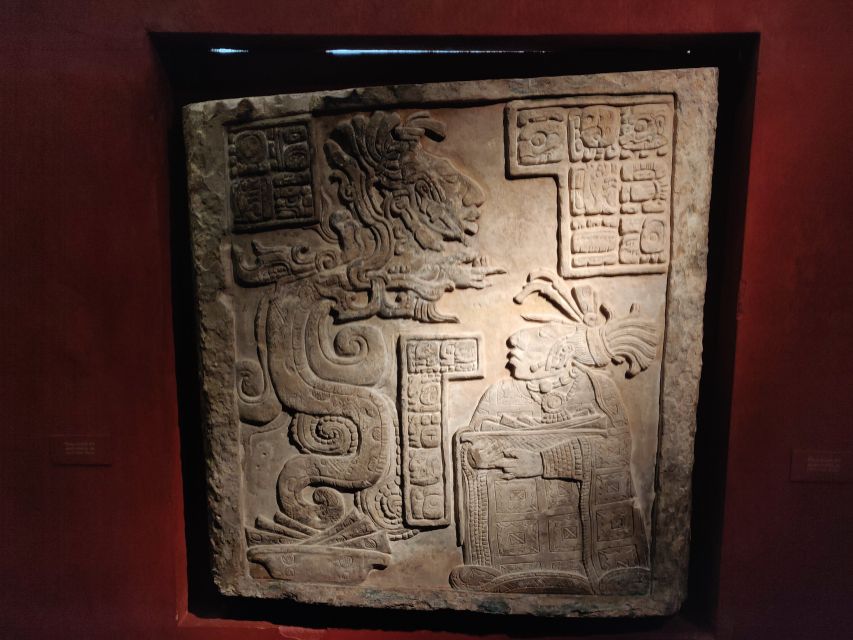
One of the most memorable elements is the chance to play the Royal Game of Ur, an ancient board game from Mesopotamia.
This small activity breaks up a long stretch of listening and gives you a direct connection with ordinary recreation in the ancient world. We often picture ancient people only through temples, rulers, graves, and wars. A game reminds you that they also spent time competing, relaxing, and making rules for fun.
The game’s rules were deciphered by British Museum scholars. That detail ties the activity back to the central theme of the course: archaeology is not only about finding objects. It is also about working out how those objects functioned.
For families, this is a welcome change of pace. A 13-year-old can follow the story more easily when there is something to do, not just something to look at. The activity also gives adults a practical way to remember the Mesopotamian section.
Vikings, Sutton Hoo, and the Lewis Chessmen
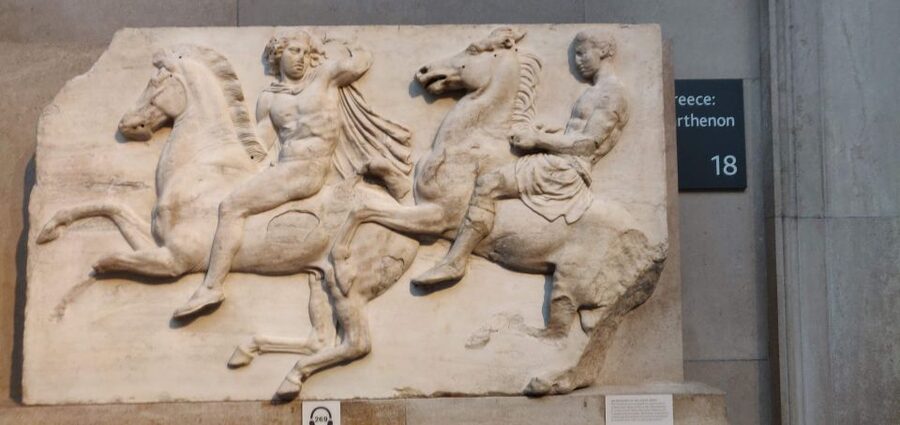
The chronological route does not stop with the classical world. You also visit galleries connected with the Vikings and later European cultures.
The Sutton Hoo Helmet offers a striking example of how archaeology can reshape our understanding of the past. A helmet is not merely a piece of equipment. It can point to status, craftsmanship, conflict, burial customs, and connections between cultures.
The Lewis Chessmen provide another useful contrast. Their small size and familiar form make them easy to approach, while their age and craftsmanship show how much care people once gave to games and objects used in daily life.
These later galleries help prevent the course from becoming an Egypt, Greece, and Rome tour. You see that the museum’s human story continues through changing societies, beliefs, technologies, and forms of art.
The Aztecs and the wider human story
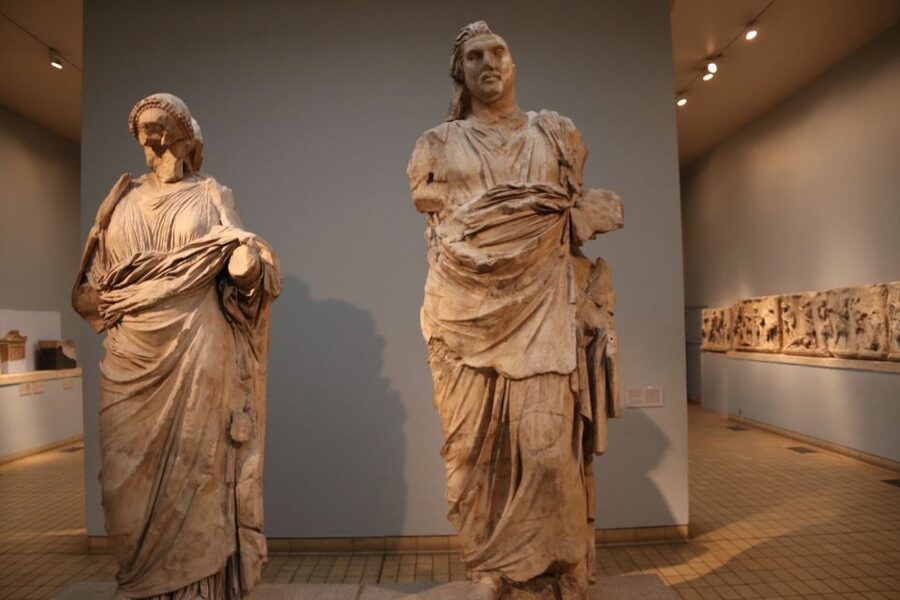
The Aztec galleries add another major civilization and broaden the geographic scope of the tour.
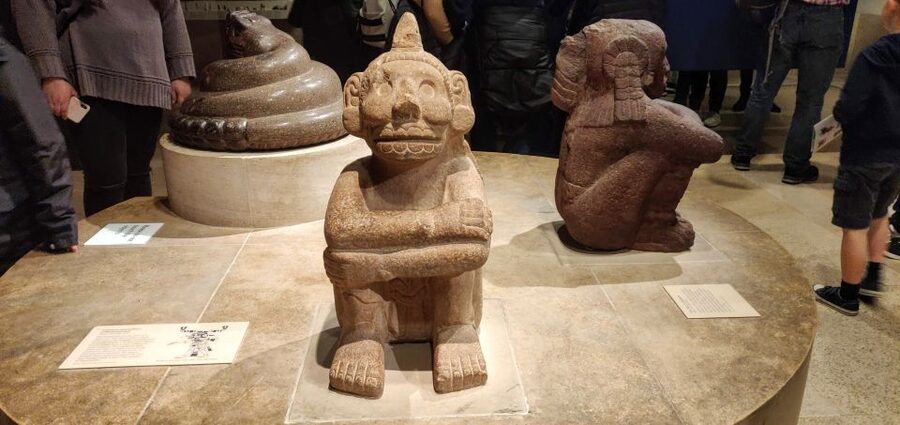
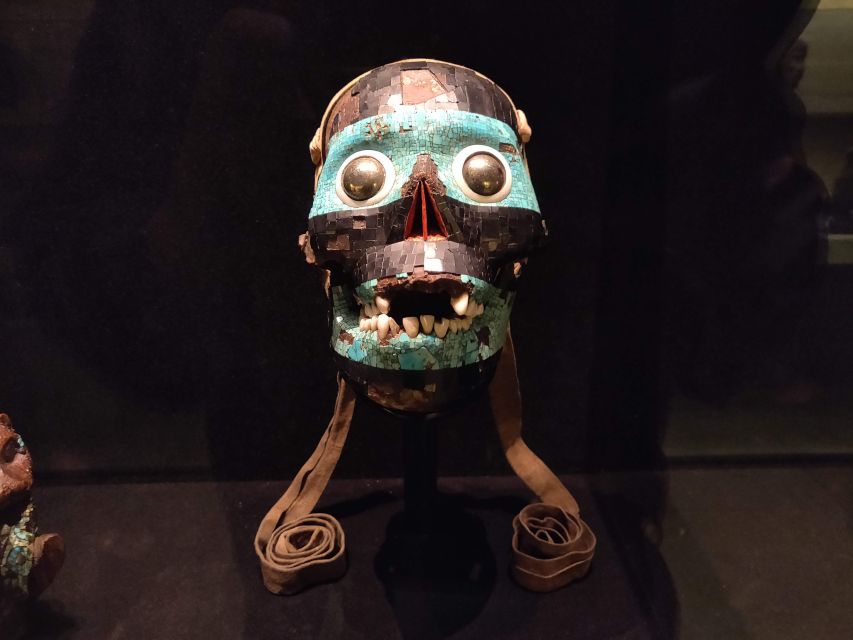
This matters because a course organized around human civilization can easily become too focused on the ancient Mediterranean and Near East. Including the Aztecs reminds you that complex societies developed in different parts of the world, with their own political systems, religious ideas, arts, and technologies.
The tour cannot give every culture equal time in five and a half hours. That is one of its limits. You get a carefully chosen route through selected galleries, not a complete account of every society represented in the museum.
Still, the wider range makes the overall course more useful. You are encouraged to compare civilizations rather than placing one at the center of the human story.
What the archaeology lessons add
The final part focuses directly on archaeological science. You learn how ancient sites become buried, how relics are dated, and why some questions remain unanswered.
This is perhaps the most useful material if you already enjoy museums but want to understand the work behind them. Burial can protect objects, damage them, or move them away from their original setting. Dating methods can establish an approximate period, but the result still needs interpretation. An artifact’s age does not automatically tell you who used it or why.
The course also shows that archaeology is an evidence-based field with limits. Some puzzles remain unresolved because the evidence is missing, damaged, or open to more than one reading. I appreciate that the experience does not present the past as a neat set of perfect answers.
That lesson stays with you after the tour. When you later visit another museum, you can ask better questions: Where was this found? Was it found with related objects? How was it dated? Who recorded or preserved it? What might be missing from the story?
Is $81 a fair price?
The price is $81 per person. The British Museum itself has free entrance, so you are paying for the archaeologist, the guided route, the teaching, and the separate entrance arrangement, not for admission alone.
For a casual visitor who wants to see a few famous objects, that may feel expensive. You can enter the museum for free and explore at your own speed. You might prefer that option if you dislike long tours, want to spend an hour in one gallery, or already know the collection well.
For a first visit, the value is stronger. Five and a half hours with a qualified archaeologist gives you a structured way through a collection that can otherwise feel scattered. It also saves you the effort of researching the museum’s major objects and building your own route.
I would consider the price fair for people who want teaching rather than simple sightseeing. It is less useful if you only have a short time in London or want a quick list of famous sights.
Comfort, pace, and accessibility
Wear comfortable shoes. You will be on your feet for much of the day, and the museum’s scale means that even a carefully planned route involves plenty of walking and standing.
A folding stool can help. The museum has portable stools available at the entrance, and using one is sensible during a long talk. Bring water, and plan your lunch before the break begins.
The experience is wheelchair accessible and suitable for people with limited mobility. Contact the provider ahead of time if you have specific requirements. Large bags and luggage are not allowed, so check your packing before leaving for the meeting point.
The tour is in English and uses a live guide. That makes it a good fit for anyone who enjoys asking questions and hearing a subject explained in real time. It may be less suitable if you need a quiet, self-paced visit or want information in another language.
Who should book this experience?
I would choose this course for:
- Families with older children who enjoy stories, puzzles, and ancient cultures
- First-time British Museum visitors who want a route through the major galleries
- Adults who prefer context and explanation over simply photographing famous objects
- Students and lifelong learners interested in archaeology, language, and early civilizations
- Museum fans who want to understand how objects are dated and interpreted
I would be more cautious if you have limited time, low tolerance for standing, or a strong wish to wander alone. The tour is long and focused. You should expect a full course, not a quick introduction.
Free cancellation is available up to 24 hours before the start, and you can reserve now and pay later. Those policies help if your London plans are still changing, but the bigger decision is simple: do you want a guided lesson or a free afternoon of independent museum browsing?
Should you book the British Museum archaeology course?
Book it if you want the British Museum to make sense. The strongest feature is not any single artifact, even one as famous as the Rosetta Stone. It is the way the tour links objects, writing, science, empire, daily life, and human development into one understandable route.
Rossa’s enthusiasm is a major part of the value. His ability to keep both adults and teenagers engaged, explain difficult subjects clearly, and add stories to the objects makes the long schedule feel purposeful.
Skip it if you only want a fast highlights visit or prefer to control every minute yourself. But if you have half a day, enjoy ancient civilizations, and want to leave with more than a camera full of museum photographs, this is a strong choice at $81.
FAQ
Where does the tour begin?
Meet your guide outside Russell Square Station. The guide will hold an iPad displaying the local partner’s name.
How long does the experience last?
The experience lasts 5.5 hours. Check availability for the starting times offered on your chosen date.
Where does the tour finish?
The tour finishes at the British Museum.
Is British Museum entrance included?
Yes. General entrance to the museum is free, and entrance is included as part of the guided experience.
Is lunch included?
No. Lunch is not included. A break is provided, so you should plan to buy food at the museum or bring a packed lunch if permitted.
What should I bring?
Bring comfortable shoes. Water is also a useful idea because the tour lasts several hours. Large bags and luggage are not allowed.
Is the tour wheelchair accessible?
Yes. The experience is wheelchair accessible and suitable for people with limited mobility. Contact the provider in advance if you have special requirements.
Recently added around London
- PRIVATE HIRE 45 min Speedboat Tour – Embankment/Westminster Pier★ 5.0 · 55 reviews
- Private Tour of London’s Historic Pubs★ 5.0 · 55 reviews
- From London: Glastonbury and Cheddar Gorge Guided Day Trip★ 4.8 · 55 reviews
- London: Kew to Westminster River Thames Cruise★ 4.2 · 55 reviews
- Gatwick Airport Taxi – Private Transfer to/from London★ 5.0 · 55 reviews
- London by Night – Tootbus Sightseeing Tour★ 3.5 · 55 reviews
- London: Tower of London After Hours Tour and Key Ceremony★ 4.8 · 56 reviews
- Palaces, Parliament & Power: A Walking Tour of London’s Royal City★ 5.0 · 56 reviews
Museums, compared.

Liverpool Football Club Museum and Stadium Tour
Read our review →
Tower of London and Crown Jewels Exhibition Ticket
Read our review →
Chelsea Football Club Stadium and Museum Tour
Read our review →




Browse the lists this tour appears in