
Reviewed · MUSEUMS
London: British Museum with Expert Guide.
Ancient stones tell surprisingly lively stories. This 80-minute British Museum tour gives you a clear route through major treasures, with a certified English-speaking guide to explain what you are seeing. I like the focus on famous objects, especially the Rosetta Stone and Parthenon Sculptures, and I like that guides such as Strabo keep the talk friendly, humorous, and easy to follow. The main drawback is the short running time: this is an introduction, not a full look at the museum.
You meet outside the Montague Place entrance, by the two stone lions, then return to that same meeting point at the end. The tour costs $20.20 per person, which is a fair price for help in a museum this large, though the overall experience depends heavily on your guide and the exact pace of your group.
In This Review
- Key points to know before you go
- Why a guide helps inside the British Museum
- Meeting at the Montague Place lions
- The Rosetta Stone and the key to Egyptian writing
- Mummies and the Egyptian idea of the afterlife
- The Parthenon Sculptures and ancient Greek power
- Assyrian lion hunts and royal power
- The Lewis Chessmen and a medieval mystery
- What the 80-minute pace feels like
- The guide’s style and the best audience
- Price, flexibility, and what you receive
- Staying after the guided route
- Should you book the British Museum guided tour?
- FAQ
- Where does the British Museum tour start?
- Does the museum have more than one entrance?
- How long does the guided tour last?
- What language is the tour conducted in?
- What objects are included in the tour?
- Can I explore the museum after the guided tour?
- Is the British Museum wheelchair accessible?
- Is photography allowed inside the museum?
- Can I bring food or drinks into the exhibition rooms?
- Can I cancel for a full refund?
Key points to know before you go
- The Rosetta Stone anchors the tour: You learn how one object helped scholars read ancient Egyptian hieroglyphs.
- Five major cultural stops fit into 80 minutes: Expect ancient Egypt, Greece, Assyria, and the medieval Lewis Chessmen.
- Strabo receives special praise: His clear explanations, good humor, and willingness to answer questions make the visit more personal.
- The Montague Place lions mark the meeting spot: This avoids confusion between the museum’s two entrances.
- You can stay afterward: The guided portion ends at the meeting point, but you can continue exploring the museum at your own pace.
- Wheelchair access is available: Some areas may still be harder to navigate, so plan for a little patience.
Why a guide helps inside the British Museum
The British Museum can be a thrilling place, but it can also feel like a giant attic with labels. It holds objects from across the world and across thousands of years. Without a plan, you may spend too long in one room and miss pieces you came specifically to see.
This tour solves that problem with a short route through landmark objects. Instead of trying to read every panel, you get a spoken explanation of why certain pieces matter. That is especially useful at the British Museum, where an object’s appearance often tells only part of its story.
I like guided visits here when I want a strong first orientation. You get dates, names, and basic context, but the best guides add a human touch. The strongest feedback for this experience praises guides who speak with enthusiasm, answer questions easily, and use humor without turning the subject into a comedy show.
Strabo is named as one such guide. His style is described as kind, helpful, and detailed without being hard to follow. That balance matters. A museum guide should help you see more, not bury you under a speech.
More Museum Visits in London
- Tower of London and Crown Jewels Exhibition Ticket
★ 4.5 · 6,677 reviews - London: Chelsea Football Club Stadium and Museum Tour
★ 4.8 · 4,576 reviews - Chelsea FC Stadium Tours and Museum
★ 5.0 · 1,908 reviews
Meeting at the Montague Place lions
The meeting point is outside the Montague Place entrance, by the two stone lions. The museum has two entrances, so this detail is important. Do not simply head to the first doorway you see and hope the group finds you.
The tour begins and ends at the British Museum. There is no separate transport segment, and the activity stays within the museum. That makes it easy to pair with other central London plans, provided you leave enough time to reach the meeting point.
You should arrive ready to identify the guide and group outside. Since starting times vary, check the selected time carefully when booking. The 80-minute duration is long enough for a useful introduction, but short enough to fit before lunch, an afternoon appointment, or another London sight.
The museum is wheelchair accessible, although some areas may be more difficult to navigate. If you use a wheelchair, allow extra time and be prepared for a less direct route in parts of the building.
The Rosetta Stone and the key to Egyptian writing
The Rosetta Stone is the natural opening star. It is famous not simply because it is old, but because its inscriptions helped scholars work out ancient Egyptian hieroglyphs.
Your guide can turn a slab of dark stone into a story about language and comparison. The same message appears in different scripts, giving researchers a way to match known writing with the mysterious symbols. That connection changed the study of ancient Egypt.
This is a good first stop because it teaches you how museums work. The object is not only beautiful or important on its own. Its value comes from the questions it helps answer. Once you understand that, you begin to look at the rest of the collection with sharper eyes.
The Rosetta Stone area can attract attention, and the object is one of the museum’s most sought-after sights. A guide helps you focus on the details and keeps the visit from becoming a quick photograph followed by a walk away.
Mummies and the Egyptian idea of the afterlife
The Egyptian section shifts the story from writing to belief. You see mummies and coffins while learning about the rituals and methods used to preserve bodies.
This part is more than a display of ancient remains. It explains how Egyptians viewed death as part of a continuing journey. Coffins, wrapping, burial practices, and objects placed with the dead all point to ideas about identity, protection, and life after death.
I find this section particularly useful with a guide because it is easy to treat mummies as curiosities. A good explanation restores the people behind the objects and shows that these were not random displays. They belonged to a system of religious beliefs and careful preparation.
The Egyptian collection is extensive, so the guide’s selection matters. In 80 minutes, you will not see everything. The benefit is that you get a manageable sample, with enough explanation to make later independent exploration more rewarding.
A different sort of outing around London:
- London: The London Eye Entry Ticket
★ 4.6 · 35,875 reviews - From London: Harry Potter Warner Bros Studio Tour
★ 4.7 · 26,588 reviews - London: Westminster to Greenwich River Thames Cruise
★ 4.5 · 22,836 reviews - Magical London: Harry Potter Guided Walking Tour
★ 4.7 · 22,044 reviews
The Parthenon Sculptures and ancient Greek power
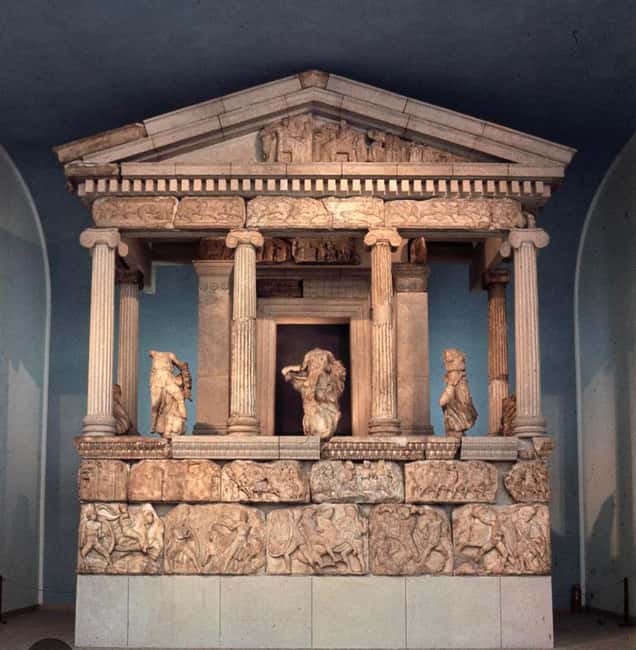
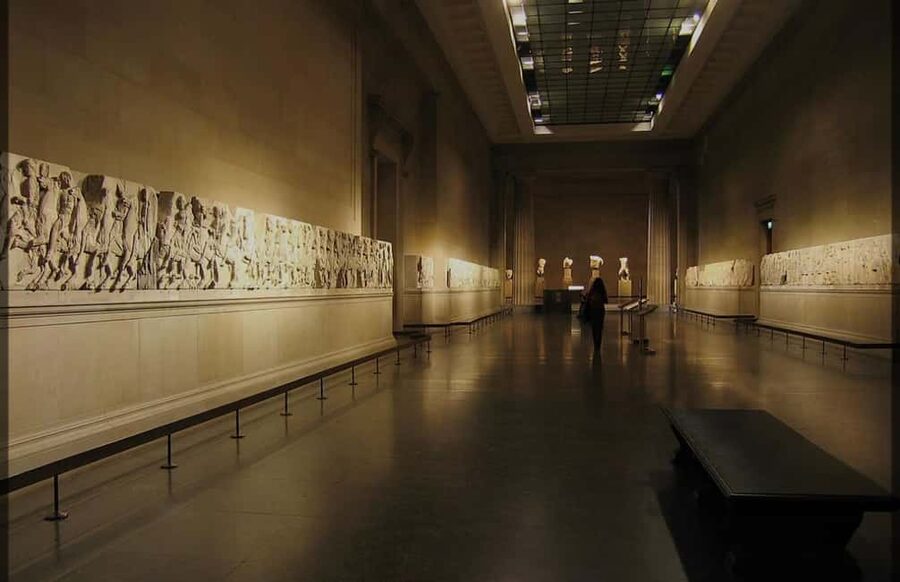
The tour then reaches the sculptures from the Parthenon in Athens, often called the Elgin Marbles. Created in the 5th century BCE, these works show scenes connected with Greek mythology and offer a glimpse of the artistic ambition of ancient Greece.
Look closely at the figures, movement, and carved fabric. Even in damaged or incomplete form, the sculptures suggest how grand the Parthenon once appeared. Your guide can help connect the fragments to the building and the stories they once represented.
This stop also carries a modern political question. The sculptures remain a subject of dispute between Britain and Greece, and the tour description presents them mainly through their artistic and historical importance. If this issue matters to you, ask your guide what current information they can add. One piece of feedback specifically suggested that current affairs would make the conversation even better.
That is a useful reminder: a museum tour can explain the past while leaving room for present-day questions. The guide may not have unlimited time, but an informed question can add a current edge to an ancient display.
Assyrian lion hunts and royal power
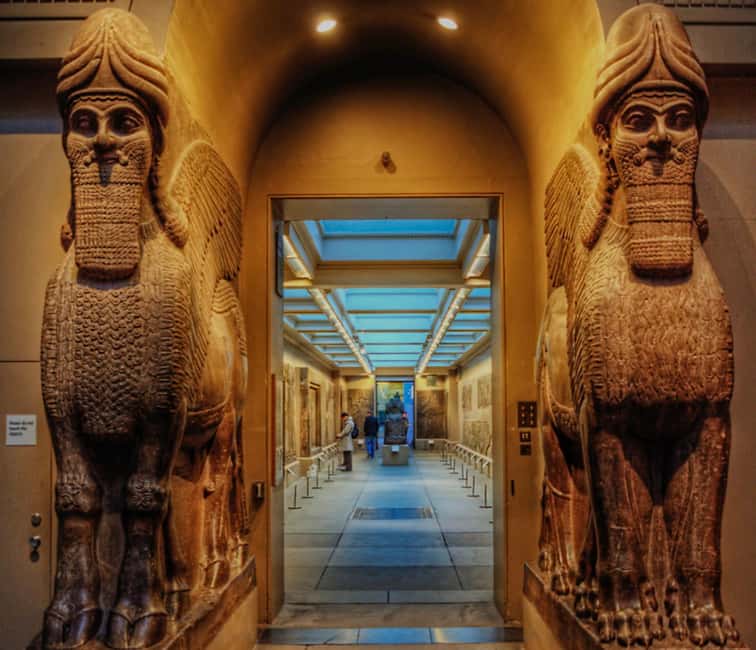
The Assyrian lion hunt reliefs provide one of the tour’s most dramatic changes in mood. These carved panels show royal hunting scenes and reveal how Assyrian rulers wanted their power to be seen.
The reliefs are detailed, especially in the treatment of animals, movement, and tension. They are not quiet nature scenes. They present the king as brave, controlled, and powerful, while the wounded lions create a strong emotional charge.
A guide helps you read the visual message. You can look beyond the skill of the carving and ask why the scene was made, who would have seen it, and what it says about kingship. The panels become political art as well as sculpture.
This is one of the sections highlighted by visitors who used Strabo’s guidance, along with the Rosetta Stone and Parthenon Sculptures. It makes sense as a core stop because the reliefs are visually striking and offer a different picture of civilisation from the Egyptian and Greek rooms.
The Lewis Chessmen and a medieval mystery
The Lewis Chessmen bring the tour closer to home and closer to the medieval period. These small carved figures were found on the Isle of Lewis in Scotland and are linked to Viking culture.
They are memorable because they feel personal. Unlike a huge temple sculpture or royal relief, chess pieces invite you to imagine hands picking them up and moving them across a board. The carved faces and poses give each figure a distinct character.
Your guide can explain the mystery around their discovery and why they matter as medieval objects. They also show how cultural connections crossed the North Atlantic. The pieces are Scottish in discovery, yet their wider story reaches into the Norse world.
This stop adds variety to the tour. You move from writing and burial customs to monumental sculpture, royal propaganda, and a board game. That range is one of the strongest reasons to choose a guided highlights visit rather than a tour focused on only one civilisation.
What the 80-minute pace feels like
Eighty minutes moves quickly in a museum of this size. You should think of the tour as a well-chosen introduction, not a complete museum visit.
The advantage is focus. You are less likely to get lost, spend half an hour reading one gallery label, or leave without seeing the objects that brought you inside. Several strong experiences with guides followed a similar pattern: the guide covered the key exhibits, answered questions, and then allowed time to continue independently.
The possible weakness is depth. You may want longer explanations about Egypt, Assyria, Greece, or the Lewis Chessmen, but the clock keeps moving. If you already know the British Museum well, you may find the route familiar. In that case, the value comes from the guide’s interpretation and ability to connect the objects.
The pace also depends on the group. A lively group with many questions can make the talk more engaging, but it may reduce the time available at each exhibit. The guide’s skill in keeping the route moving matters a great deal.
The guide’s style and the best audience
The guide is the heart of this experience. The strongest comments praise clear explanations, enthusiasm, humor, politeness, and an easy ability to answer questions. One guide managed to keep the material suitable for the youngest teenager in a family while still giving adults useful information.
That makes this a good choice for mixed-age groups. Teenagers may appreciate the stories and visual drama more than a long academic lecture. Adults get the historical framework, while children can connect with mummies, kings, lions, and chess pieces.
It also suits first-time British Museum visitors who want orientation without committing to a much longer tour. The experience is conducted in English, so you should be comfortable following spoken English for 80 minutes.
Independent museum explorers may prefer to skip the guide and set their own route. You pay for structure and explanation here. If your main goal is quiet, unhurried examination of one particular room, an unguided visit gives you more control.
Price, flexibility, and what you receive
At $20.20 per person, the price is modest for a live guided visit in one of London’s major museums. The fee pays for the guide’s route, explanations, and help making sense of objects that can be hard to understand from labels alone.
The value is strongest if you have limited time. Paying a small amount to see the major highlights in a sensible order can prevent a wasted visit. It is also useful if you are visiting with family members who would lose interest during an unstructured museum wander.
The price is less compelling if you plan to spend several hours in the museum and already know exactly what you want to see. You may prefer to explore on your own and spend that time with specialist galleries.
You can reserve now and pay later, which helps if your London schedule is still changing. Cancellation is free up to 24 hours before the activity for a full refund. Those terms reduce the risk of booking a short tour around a busy sightseeing day.
Photography is allowed inside, but flash photography is prohibited. Food and drinks are not allowed in the exhibition rooms, so finish your snack before entering the galleries.
Staying after the guided route
The formal activity ends back at the Montague Place meeting point, but you can stay and continue exploring the collection at your leisure. This is a major benefit.
Use the 80-minute tour to get your bearings, then return to the areas that caught your attention. You might want more time with the Egyptian objects, a second look at the Assyrian reliefs, or a slower examination of the Parthenon Sculptures.
The gift shop is also available after the tour, with books, souvenirs, and replicas. A book can be a better reminder of the museum than a rushed purchase of a small trinket, especially if the guide has sparked interest in one civilisation.
Should you book the British Museum guided tour?
Book it if you want the museum’s essential objects explained by a live guide in a compact 80-minute route. I would especially recommend it for first-time visitors, families with teenagers, and anyone who wants to see the Rosetta Stone, Egyptian objects, Parthenon Sculptures, Assyrian reliefs, and Lewis Chessmen without planning a route alone.
The tour is also a smart choice if you value a friendly guide who can answer questions and keep the history lively. Strabo’s praised style suggests the best version of this experience is warm, clear, and lightly humorous rather than stiff or overly academic.
Skip it if you want a long, slow study of one collection or if you already know the museum well. The short format cannot cover every room, and the quality of the visit rests heavily on the individual guide.
For $20.20, the tour offers good value as an orientation. Plan to stay afterward, and you get the best of both approaches: expert guidance first, independent museum time second.
FAQ
Where does the British Museum tour start?
It starts outside the Montague Place entrance, by the two stone lions.
Does the museum have more than one entrance?
Yes. The British Museum has two entrances, so use the Montague Place entrance and look for the stone lions.
How long does the guided tour last?
The guided tour lasts 80 minutes.
What language is the tour conducted in?
The live tour guide speaks English.
What objects are included in the tour?
The route includes the Rosetta Stone, Egyptian mummies and coffins, the Parthenon Sculptures, Assyrian lion hunt reliefs, and the Lewis Chessmen.
Can I explore the museum after the guided tour?
Yes. The activity ends back at the meeting point, and you can stay afterward to explore the museum independently.
Is the British Museum wheelchair accessible?
The museum is wheelchair accessible, though some areas may be more challenging to navigate.
Is photography allowed inside the museum?
Photography is allowed, but flash photography is prohibited.
Can I bring food or drinks into the exhibition rooms?
No. Food and drinks are not allowed inside the exhibition rooms.
Can I cancel for a full refund?
Yes. You can cancel up to 24 hours in advance for a full refund.
Recently added around London
- PRIVATE HIRE 45 min Speedboat Tour – Embankment/Westminster Pier★ 5.0 · 55 reviews
- Private Tour of London’s Historic Pubs★ 5.0 · 55 reviews
- From London: Glastonbury and Cheddar Gorge Guided Day Trip★ 4.8 · 55 reviews
- London: Kew to Westminster River Thames Cruise★ 4.2 · 55 reviews
- Gatwick Airport Taxi – Private Transfer to/from London★ 5.0 · 55 reviews
- London by Night – Tootbus Sightseeing Tour★ 3.5 · 55 reviews
- London: Tower of London After Hours Tour and Key Ceremony★ 4.8 · 56 reviews
- From London: Cotswolds Guided Trip Including Bourton-on-the-Water★ 4.5 · 56 reviews
Museums, compared.

Liverpool Football Club Museum and Stadium Tour
Read our review →
Tower of London and Crown Jewels Exhibition Ticket
Read our review →
Chelsea Football Club Stadium and Museum Tour
Read our review →




Browse the lists this tour appears in