
Reviewed · ROMAN BATHS TOURS
Bath: Roman Baths Entry Ticket with Audio Guide
History still bubbles beneath Bath. This ticket opens one of Britain’s most remarkable ancient sites, where you can walk around the Great Bath, see the temple of Sulis Minerva, and follow a detailed audio guide at your own pace. I especially like the excellent museum displays and the way projected scenes help explain the ruins. The included spa-water tasting adds a small but memorable finish.
The main drawback is that this is a self-guided visit, yet the price is about $30.31 per person. That can feel high if you rush through, and the handheld audio unit may tire your arm because it is not worn as headphones. Still, the site is larger than it looks from the street, and you can easily spend two hours or more here.
In This Review
- Key points to know before you go
- What this Bath attraction really is
- Starting in the museum galleries
- The Gorgon’s head and Sulis Minerva
- Seeing the Great Bath for the first time
- Exploring rooms beyond the Great Bath
- Why the audio guide is worth using
- The spa-water tasting
- Allow enough time and choose your hour
- Is $30.31 good value?
- Who should book this experience?
- Should you book the Roman Baths ticket?
- FAQ
- How long is the Roman Baths ticket valid?
- Is an audio guide included?
- Can I enter the water at the Roman Baths?
- Is the Roman Baths accessible by wheelchair?
- Are children catered for on the audio guide?
- Can I bring luggage, a stroller, or a pet?
Key points to know before you go
- The Great Bath is only the centerpiece: The visit also includes temples, heated rooms, plunge pools, a sauna, museum galleries, and Roman objects.
- The audio guide does the heavy lifting: It is available in 12 languages, with a separate BSL video guide, and gives useful context at each marked stop.
- Arrive early for a calmer visit: The museum can become crowded soon after opening, while early entry gives you more room around the Great Bath.
- Look closely at the Gorgon’s head: This huge temple decoration may show the mythical monster, or perhaps a water god.
- Save time for the final tasting: The spa water contains more than 43 minerals and is available from a dedicated tap.
- Pack light: Pets, baby strollers, luggage, and large bags are not allowed.
What this Bath attraction really is
The Roman Baths are not a working spa where you can bathe today. They are an archaeological site and museum built around the hot spring that drew people here nearly 2,000 years ago.
Roman visitors came for two linked reasons: the water was thought to have healing powers, and the spring was sacred to Sulis Minerva. This goddess combined the local Celtic deity Sulis with the Roman goddess Minerva. The result was a religious center as well as a place for bathing and social life.
That combination gives the site its character. You are not simply looking at old stone pools. You are tracing how worship, medicine, engineering, and everyday life met in one Roman complex.
I like that the visit begins with objects and stories before taking you to the Great Bath. You first learn about the people who used this place, then see the rooms where their rituals and bathing took place. Without that museum section, the exposed stonework would be much harder to understand.
More Roman Baths Visits:
- Bath: City Walking Tour with Optional Roman Baths Entry
★ 4.7 · 1,401 reviews - Roman Baths and Bath City Walking Tour
★ 4.5 · 762 reviews - Bath: Guided City Walking Tour with Entry To The Roman Baths
★ 4.8 · 343 reviews
Starting in the museum galleries
After redeeming your ticket at the Roman Baths, you enter the museum and collect the audio guide. The route is clearly marked, and numbered points tell you where to listen. Arrows help keep the visit moving in the intended direction, though you remain free to pause and spend as long as you like in each area.
The audio guide is one of the strongest parts of the experience. It is offered in English, Dutch, French, German, Italian, Japanese, Chinese, Korean, Polish, Russian, Portuguese, and Spanish. A handheld BSL video guide is also available.
The commentary covers the objects in front of you rather than giving only broad historical facts. That makes a difference. You can look at a particular piece while hearing why it mattered, instead of trying to read every panel in a crowded room.
There is also a children’s version of the guide. It is designed to be more entertaining and easier for younger listeners to follow. I would particularly recommend it for children from around eight years old, though interest will vary. Families with time could listen to both versions at selected points, since the children’s commentary adds its own details.
The equipment is easy to use, but it is a handheld unit. If you hold it up for the entire route, your shoulder or arm may become uncomfortable. Parents may also find it awkward while helping children. Bring your own headphones only if the venue’s equipment and connection rules permit it, as the supplied information does not confirm headphone compatibility.
The Gorgon’s head and Sulis Minerva

Two museum pieces deserve extra time.
The first is the Gorgon’s head, which once decorated the temple pediment. It would have looked down from around 15 metres above anyone approaching the temple. The face is forceful and a little unsettling, exactly the sort of image intended to make a sacred building feel powerful.
But the identity is not completely certain. It may represent the Gorgon from Greek mythology, or it may be a depiction of a water god. That uncertainty gives you something to think about instead of a simple label to accept.
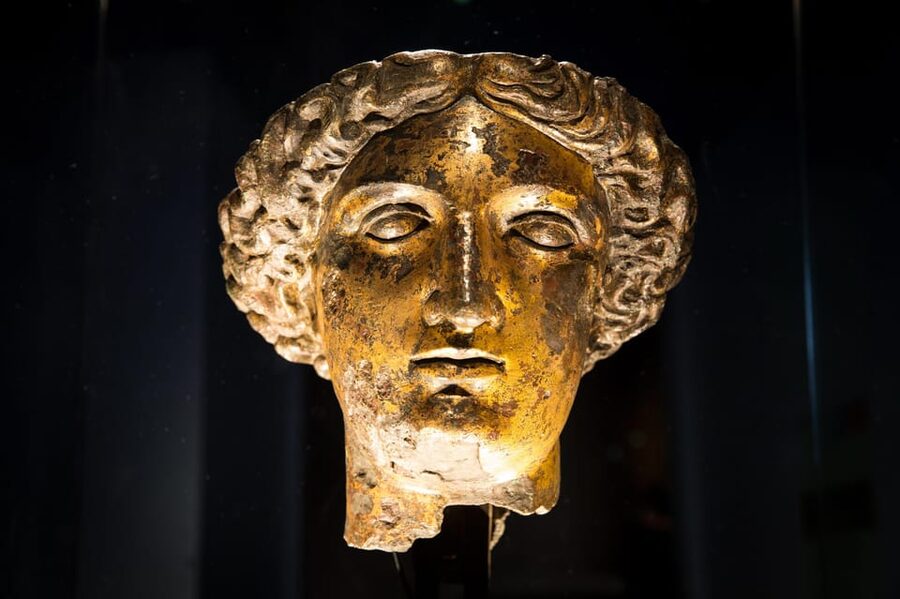
The other major object is the gilt bronze head of Sulis Minerva. This once belonged to the cult statue inside the temple. Its workmanship is striking, and its fixed gaze helps you picture the goddess presiding over the sacred space.
These objects also explain why the baths were more than a practical bathing facility. People came to ask the goddess for help, make offerings, and seek relief from illness. The museum includes possessions left behind by people in Roman Britain, giving the site a human scale beyond emperors and grand buildings.
Seeing the Great Bath for the first time

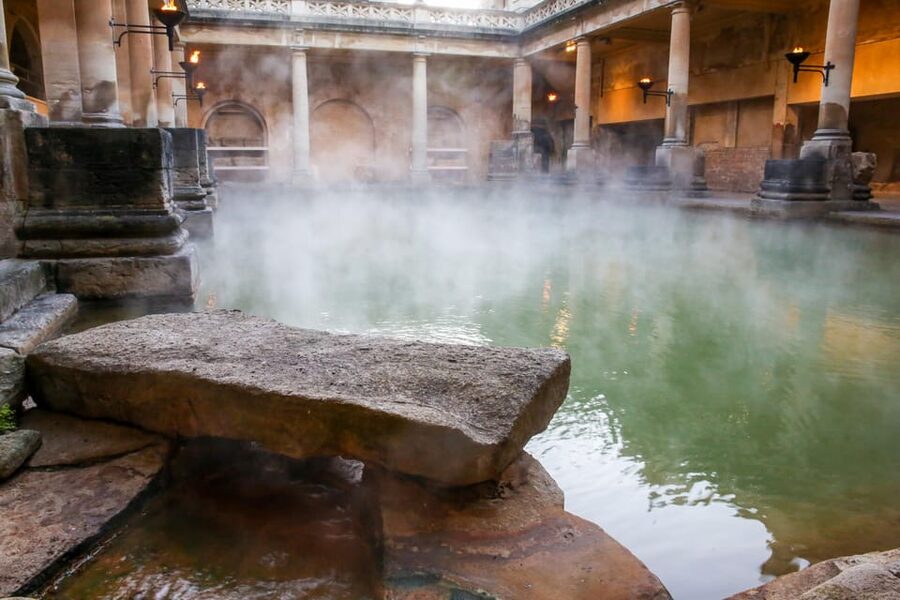
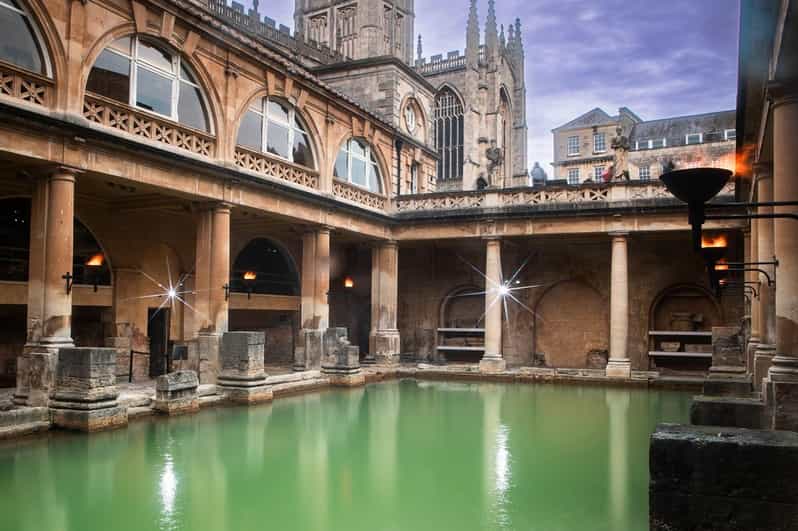
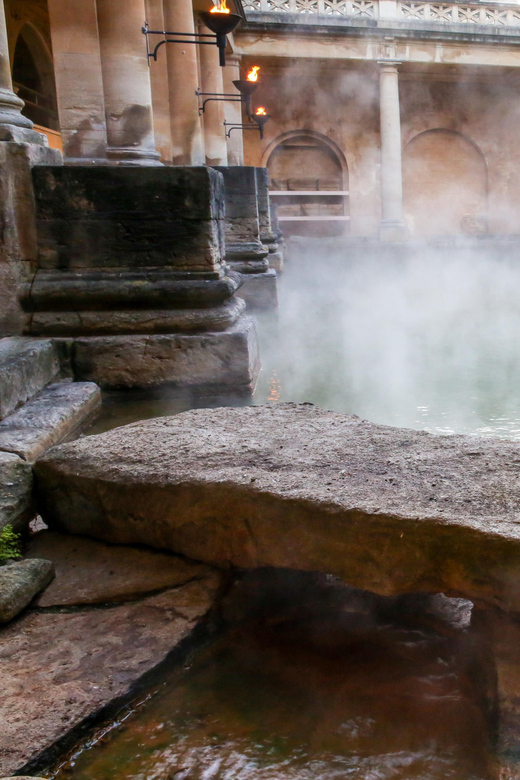
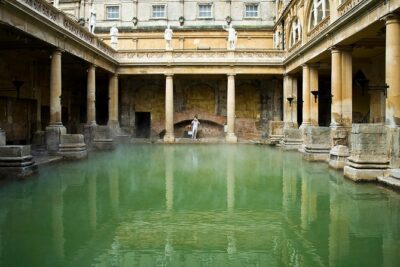
The route eventually brings you out to the Great Bath, the famous pool shown in most photographs of Bath. A stone walkway runs around the water, with the modern rooftops of Bath visible above the ancient complex.
On a cold morning, steam often rises from the warm water. It is one of the most atmospheric moments of the visit, especially when the weather makes the heat visible. The water looks inviting, but you cannot enter it.
Take a slow lap around the pool before moving on. The walkway lets you see the pool from several angles, and the audio commentary helps explain how the Roman bathing complex functioned. This is also the busiest area, so early entry matters if you want a clearer view and fewer people around the edge.
Some of the best photographs come from simply looking down across the water and then up toward the stone buildings of modern Bath. Ancient and present-day Bath occupy the same tight space, which is part of the attraction.
The Great Bath can feel crowded at busy times. The audio guide helps because you can move at your own speed, but it cannot create more room. If you arrive late in the day, remember that last entry is one hour before closing, leaving less time for a slow visit.
A few more trips worth a look before you book
- London: Emirates Stadium Entry Ticket and Audio Guide
★ 4.7 · 5,513 reviews - Westminster Abbey Entrance Ticket Including Audio Guide
★ 4.0 · 661 reviews - London: British Museum Audio Tour & Priority Entrance Ticket
★ 4.5 · 631 reviews - Western Approaches Self Guided Tour
★ 5.0 · 505 reviews
Exploring rooms beyond the Great Bath

It is easy to spend all your time at the main pool and miss the rest. Do not make that mistake. The East Baths, West Baths, Roman Gym, sauna, and Circular Bath show how much more was involved in Roman bathing.
The East Baths included heated rooms and massage facilities. These spaces help you picture bathing as a long social routine rather than a quick wash. Visitors moved through different temperatures and activities, with time for conversation and treatment.
The Roman sauna, known as a laconicum, is another useful stop. The name may be unfamiliar, but the purpose is easy to grasp once the audio guide explains how heat was used. The evidence here also gives you a better sense of the engineering behind the complex.
The West Baths contain plunge pools. Their cooler water would have offered a sharp contrast to the heated rooms. The route does not ask you to imagine everything from a single pool. Instead, you see the separate spaces that made up a large bathing system.
The Circular Bath provides another change of shape and scale. It is a good reminder that the Roman Baths were not designed as one grand pool, but as a series of connected rooms with different roles.
Subtle video projections in some rooms show how the Romans may have used the spaces. These do not replace the ruins. They give you just enough visual help to imagine walls, people, and activity without turning the site into a theme park.
Why the audio guide is worth using

You can look around without listening, but I would not recommend it. The ruins are impressive, yet much of their meaning is not obvious from the stones alone.
The guide explains the layout, the religious purpose of the spring, the bathing routines, and the objects found on site. It also helps you notice details you might otherwise pass. Each stop is labelled, and you can pause or replay information instead of keeping up with a group.
That freedom is valuable if one person in your party walks slowly, wants to take photographs, or needs regular seats. The route includes places to rest, though the visit still involves standing and walking through several levels.
The audio guide is also a good option for mixed-age groups. Adults can choose the fuller commentary, while children listen to their own version. You do not have to move together at every point, which makes the visit less stressful than a tightly timed guided tour.
The tradeoff is the equipment. Holding the unit can become tiring during a visit lasting two hours or more. The attraction is wheelchair accessible to around 90 percent, with elevators available for different levels, but not every part is fully accessible. If you have a mobility concern, allow extra time and make use of the available seating.
The spa-water tasting
Near the end, you can sample the spa water from a dedicated drinking tap. It contains more than 43 minerals and has been associated with the supposed healing qualities of Bath’s spring for centuries.
I would treat this as a historical experience, not medical advice. The taste may not be to everyone’s liking, but it connects the modern visit with the reason people came here in the first place. After seeing how the Romans revered the spring, tasting the water gives you a direct, if unusual, link to the site.
The tasting is brief, so do not expect a full spa treatment or a comfortable refreshment room. One person with a leg problem found the available rest points useful but wished for a longer place to sit and take refreshments. That is fair criticism. If you need frequent rests, plan a slower route and do not feel pressured to keep moving.
Allow enough time and choose your hour
The ticket is valid for one day, with entry times based on availability. Check the available starting time before booking, then arrive with enough room for the full museum and bathing complex.
A quick visit is possible, but it would miss much of what makes the admission worthwhile. I would allow at least two hours if you want to listen to the audio guide, inspect the main objects, walk through each bathing area, and stop at the spa-water tap. A longer visit is reasonable if you read many labels or need regular rests.
The clearest practical tip is to go early. The site can fill quickly, especially in the museum and around the Great Bath. An early time slot gives you more space and makes the audio commentary easier to follow.
Buying ahead can also reduce worry if your day is tightly planned. One party arrived late after a rental-car problem and was accommodated after contacting the attraction, but I would not count on that every time. The ticket is non-refundable, so choose your time carefully.
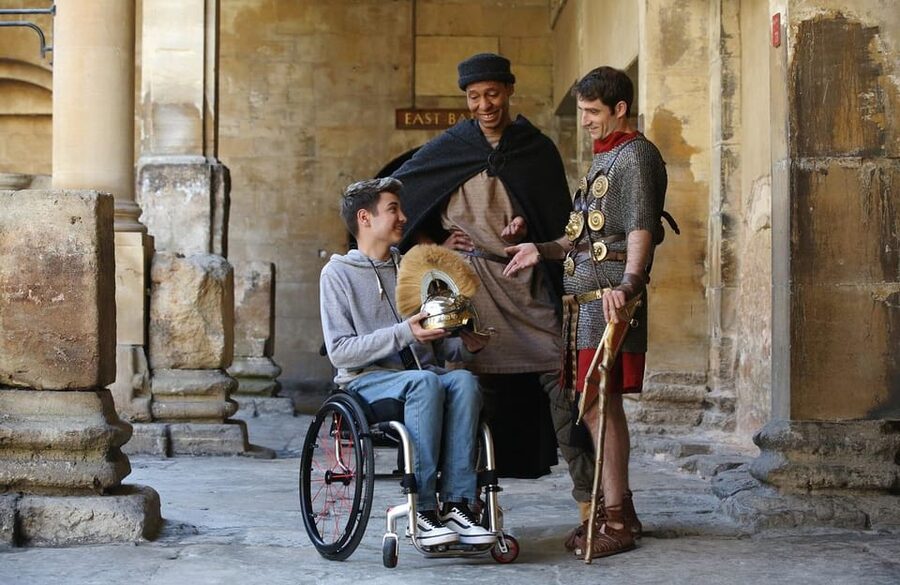
Although the booking information describes this as a small group limited to six participants, the actual attraction is a self-guided public museum visit rather than a private guide-led tour. You will not have a guide walking beside you and answering questions throughout. Costumed Roman characters may appear at the baths, and you can ask them about life in Roman Britain or pose for a photograph, but their availability is not guaranteed at every moment.
Is $30.31 good value?

At about $30.31 per person, the ticket is not a cheap walk-in attraction. Some people may feel the cost is high for a self-guided visit, particularly because the audio guide is delivered through a handheld device rather than a live historian.
I think the value improves when you use the full route. You are paying for a substantial museum, a major archaeological site, multilingual commentary, accessibility equipment such as elevators, costumed interpretation, and the spa-water tasting. The complex is also considerably larger than its street entrance suggests.
The audio guide is the key to making the price work. It is detailed, easy to navigate, and lets you spend extra time where your interest is strongest. If you plan to rush in for a photograph of the Great Bath and leave, the admission will feel expensive. If you treat it as a two-hour historical visit, it becomes a more reasonable use of your Bath sightseeing budget.
The shop adds another optional stop. It sells jewellery, prints, books, homeware, games, bathing products, local honey, botanical gin, handmade soaps, and other goods from independent makers. You do not need to buy anything, but it is a convenient place to find a souvenir connected to the site and the city.
Who should book this experience?
I would recommend it to first-time visitors to Bath, families with older children, history fans, and anyone who prefers to set their own pace. The children’s audio option and projected scenes make the visit more approachable than a museum filled only with labels and fragments.
It also works well in poor weather because much of the route is indoors or sheltered. The exposed Great Bath is the main outdoor section, so you can still enjoy the visit on a wet day.
You may want to reconsider if you dislike handheld audio guides, cannot stand or walk for long periods, or prefer a live guide to answer questions. The site has seating and is around 90 percent wheelchair accessible, but it is not completely accessible in every area. Large bags, luggage, pets, and baby strollers are not allowed, so plan accordingly.
Should you book the Roman Baths ticket?
Yes, if you have time to listen properly. The Great Bath is the visual highlight, but the museum objects, temple remains, heated rooms, plunge pools, and audio commentary give the visit its real substance.
Book an early time if possible, allow at least two hours, and use the child or adult commentary that best fits your group. For a self-guided attraction, the price is fairly strong rather than cheap, but the amount to see makes it worthwhile for most people visiting Bath. Skip it only if you need a fully guided tour, a hands-free audio experience, or a quick budget stop.
FAQ
How long is the Roman Baths ticket valid?
The ticket is valid for one day. You should check availability for the specific starting time when booking.
Is an audio guide included?
Yes. The entry includes an audio guide in 12 languages: English, Dutch, French, German, Italian, Japanese, Chinese, Korean, Polish, Russian, Portuguese, and Spanish. A handheld BSL video guide is also available.
Can I enter the water at the Roman Baths?
No information indicates that visitors can bathe in the Great Bath. The visit is an archaeological and museum experience, with spa water available to taste from a dedicated drinking tap.
Is the Roman Baths accessible by wheelchair?
The site is around 90 percent accessible to wheelchair users, and elevators are available to help reach different levels. Not every part is fully accessible.
Are children catered for on the audio guide?
Yes. A children’s version of the audio guide is available. The supplied information suggests it may be especially suitable for children from around eight years old.
Can I bring luggage, a stroller, or a pet?
No. Pets, baby strollers, luggage, and large bags are not allowed inside the attraction.
More Audio Tours
- Golden Tours York Hop-on Hop-off Open Top Bus Tour with Audio Guide
★ 4.5 · 468 reviews - Canterbury Cathedral: Entry Ticket with Audio Guide
★ 4.6 · 266 reviews - London: Churchill War Rooms Ticket & Political London Audio
★ 4.6 · 224 reviews - Windsor Castle Tour from London with Transportation & Audio Guide
★ 3.5 · 222 reviews
Recently added around Bath
- Roman Baths Entry and Walking Tour with Blue Badge Tour Guide★ 5.0 · 58 reviews
- Discover Bath and Bridgerton with Music★ 4.6 · 64 reviews
- BATH: Private Walking Tour | Blue Badge Guide, 2h, £225 per group★ 5.0 · 66 reviews
- Exceptional Bath tour guide making your visit splendidly memorable.★ 4.5 · 69 reviews
- Jane Austen’s Bath And History Trail★ 5.0 · 77 reviews
- The ‘Hidden Cotswolds’ Shared Tour from Bath for 2-8 people★ 5.0 · 83 reviews
- BATH: 2-Hour Bath Walking Tour of Bridgerton Filming Locations★ 5.0 · 99 reviews
- Bath: Guided Relaxation and Sound Bath★ 4.8 · 108 reviews
Roman Baths Tours, compared.

Windsor, Stonehenge, Bath, and Roman Baths Day Trip
Read our review →
Stonehenge and Bath Day Trip from London with Optional Roman Baths Visit
Read our review →
City Walking Tour with Optional Roman Baths Entry
Read our review →

Stonehenge & Bath Day Trip with Optional Roman Baths
Read our review →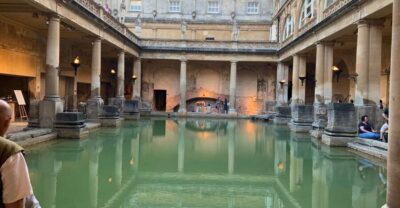
Guided City Walking Tour with Entry To The Roman Baths
Read our review →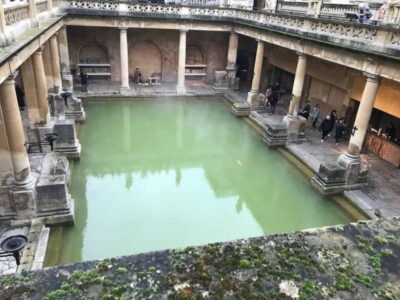
Stonehenge, Bath, Windsor and Roman Baths London Day Tours
Read our review →Browse the lists this tour appears in