
Reviewed · MUSEUMS
IRA Troubles Conflict Private Tour Museum Graves Murals and Political Analysis
Belfast’s past is still written on its walls. This three-hour private tour takes you through Falls Road, Shankill Road, the peace walls, Milltown Cemetery, and Republican memorial sites while explaining The Troubles from an Irish Republican perspective. The personal stories and political discussion make it far more than a quick mural drive.
I like the access to the Eileen Hickey Irish Republican History Museum, which is not normally open to the public, and I like the private format, since you can ask questions and adjust the conversation as you go. The main consideration is clear: this is not designed as a neutral, two-sided survey. If you want the Loyalist and British case given equal weight, choose a different Belfast tour or pair this with one that takes that approach.
The price is $255.50 per person, with group discounts available. That is a serious fare for three hours, but private transport, hotel pickup from the central meeting point, a specialist guide, cemetery visits, and museum access make the cost easier to justify for visitors who want a focused political history experience.
In This Review
- Key points to know before booking
- Why this Belfast tour takes a clear side
- From Divis Street to the Falls Road murals
- Seeing both sides of Belfast’s Peace Wall
- Shankill Road and the Loyalist story
- Clonard, Bombay Street, and the memory of 1969
- Milltown Cemetery and the Republican graves
- Bobby Sands, hunger strikes, and the Garden of Remembrance
- The private museum and the Ballymurphy alternative
- How the three hours work in practice
- Is $255.50 per person a fair price?
- Who should book this experience?
- Should you book the IRA Troubles Conflict Private Tour?
- FAQ
- How long does the tour last?
- What viewpoint does the tour present?
- Is the tour private?
- Is hotel pickup included?
- Is airport pickup available?
- Is cruise ship pickup available?
- When is the Irish Republican History Museum open?
- What happens if the museum is closed?
- Can I visit Milltown Cemetery?
- Can I cancel for a full refund?
Key points to know before booking
- Republican viewpoint: The tour follows the history of Irish Republicanism, from earlier resistance to the Provisional IRA, the hunger strikes, and the current peace process.
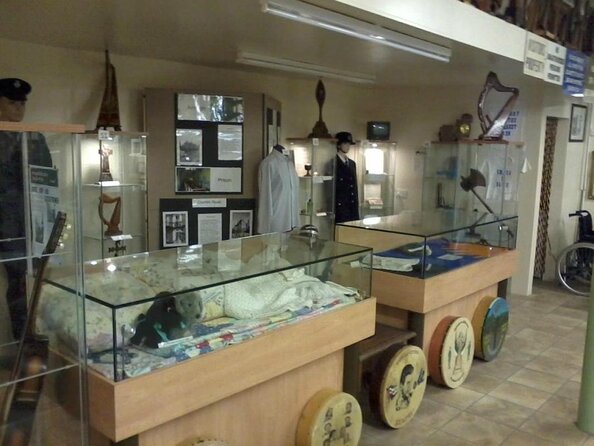
- Rare museum access: The Eileen Hickey Irish Republican History Museum is included when open, with former prisoners available to share their experiences.
- Major Belfast interfaces: You visit both sides of the Peace Wall and see the Falls Road, Shankill Road, Divis, Ballymurphy, and Clonard.
- Memorials with emotional weight: Milltown Cemetery and the Clonard Martyrs Memorial Garden require more reflection than sightseeing.
- Private and flexible: Your group travels alone, so you can ask questions and spend more time on subjects that matter to you.
- Check the museum hours: The museum opens from 10 a.m. to 2 p.m., Tuesday through Saturday. If it is closed, the tour substitutes a visit around Ballymurphy.
Why this Belfast tour takes a clear side
The Troubles cannot be understood by looking at murals alone. You need the background: the division between Nationalist and Unionist communities, the role of British state forces, the growth of Loyalist and Republican paramilitary groups, and the long road toward the peace process.
This experience places Irish Republican history at the center. Your guide explains how Republicans understood British rule, why the Provisional IRA formed, how the conflict developed after 1969, and how Republican politics changed over time. The tour also discusses Loyalist groups such as the UDA, UFF, and UVF, but through the Republican version of events.
That focus is not a flaw if you book with the right expectations. It gives you a viewpoint that is often missing from a standard city tour. But it does mean you should listen critically and ask questions. One guide, Barry, is described as having studied Irish history at Queen’s University Belfast, while several guides, including Barry, Joe, Paula, Brendan, Ciarán, and Kieran, are praised for personal knowledge of Belfast and the conflict. Your exact guide may vary.
I especially like the private structure. The subject is complicated, and a group of strangers on a fixed script can leave little room for clarification. Here, you can ask about a mural, a memorial inscription, a family connection, or the difference between Republican and Nationalist politics. Several stops are brief, so the ability to continue a discussion in the vehicle matters.
More Museum Visits:
- Belfast Titanic Museum and Sighseeing Tour
★ 4.5 · 59 reviews - Liverpool: Liverpool Football Club Museum and Stadium Tour
★ 4.8 · 10,764 reviews - Tower of London and Crown Jewels Exhibition Ticket
★ 4.5 · 6,677 reviews
From Divis Street to the Falls Road murals
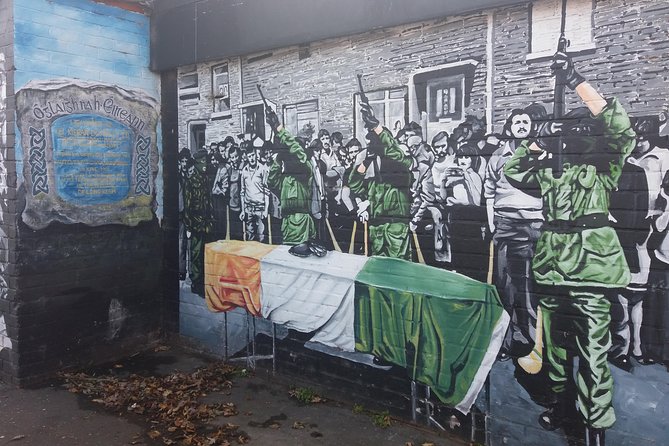
The tour begins at the International Mural Wall on Divis Street and continues through the Falls Road area. This is the Republican heartland of west Belfast, where large political murals turn ordinary buildings into a record of memory, identity, and argument.
Your guide explains how the modern conflict began in 1969 and how the Republican movement developed. You will hear about the role of former prisoners of war, many of whom were involved in painting murals after their release. The artwork can honor dead volunteers, support international causes, remember hunger strikers, or call for Irish unity.
The scheduled stop is short, about 10 minutes, so this is mainly an introduction. You will get the most from it if you ask your guide to explain the symbols and names rather than treating the wall as a photo stop. Political murals change, and the value here lies in the story attached to each image.
The tour also includes Divis Tower, which overlooks the Falls. The tower once had a British Army sniper position and observation post, reportedly remaining in use until 2005. You will also see murals connected with the first two victims of The Troubles. These details help show that the conflict was not only fought in distant military locations. It shaped homes, streets, schools, and views from apartment towers.
Seeing both sides of Belfast’s Peace Wall
The Peace Wall is one of the most important stops because it shows that Belfast’s division is physical, not just political. The walls separate mainly Republican and Nationalist Catholic districts from mainly Loyalist and Unionist Protestant districts.
The tour takes you to both sides of the wall and explains why it was built. The first barriers went up in 1969, after sectarian riots burned homes and drove families from areas such as Bombay Street. What began as a temporary measure remained because it reduced the immediate risk of violence. Some sections later grew longer, higher, and more numerous.
You can sign your name and leave a message of peace. That small act may feel touristy, but it also reveals an uncomfortable truth: a city can promote peace while still relying on concrete barriers and gates. Some gates continue to close at night, a detail that makes the peace process feel unfinished.
The wall between the Falls Road and Shankill Road is particularly imposing. It stretches for about 800 metres and separates two communities with a long record of tension. Take time to look beyond the painted messages. The wall is not simply a backdrop for photographs. It is evidence of how conflict can become part of the built environment.
Shankill Road and the Loyalist story
Crossing toward Shankill Road brings a different visual language. This is the center of Ulster Loyalism, and the murals here often show masked men, weapons, flags, memorials, and references to Loyalist paramilitary organizations.
The tour explains how Loyalism developed and how groups including the UDA, UFF, and UVF operated during The Troubles. You will see the area from the Republican side of the wider story, but the stop matters because it prevents the tour from presenting west Belfast as a single political community.
You should expect a frank discussion rather than a polished heritage display. The murals may be difficult to look at, especially when memorial images celebrate people involved in violence. Your guide can help explain the difference between commemoration, intimidation, community identity, and political messaging.
The Shankill stop is about 10 minutes, so do not expect an extended walk through every side street. Much of the tour is viewed from the vehicle, with stops chosen for key murals and landmarks. That makes the experience efficient, though visitors who want long walks and close architectural study may prefer a walking tour.
A few more trips worth a look before you book
- Titanic Belfast Entrance Ticket: Titanic Visitor Experience Including SS Nomadic
★ 4.5 · 3,698 reviews - Cab Tours Belfast Famous Black Taxi Tours
★ 5.0 · 3,633 reviews - A History of Terror – Belfast City Centre Walking Tour
★ 5.0 · 2,883 reviews - Game of Thrones and Giant’s Causeway Full-Day Tour from Belfast
★ 5.0 · 2,291 reviews
Clonard, Bombay Street, and the memory of 1969
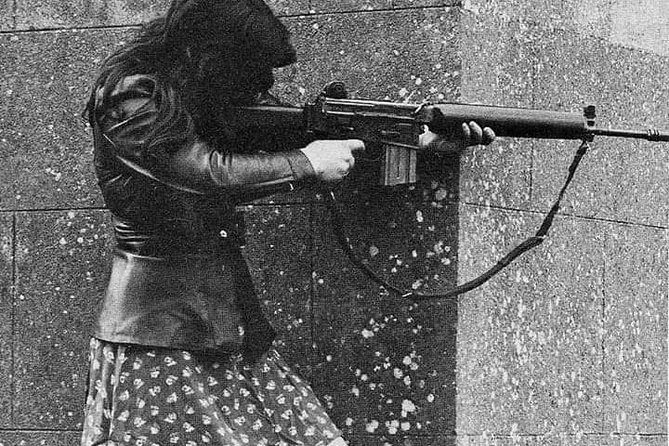
The Clonard Martyrs Memorial Garden is one of the tour’s most detailed and serious stops. Located near Bombay Street, the garden commemorates Republican volunteers, civilians from the Greater Clonard area, and Republican prisoners who died across different periods, beginning in 1916.
The site includes black iron gates with a rising phoenix, a Celtic cross, plaques, rolls of names, and memorial panels for civilians killed by Loyalists and British forces. The memorial language is openly Republican. It honors sacrifice and resistance, and it connects the modern conflict with earlier Irish struggles.
This is not a casual photo stop. The amount of information on the plaques can be overwhelming, and the scheduled visit lasts about 30 minutes. I see that as a strength if you want detail, but it may feel long if you are mainly interested in murals or general sightseeing.
The garden also helps explain why Bombay Street carries such weight in Belfast’s memory. In August 1969, Loyalist attacks forced Catholic residents from their homes, and much of Bombay Street was burned. The violence helped lead to the construction of the first peace walls and to a new phase of the conflict.
Nearby Clonard Monastery adds another part of the story. The monastery sat near the interface between Falls Road and Shankill Road, and its priests worked to protect residents and seek peace. Fathers Alec Reid and Gerry Reynolds lived there and became important figures in efforts to bring opposing sides into dialogue.
Milltown Cemetery and the Republican graves
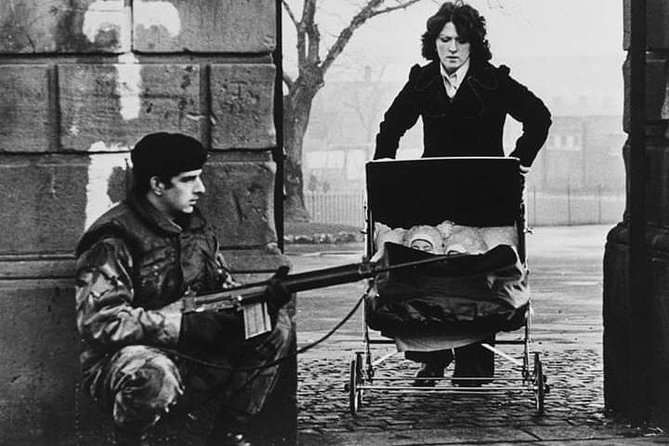
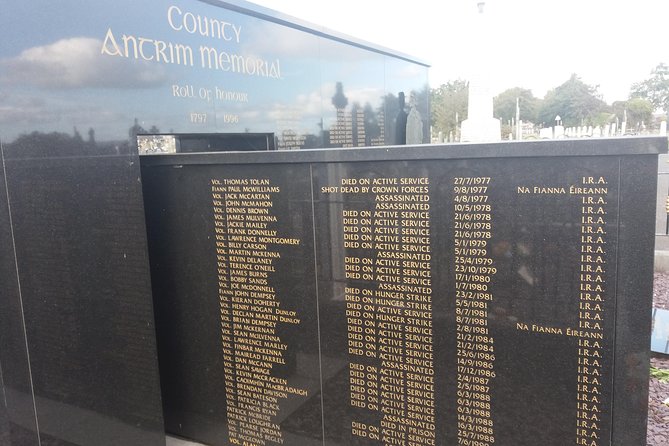
Milltown Cemetery is likely to be the most moving stop for anyone interested in the conflict’s human cost. The tour visits the Republican plots, where volunteers from the 1920s, the Northern Campaign of the 1940s, and later decades are buried.
The graves are cared for in large part by the National Graves Association in Belfast. The New Republican Plot contains 77 IRA volunteers, including Mairéad Farrell. The red hand markings and organized memorial areas make the cemetery feel less like a random collection of graves and more like a place of political remembrance.
The central figure here is Bobby Sands. He was a member of the Provisional IRA, an elected Member of Parliament, and the leader of the 1981 hunger strike at the Maze prison. He died after 66 days without food while protesting the removal of Special Category Status for Republican prisoners.
The cemetery visit lasts about 25 minutes. One practical point matters: the tour can be emotionally heavy, and the amount of time spent among graves may not suit everyone. If you have a family grave to visit, one guide has stopped at a flower shop so a visitor could bring flowers to Milltown. Arrange such requests in advance rather than relying on extra time.
Bobby Sands, hunger strikes, and the Garden of Remembrance
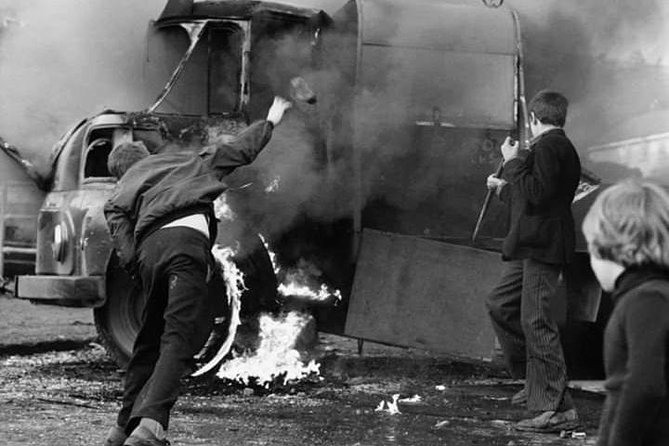
The tour visits more than one Bobby Sands site. At the mural, you will see his familiar portrait and hear about the Blanket Protest, the Dirty Protest, and the 1981 hunger strikes that followed.
The discussion connects the prison protests with wider Republican politics. It also explains why Sands became an international symbol. For Republicans, he represented political resistance and the denial of prisoner status. For the British government and its supporters, the IRA remained an armed organization responsible for violence. The tour presents the first argument most strongly, so listen for the political assumptions behind the language.
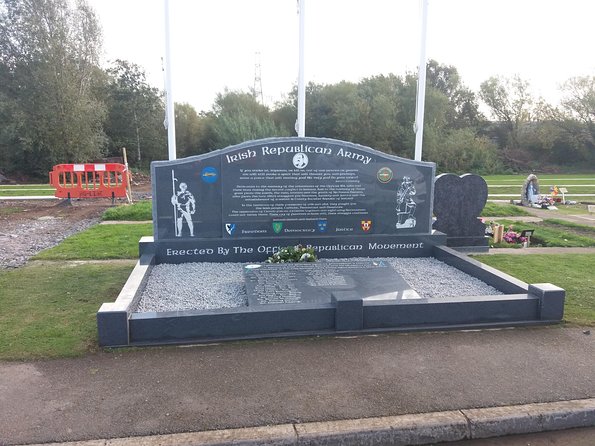
You also visit the Second Battalion IRA Garden of Remembrance, associated with D Company, sometimes called The Dogs. The site commemorates local volunteers and refers to major events such as the Battle of the Falls in 1970 and the Falls Road Massacre of 1920. Images of 12 of the 22 hunger strikers are also included.
Another Garden of Remembrance stop focuses on the Belfast Brigade of the Provisional IRA. The brigade was organized into battalions covering areas such as Andersonstown, Lenadoon, Twinbrook, Falls Road, Clonard, Ballymurphy, Ardoyne, New Lodge, the Markets, Lower Ormeau, and Short Strand.
These memorials are presented as part of a living political tradition, not as museum pieces. That can be powerful, but it also means you should be ready for language that treats volunteers as patriots. If you are looking for a detached account, this is the point where the tour may feel most one-sided.
The private museum and the Ballymurphy alternative
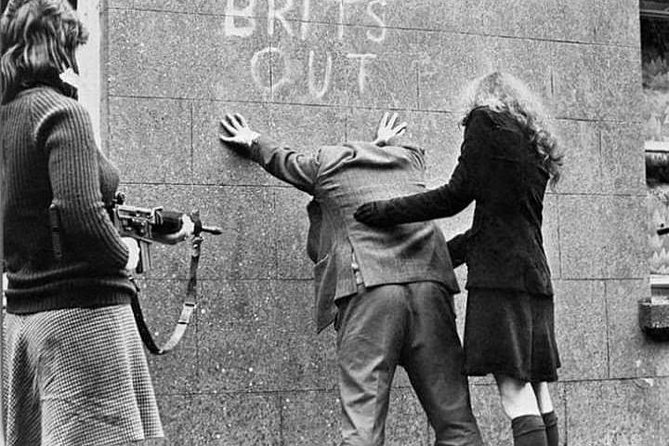
The Eileen Hickey Irish Republican History Museum is a major reason to choose this experience. It holds material connected with Republican resistance and the broader struggle against British rule, including items from the last 800 years of Irish history.
The tour description specifically includes the chance to see and handle plastic and rubber bullets used by British Crown forces. A former prisoner may also share personal experiences of The Troubles. That direct connection can make the history more immediate than a display behind glass.
Museum access depends on timing. It opens from 10 a.m. to 2 p.m., Tuesday through Saturday. If it is closed, the alternative is a guided look around Ballymurphy, including murals to local volunteers and the area’s Republican history.
Ballymurphy includes murals connected with An Gorta Mór, or the Great Famine, along with images of local figures such as Jim Bryson and his Big Louie machine gun. The vehicle route gives you a sense of the streetscape and the close-knit areas where conflict took place.
The museum is the part I would confirm most carefully before booking. If it is central to your decision, choose a start time within the opening window and avoid Sunday or Monday. The Ballymurphy substitute still has value, but it is not the same experience.
How the three hours work in practice
The tour covers a remarkable amount in about three hours. That efficiency comes from private transportation and a vehicle that handles navigation while you look out at the city. Stops range from five minutes at Divis Tower and Ballymurphy to 30 minutes at the Clonard memorial garden.
You will not spend long at every location. The format is closer to a guided political route with selected walks and photo stops than a full walking tour. That is useful in Belfast, where the sites are spread across several districts and crossing between them takes time.
Pickup is free from the Leonardo hotel, which is the central meeting location. Other central locations may carry an added charge, including Lanyon train station, St George’s Market, Titanic Belfast, Crumlin Road Gaol, Queen’s University, the Botanic Gardens, and the Ulster Museum. Airport pickup is not offered.
Cruise ship pickup and drop-off cost £25 each way, paid directly to the guide. An upgrade to a Mercedes-Benz V-Class with leather reclining seats, electric doors, and privacy glass may be available for an additional £25. Ask before the day if those extras matter to you.
The tour is offered in English, includes air-conditioned private transport, and is suitable for most participants. Group discounts are available, but the exact saving is not specified. Since the vehicle and guide are private to your party, the price makes more sense when shared among several people.
Is $255.50 per person a fair price?
At $255.50 per person, this is not a budget activity. A large part of the cost pays for privacy, transportation, a specialist guide, and access to places that are not normally part of a standard Belfast sightseeing route.
I think the value is strongest for a small group with a serious interest in Irish history, politics, or oral memory. You are not simply paying to see the Bobby Sands mural. You are paying for the connections between the mural, the cemetery, the peace walls, the memorial gardens, the museum, and the present peace process.
The price is harder to justify if you only want a quick look at Belfast’s murals. You could see several famous sites on a shorter and less expensive taxi tour. This experience earns its higher cost through the depth of the explanation and the private format.
The 97 percent recommendation rate and 4.9 rating suggest that the experience has worked very well for most bookings, especially when the guide’s personal connection matches the visitor’s interests. Still, one lower rating praised the content but found the tour expensive, and another noted difficulty understanding an accent and felt too much time was spent in the cemetery. Those are useful warnings, not reasons to dismiss the tour.
Who should book this experience?
Book it if you want a Republican account of Belfast, direct access to memorial sites, a private vehicle, and enough freedom to ask difficult questions. It suits history students, politically curious visitors, family groups, and anyone who wants to understand why the peace walls still matter.
It also suits a short Belfast stay. One three-hour route gives you a grounding in the Falls, Shankill, Clonard, Divis, Ballymurphy, Milltown Cemetery, and the main Republican memorials. You can then spend the rest of your visit seeking a different viewpoint at another museum or tour.
Think twice if you want a carefully balanced account of all sides. The guide may explain Loyalist and British involvement, but the organizing story is Republican. That is stated plainly, and you should treat the focus as part of the product, not an accidental omission.
Free cancellation is available up to 24 hours before the start time. Changes or cancellations made within 24 hours are not accepted for a refund.
Should you book the IRA Troubles Conflict Private Tour?
I would book this tour if your main goal is to understand Belfast through Republican memory, memorials, and personal testimony. The private museum, Milltown Cemetery, Clonard Martyrs Garden, and the chance to question your guide give it substance that a mural drive alone cannot match.
I would not book it as your only source on The Troubles if you want equal treatment of Republican, Loyalist, and British positions. Pair it with a balanced political tour, or choose the operator’s separate Belfast taxi tour, which is described as covering both sides of the divide.
For the best chance of visiting the museum, book Tuesday through Saturday between 10 a.m. and 2 p.m., confirm the pickup charge for your location, and ask which guide is assigned. If Barry, Paula, Joe, Brendan, Ciarán, or Kieran is available, the guide’s personal style may shape the experience as much as the route itself.
FAQ
How long does the tour last?
The tour lasts approximately three hours.
What viewpoint does the tour present?
It presents The Troubles and Irish history primarily from an Irish Republican perspective.
Is the tour private?
Yes. Only your group participates, and you can ask questions throughout the experience.
Is hotel pickup included?
Free pickup is offered from the Leonardo hotel, the central meeting location. Pickup from other locations may cost extra.
Is airport pickup available?
No. The tour does not provide pickup or drop-off from airports.
Is cruise ship pickup available?
Yes. Cruise ship pickup costs £25 each way, paid directly to the guide by cash or card.
When is the Irish Republican History Museum open?
The museum is open from 10 a.m. to 2 p.m., Tuesday through Saturday.
What happens if the museum is closed?
If the museum is closed, the tour substitutes a visit around Ballymurphy.
Can I visit Milltown Cemetery?
Yes. The tour includes the Republican Plot at Milltown Cemetery, including Bobby Sands’s resting place.
Can I cancel for a full refund?
Yes, if you cancel at least 24 hours before the experience start time. Cancellations made less than 24 hours in advance are not refunded.
Recently added around Belfast
- Private Belfast Troubles Cab Tour Adventure 2hrs Personal Guide★ 5.0 · 55 reviews
- Giants Causeway private tour from Belfast★ 5.0 · 57 reviews
- Giants Causeway Tour from Belfast + FREE Belfast Mural Tour★ 5.0 · 59 reviews
- Belfast Titanic Museum and Sighseeing Tour★ 4.5 · 59 reviews
- Belfast’s Sensory Cocktail Experience with 4 Cocktails★ 5.0 · 61 reviews
- Belfast Music and Street Art Small Group Guided Experience★ 4.5 · 62 reviews
- Private Giants Causeway Tour From Belfast★ 5.0 · 67 reviews
- Belfast Famous Black Taxi Tour Political Murals & Peace Wall 2 Hr★ 5.0 · 67 reviews
Museums, compared.

Liverpool Football Club Museum and Stadium Tour
Read our review →
Tower of London and Crown Jewels Exhibition Ticket
Read our review →
Chelsea Football Club Stadium and Museum Tour
Read our review →




Browse the lists this tour appears in